

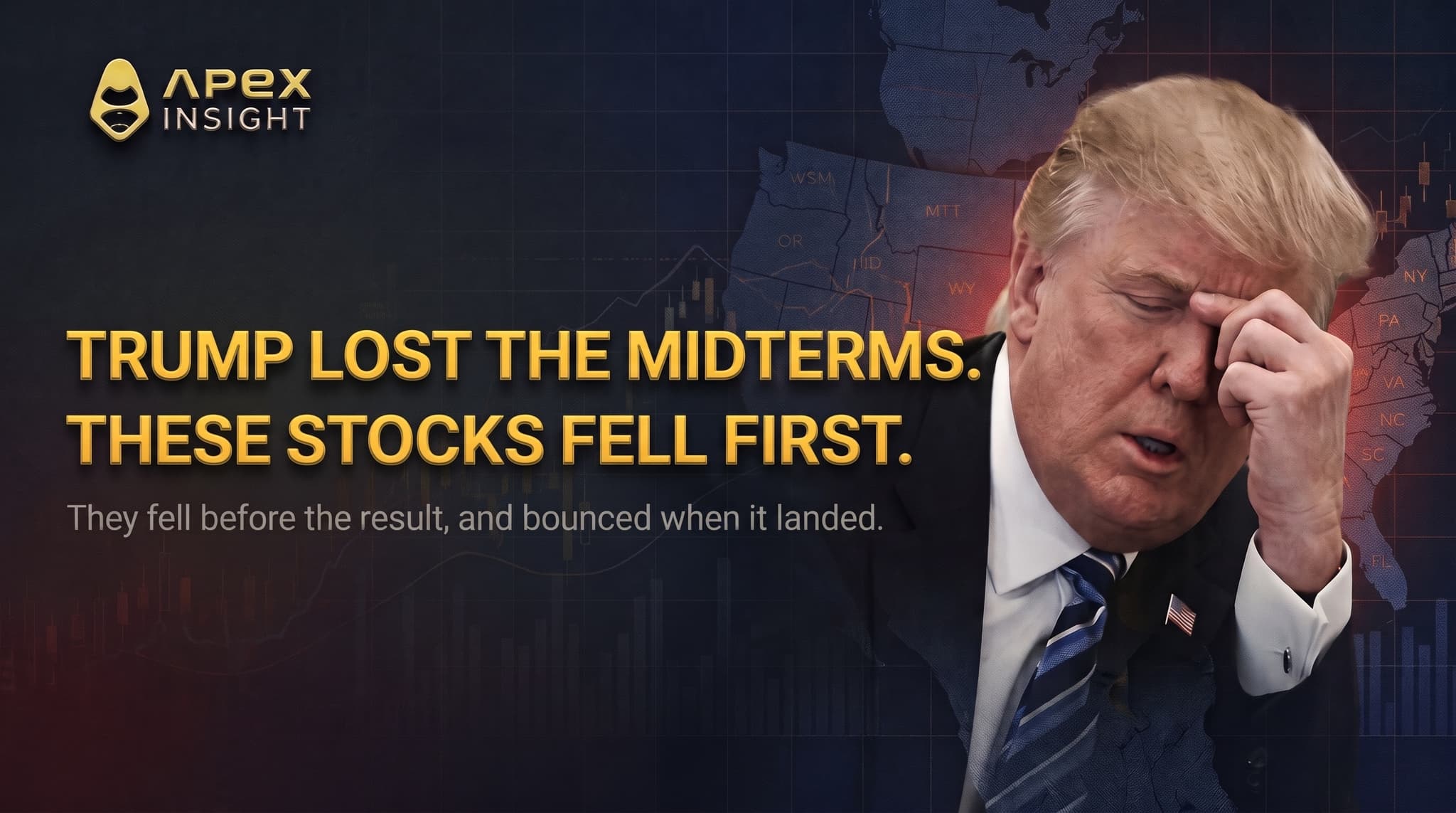



Democrats won control of both the House and the Senate, taking Congress away from Trump's party. The two worst contracts on ApeX this morning are Tesla, down 4.80%, and SpaceX, down 4.36%. Both are Elon Musk's.
Nineteen of the contracts we track are lower on the day. Eighteen of them rose once the result was confirmed. Tesla is the only one that did not.
One thing to be clear about before the numbers. US cash markets have not opened since the result, so every US equity figure here is an ApeX perpetual contract price rather than a share price at a close. Samsung and SK Hynix are the exception: their Korean listings traded from 00:00 to 06:30 UTC, straddling the split used below, so for those two there was a live cash market underneath part of the move.
Here are five things the timestamps show.
1. Tesla and SpaceX ended worst, and both are Musk's
Start with where the night ended, because the damage is concentrated in a way that is hard to miss. Note this is the full-night measure. In the overnight window alone, SOXL and SK Hynix fell further than either Musk name; they just got it back.
Tesla is the worst contract on the board at 4.80% lower than its price at the US cash close on 3 November. That is the perpetual contract, trading overnight while the share itself was not. SpaceX is close behind at 4.36%. Nothing else is near them: Samsung is down 2.80%, SK Hynix 1.81%, Palantir 1.75%.
The two worst performers are the two Elon Musk companies.
The mechanism reporting points to is political standing rather than anything operational. Musk spent the cycle campaigning for Republicans, posting on X in January that "America is toast if the radical left wins", and his midterm donations reached a record $474m, a New York Times tally that includes $168m to the Senate Leadership Fund. With Democrats taking both chambers, investors are weighing congressional investigations and tougher federal oversight of companies that depend heavily on government contracts. Senator Richard Blumenthal has already pursued an inquiry into SpaceX's Starlink and Starshield work, and Democrats have proposed extending the ban on political donations by federal contractors to their officers and anyone holding 5% or more of the company. The bill does not name Musk, but its sponsor, Senator Chris Van Hollen, framed it around him, saying the current system "allows individuals like Elon Musk to spend unlimited sums of money".
For Tesla specifically, the exposure runs through autonomous driving safety standards and robotaxi rules rather than through car sales.
Two caveats, because this is the part most likely to be overstated. Winning seats does not let Congress impose sweeping federal restrictions on its own, particularly with a Republican president holding a veto. And Tesla carried its own overhang into the night: it was already among the worst performing of the Magnificent Seven this year, with a contested Tesla and SpaceX merger vote that needs a majority of all outstanding shares, not just those voted.
So the honest answer to whether this is a Trump trade: the pattern fits, the mechanism is specific and documented, and it is still one night of trading.
2. Everything outside the Musk complex bounced back
Now the part that changes the story.
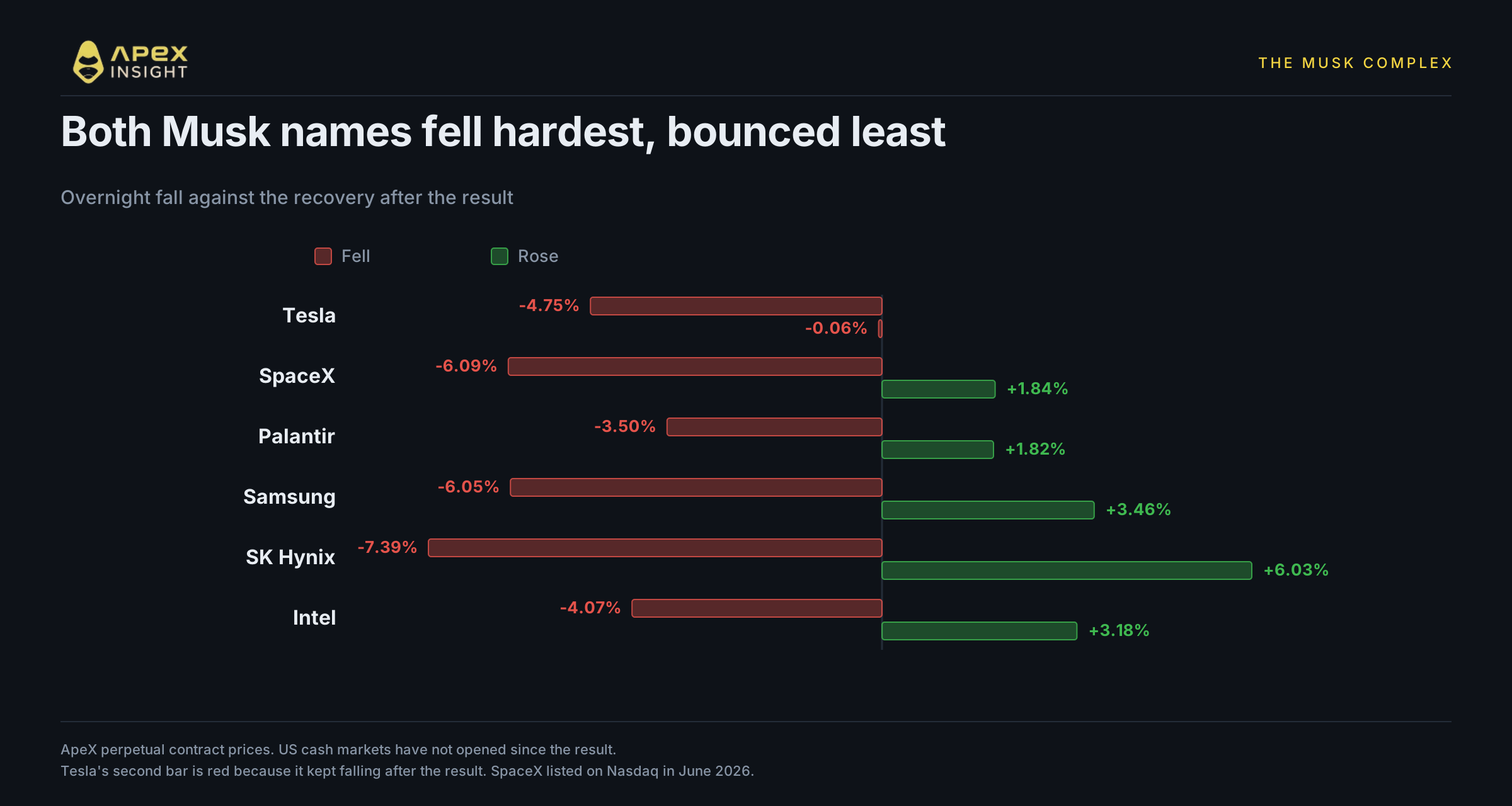
Split the night in two at 04:00 UTC, when gold broke out and the scale of the Democratic win stopped being in doubt. Before that point almost everything was sold: SOXL lost 8.59%, SK Hynix 7.39%, SpaceX 6.09%, Samsung 6.05%, Tesla 4.75%, Intel 4.07%.
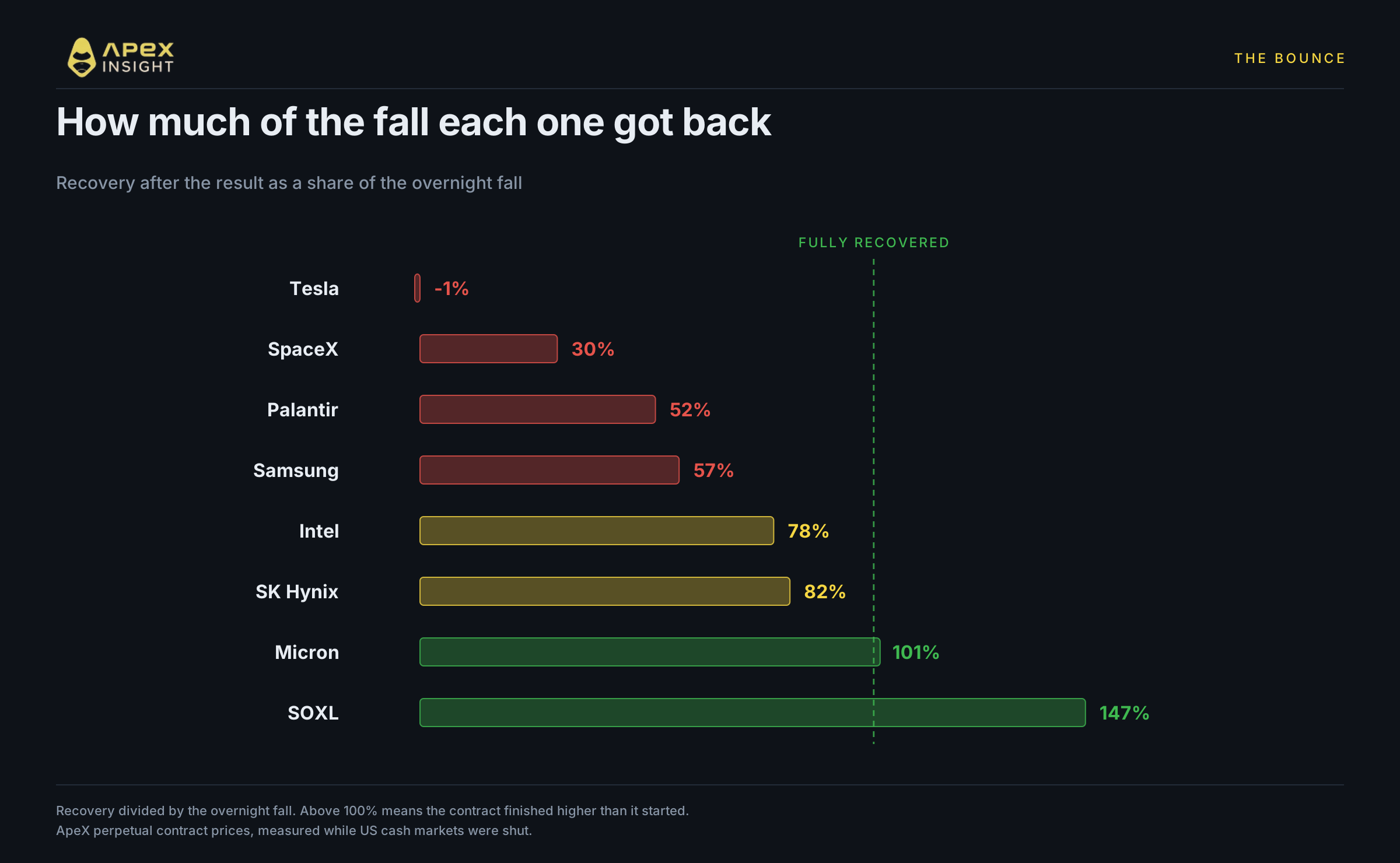
After that point, the same names went the other way, and the useful measure is how much of the fall each one got back.
SOXL recovered 147% of its drop, finishing higher than it started. Micron got back 101%. SK Hynix landed at 82%, Intel 78%, Samsung 57%, Palantir 52%.
Tesla recovered nothing. It fell a further 0.06% after the result, the only contract of the nineteen that kept going down. SpaceX recovered 30%, the second worst, and there is a 22 point gap between it and the next name.
That ranking is consistent with two different events rather than one. The chip complex's fall reversed; the Musk names' did not. The two Musk names sit first and second from the bottom, and they are the only two that got back less than half.
Of the nineteen contracts with volume in the window that were lower on the day, eighteen were higher after the result than before it. The selling ran ahead of the outcome, not after it, and a simpler explanation is available for the overnight weakness in chips: they were already under pressure from a global tech rout driven by AI funding worries, and analysts had flagged Micron and SanDisk as exposed to stronger AI oversight before a single vote was counted.
The most coherent explanation for the bounce is not that the market liked the Democrats. It is that the market disliked not knowing. Ahead of the vote, Wall Street was positioned for a clear result and worried a contested count would rattle edgy markets. A decisive sweep would have removed that risk, whichever way it went.
3. Seven Senate seats changed hands
Here is the event itself.
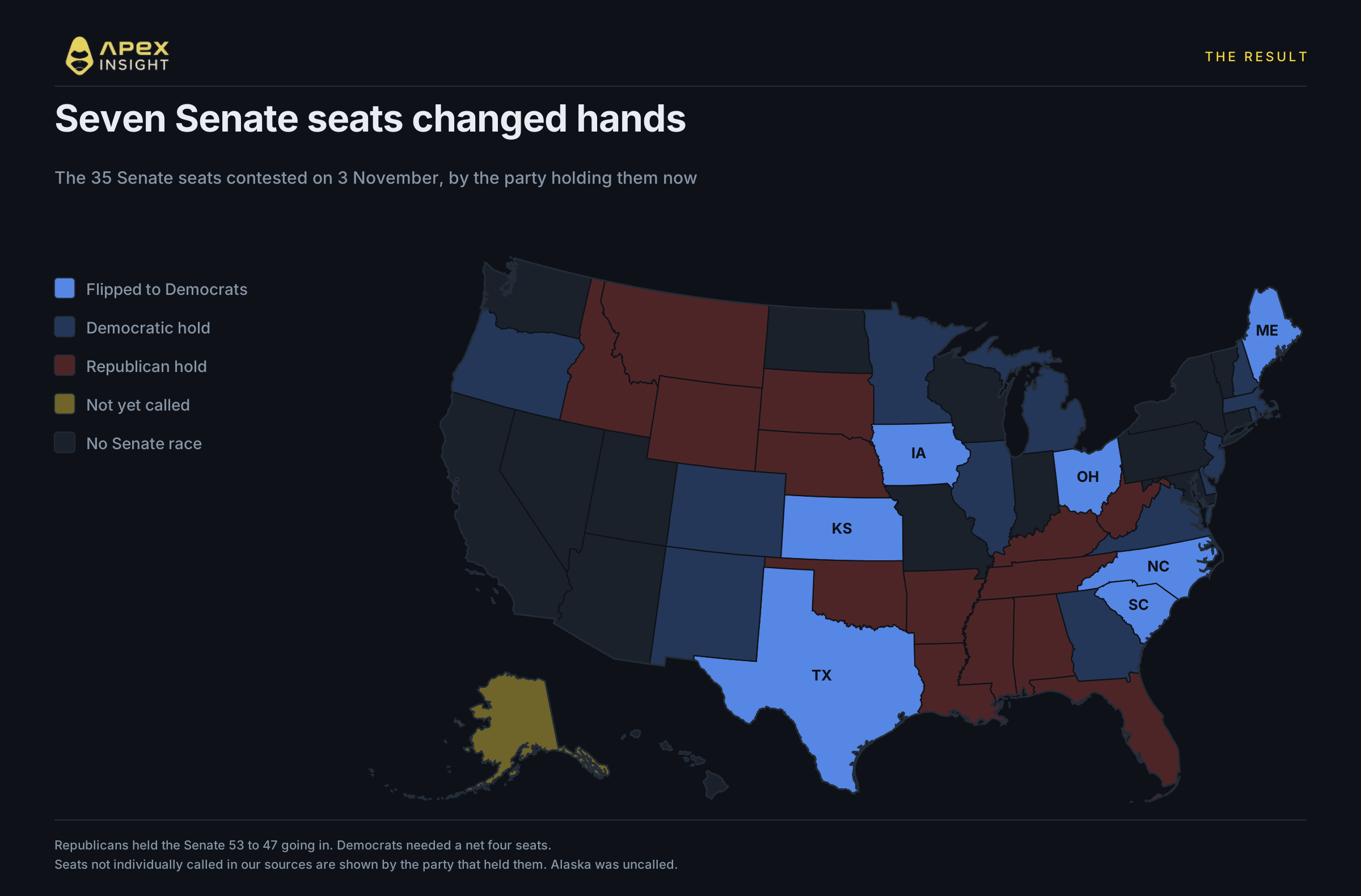
Thirty-five Senate seats were contested. Republicans went in holding the chamber 53 to 47, and Democrats needed a net four seats to take it.
They took seven: Texas, North Carolina, South Carolina, Ohio, Kansas, Iowa and Maine, where Susan Collins was defeated. Alaska had not been called when this was written.
Texas and South Carolina are the ones to notice. Those are not swing states, and Democrats flipping seats in deep red states is what turned a close night into a decisive one. A decisive night is what the market appears to have been waiting for, which is the most coherent explanation for the chip bounce. On the same reading, it is also what left Musk's companies on the wrong side of the result.
4. The US stock market was shut for every minute of it
Here is why most people missed the whole thing.
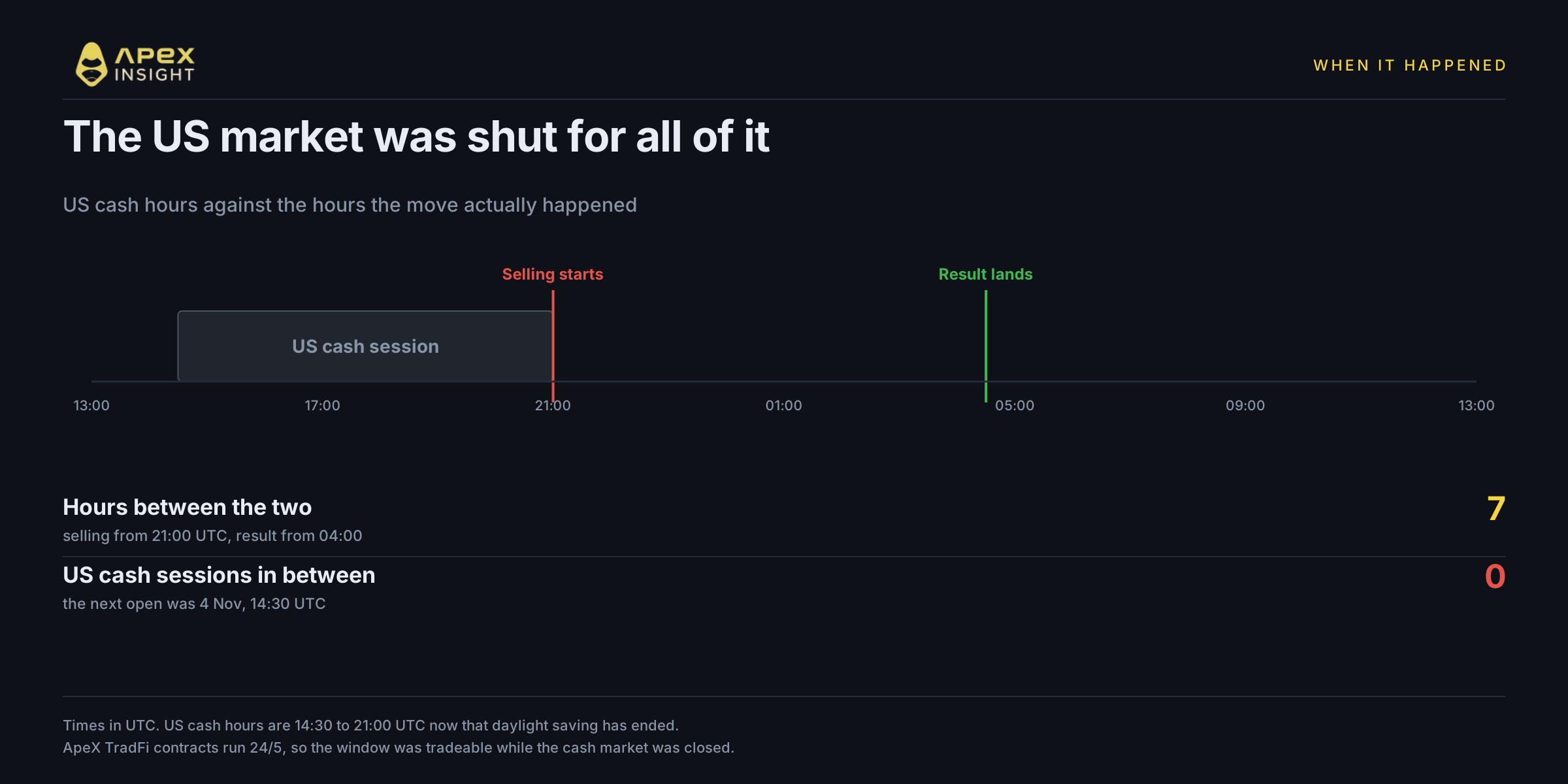
US cash hours are now 14:30 to 21:00 UTC, having shifted an hour when daylight saving ended on 1 November. The selling ran from 21:00. The recovery ran from 04:00. Between the two there was not a single US cash session.
Anyone holding only US cash equities watched an 8.59% fall and a 12.60% recovery in SOXL happen with no way to act on either. Note SOXL is a 3x leveraged ETF, so that swing is roughly a third as large in the underlying index. Samsung and SK Hynix holders are the exception here, since Korea was open for part of it. Reporting through the night captured only the first half, describing Asian chip stocks sliding as the blue sweep jolted AI bets. The opening bell came hours after both halves were finished.
TradFi Perpetuals on ApeX run 24/5, so the whole window was tradeable. On an election night, when the repricing happens between sessions by definition, that is the difference between having a view and being able to act on it.
5. Gold was the only clean election trade
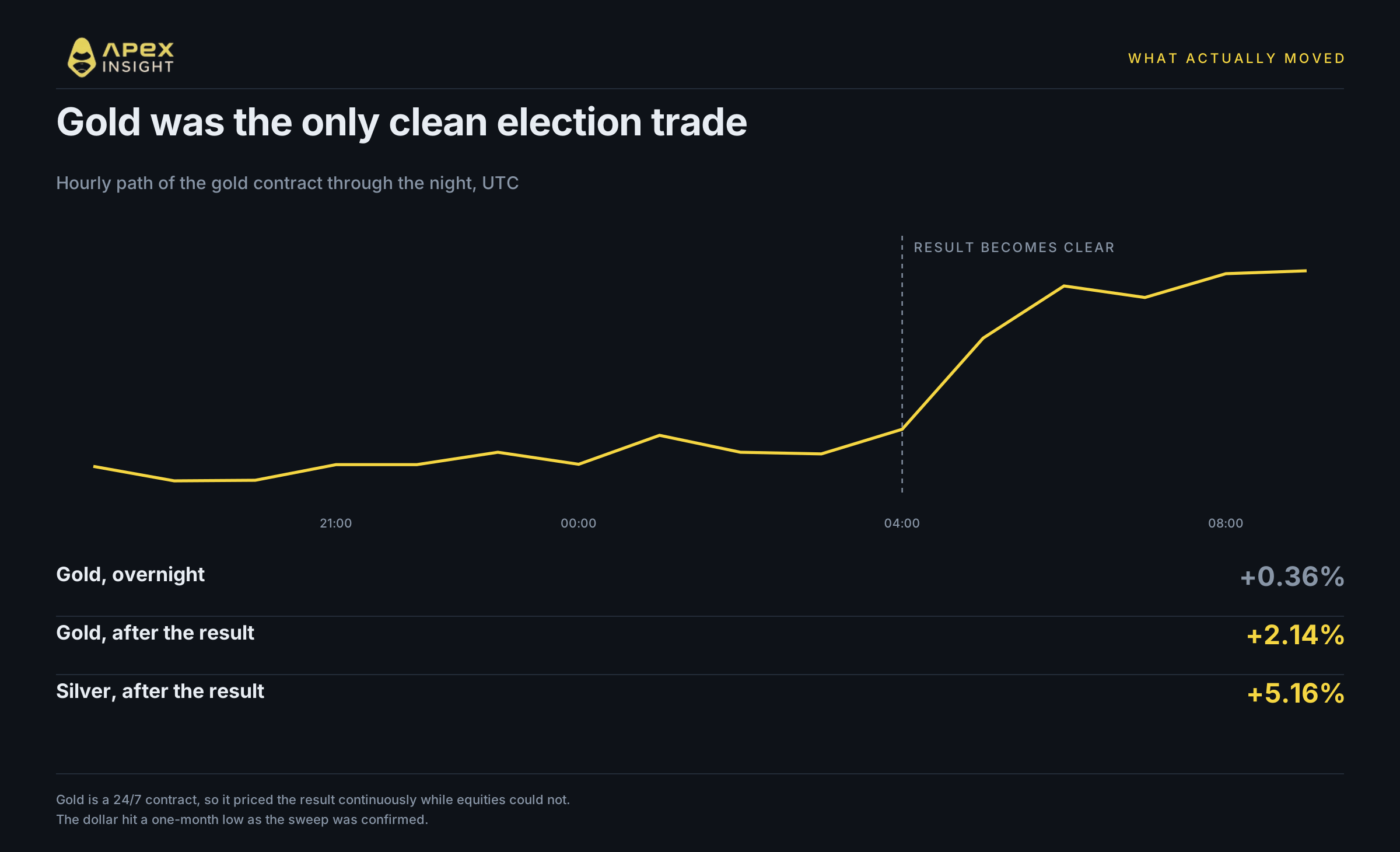
One contract rose in both halves of the night: gold, up 0.36% before the result and 2.14% after it, for 2.51% on the day. Silver fell 1.01% in the first half before its recovery.
A caveat on that, because it is the weakest link in this piece. The 04:00 split is defined as the hour gold began moving, so gold looking clean on both sides of it is partly an artefact of where we cut the night. The size of the move is real. Its neatness is not fully independent of the method.
Silver did more in the second window, gaining 5.16% to finish 4.11% higher. Spot gold rose 2.4% and silver 4% in the same window on external pricing, with the dollar at a one-month low. Pepperstone's Chris Weston attributed part of the bid to demand for protection against a "potentially more unpredictable and confrontational Trump administration".
That is the one asset whose move reads most readily as a response to the politics rather than to the chip tape. It is also the one that never stopped pricing, because metals trade around the clock while equities do not.
Trade the markets
The Musk complex. The two worst contracts on the board, and the two that recovered least.
The swing names. These had the widest gap between the overnight fall and the recovery.
The macro trade.
Every price in this piece is a perpetual contract price. TradFi contracts settle against an index rather than the underlying asset, and ApeX lists them separately from its crypto perpetuals in its own contract data. If you are trading to qualify for a volume campaign, check the promotion terms first, because not every contract is eligible.
Race to the Top 50
Trade to climb the leaderboard and share a pool of up to 10,000 USDT. Ends 6 November, 10:00 UTC.
The current trading competition runs until 6 November, 10:00 UTC, with a prize pool of up to 10,000 USDT shared by the top 50. The pool stays locked until campaign volume reaches 30,000,000 USDT, and only the highest unlocked tier applies.
Score combines trading volume, P&L percentage, net deposits and referrals. Qualifying needs registration through the campaign page, at least 100 USDT in the perpetual futures account, at least 10,000 USDT of eligible volume, and a top 50 finish. Full rules and the prize table are on the campaign page.
Trading perpetual futures carries a high risk of loss and leverage magnifies losses as fast as gains. Nothing here is financial advice.
If you need any help, feel free to reach out to our team on Discord.
Website: https://www.apex.exchange
Twitter: https://twitter.com/OfficialApeXdex
Telegram: https://t.me/ApeXdex
Methodology: all moves are computed from ApeX hourly klines, which are start-stamped, so the price at hour H is the close of the bar stamped H minus one. The night is split into two windows: 3 November 21:00 UTC to 4 November 04:00 UTC, and 4 November 04:00 to 08:00 UTC. 21:00 is the US cash close, which moved from 20:00 when US daylight saving ended on 1 November. 04:00 is the hour gold began its breakout and is used here as the point the result became clear; it is a judgement call, not an official timestamp. Gold and silver are 24/7 contracts. Every US equity contract quoted was outside US cash hours for the entire period, so these are perpetual contract prices rather than cash equity closes. Samsung and SK Hynix are the exception: the Korea Exchange was open from 00:00 to 06:30 UTC, so those two had a live cash market underneath part of the window. Equity perp prices can diverge from the cash quote, which is why external reporting and the figures here can rank the same two names differently at different timestamps. UNH, MRK, ABBV, IWM, BOTZ and KORU recorded no volume in the window and are excluded. On the Senate map, seats not individually called in our sources are shown by the party that held them going in. Spot metal prices quoted from external reporting differ slightly from ApeX contract prices because they are different instruments. Figures as at 4 November 2026, 08:00 UTC.