

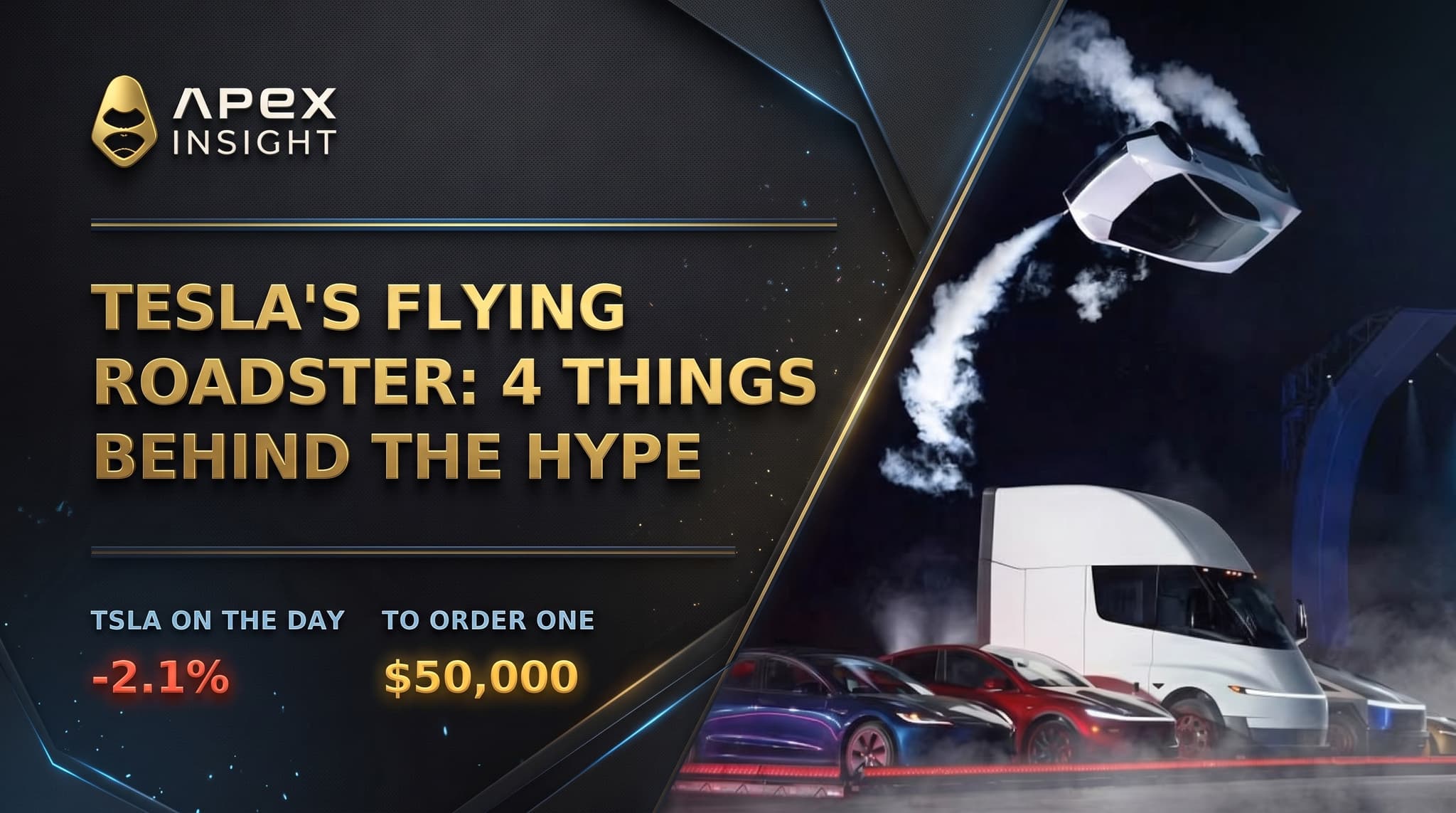


A car drove up a curved ramp, went fully upside down, fired a bank of compressed-air thrusters, rotated in mid-air, and landed on its wheels.
Then, for an encore, it lifted itself over a moving Cybercab, a Cybertruck, a Tesla Semi, a Model Y and a Model 3.
Elon Musk's review of his own event: "Well, it worked."
Marques Brownlee's, posted the same night: "This is a prank, right?"
Both reactions were fair. The flying Tesla Roadster is simultaneously the most ridiculous and the most genuinely impressive thing a carmaker has done in years, and almost everything interesting about it got compressed into a nine-second clip of a car jumping a Cybertruck.
So here are four things behind the hype — including the one the market noticed about nine hours before most people did.
1. It really flew. For roughly a second or two.
Start with the part that is not hype: the car left the ground under its own power and landed on its wheels, on camera, at SpaceX's rocket test site in McGregor, Texas on 15 October.
The how is the fun bit. Tesla says the car carries ten thrusters fed by up to 600 litres of compressed air, and that the tank recharges. A fan-based suction system pulls air from underneath to glue the car to the ramp on the way up. Tesla's own post added that "every usable void" in the vehicle is packed with COPVs — carbon fibre overwrapped pressure vessels, the same family of tank SpaceX has had some memorable problems with.
These are cold gas thrusters: the simplest rocket there is. No combustion, no fuel, just compressed gas shoved through a nozzle while Newton's third law does the rest. Precise, reliable, and extremely thirsty. Specific impulse — roughly, how much push you get per kilogram of propellant — is about 73 seconds for nitrogen, against several hundred for a chemical rocket.
Here is the back-of-envelope, and it is our arithmetic rather than Tesla's. Tesla says four rear thrusters make over 80 kilonewtons. At that specific impulse, 80 kN needs something like 110 kg of gas per second. Six hundred litres of carbon-fibre tank at a few hundred bar holds roughly 200 kg of air. So at full rear-thruster flow you have under two seconds of firing — less in practice, because thrust decays as the tank empties and you cannot drain a COPV to nothing.
Call it one to three seconds of serious thrust. Which is exactly what Tesla showed: a launch, a rotation, a landing, a hop over a truck. Short, spectacular bursts.
So when you see "flying car," calibrate. This is not a commute, and it is not an air taxi. It is a very fast car that can also, briefly, be somewhere other than the road.
Two details that make the trade-off concrete:
The fastest trim has one seat because the passenger seat is a fuel tank. The 600-litre figure applies only to the top Rocket trim, and it is made up of a 200-litre tank at the rear plus a 400-litre tank where the passenger would otherwise sit. You can have a co-driver or you can have the full thruster package. Not both.
Those 80 kilonewtons are about four and a half times the car's own weight, which squares with Tesla's claim that the thrusters deliver several times the force the tyres can. It also explains why, according to reporting ahead of the event, spectators had to be kept several hundred yards back: the thrusters are loud enough to risk hearing damage.
Regulators have so far been noncommittal. The FAA reportedly told CBS News that the vehicle does not meet its definition of an aircraft, while NHTSA said the manufacturer must ensure it does not defy federal motor vehicle safety standards and that it would keep monitoring. The hardest fact here is Tesla's own: the Rocket trim is not approved for public road use.
Musk, to his credit, was fairly direct about what this is. He called it "the best of the last of the human-driven cars," and said he is "not sure it moves the needle massively from a revenue standpoint." Gene Munster, a long-time Tesla bull, called the whole thing an "engineering flex" rather than a stock catalyst.
As for safety, Musk's much-quoted line — "If you buy a Ferrari, safety is not the number one goal," along with the promise that Tesla would "aspire not to kill anyone in this car" — is real, but it is worth knowing it came from a podcast appearance back in January, not from the stage at McGregor.
2. Nearly nine years on, exactly one number got better
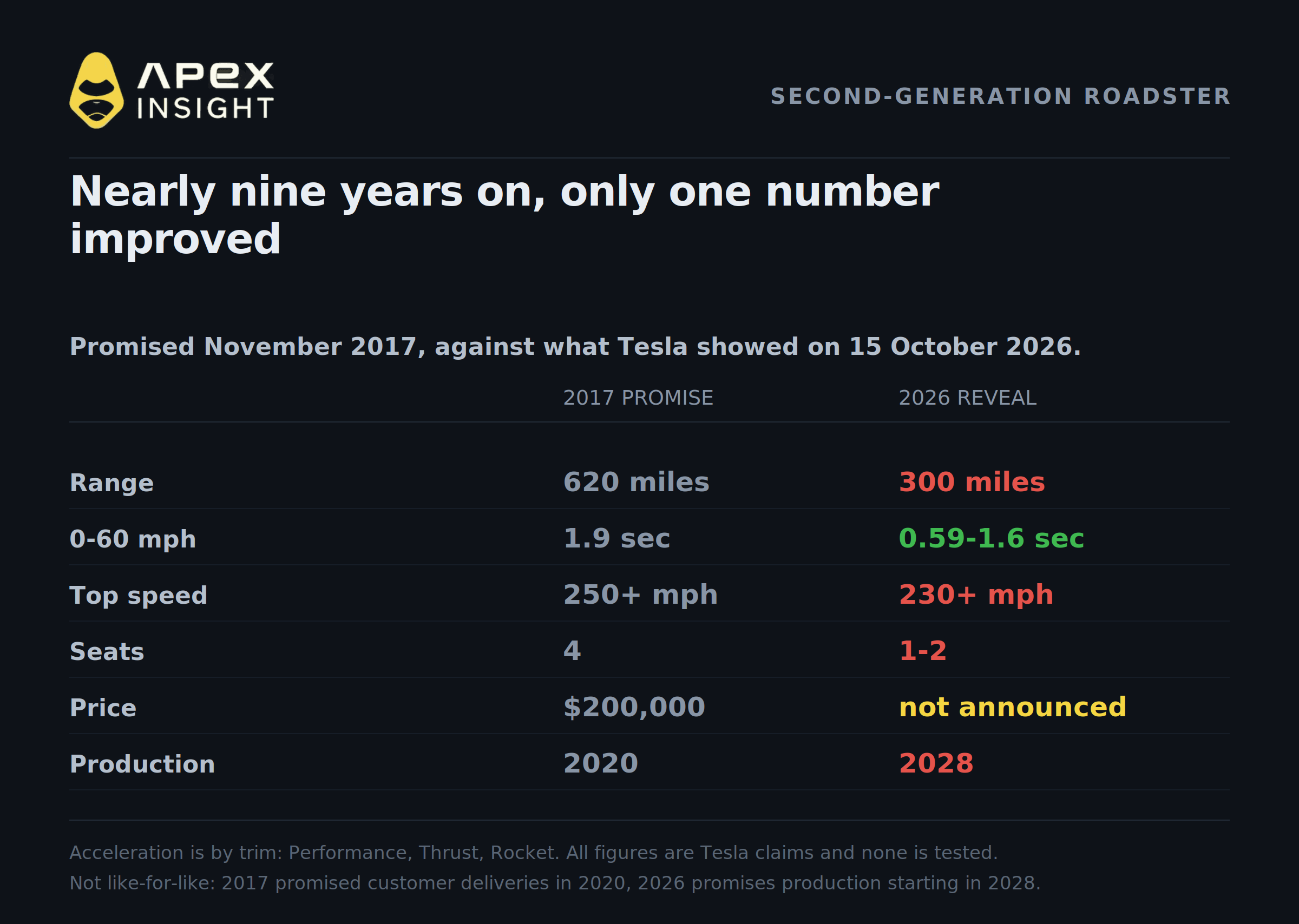
The second-generation Roadster was first unveiled on 16 November 2017, rolled out of the back of a Tesla Semi. The car shown last week arrived a month shy of nine years later — and it is not the same car.
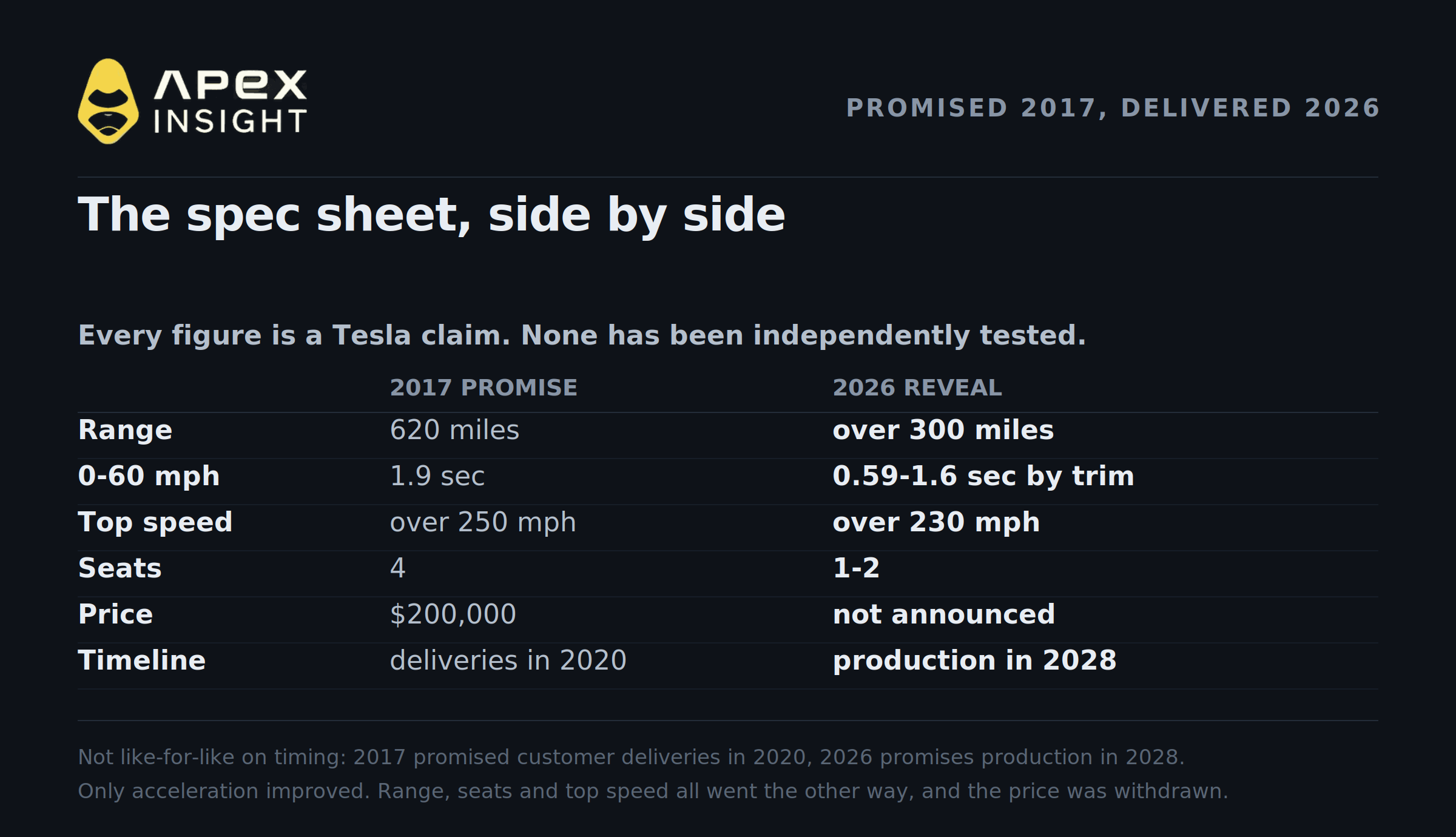
Read that column again. Range roughly halved. Seats halved. Top speed down. Price withdrawn. The only figure that improved is acceleration.
That one, admittedly, improved a lot. The single-seat Rocket trim is claimed at under 0.59 seconds to 60 mph — well over 4g of sustained forward acceleration, the sort of thing fighter pilots do with a g-suit and training.
But note what was actually demonstrated. The run shown on the night clocked 0.81 seconds, and Tesla did not say which trim did it. The 0.59-second number has never been shown, and nothing here has been independently tested. Every figure in that table is a company claim.
The extra specs that spread fastest online — a 4,000-pound kerb weight and a 380 mph top speed — came from Brownlee's post, not from Tesla. Musk did separately say he aspires to Mach 0.5, which is where the 380 came from.
3. There is no price. There is only a place in the queue.
This got lost in the confetti, and it is genuinely unusual.
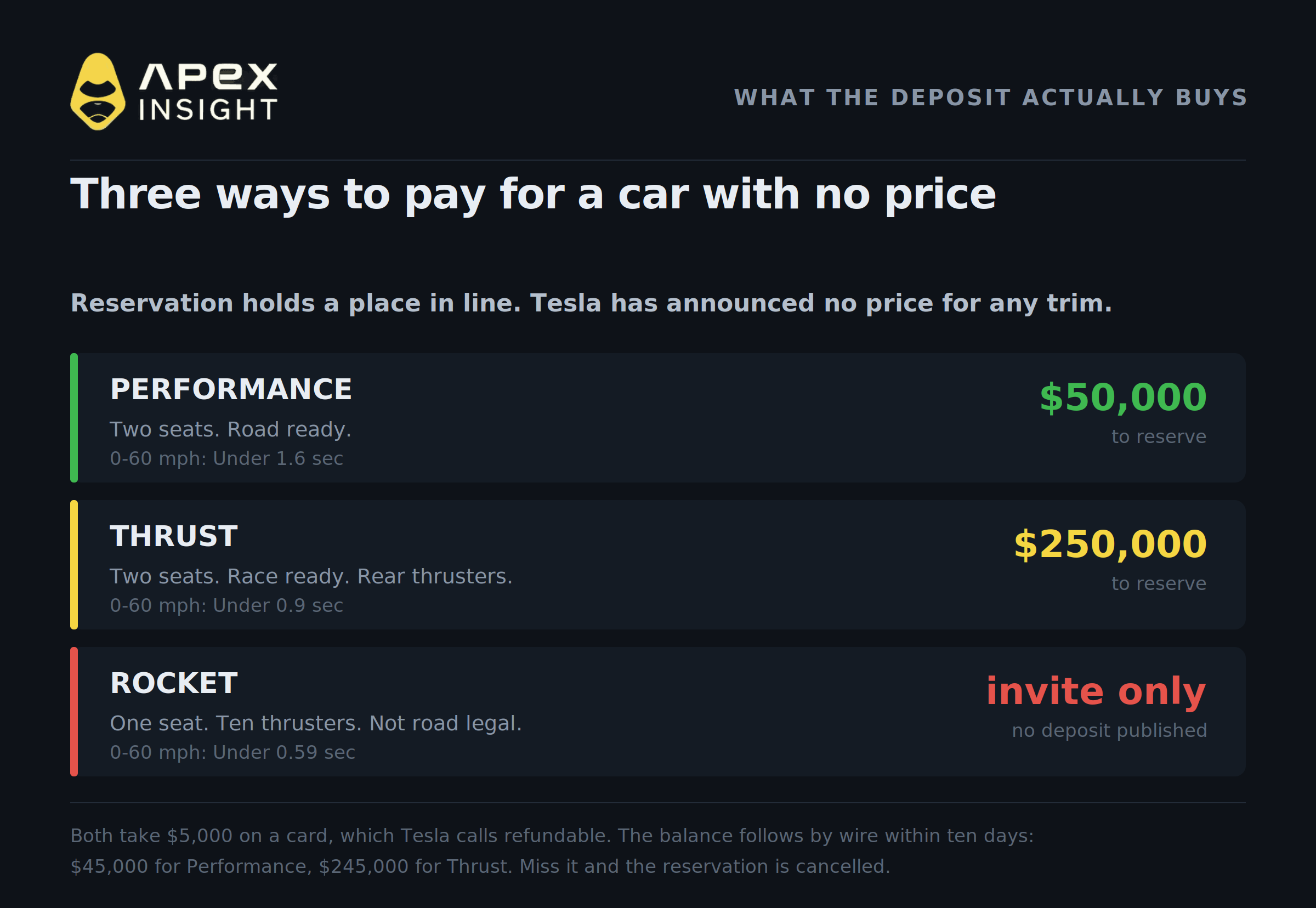
Tesla announced no price for the Roadster. Not for any trim. What it announced is what it costs to reserve one:
Performance — two seats, road ready, 0–60 under 1.6 sec: $50,000
Thrust — two seats, race ready, rear thrusters, 0–60 under 0.9 sec: $250,000
Rocket — one seat, ten thrusters, not road legal, 0–60 under 0.59 sec: invitation only
Both open trims take $5,000 on a card, which Tesla calls fully refundable, with the balance due by wire within ten days or the reservation is cancelled — $45,000 for Performance, $245,000 for Thrust.
So the Thrust reservation is a quarter of a million dollars, wired inside ten days, to hold a position in a queue for a product whose price nobody knows. There is a neat symmetry in the entry ticket, mind: $50,000 is the exact figure Tesla asked for a Roadster reservation in 2017.
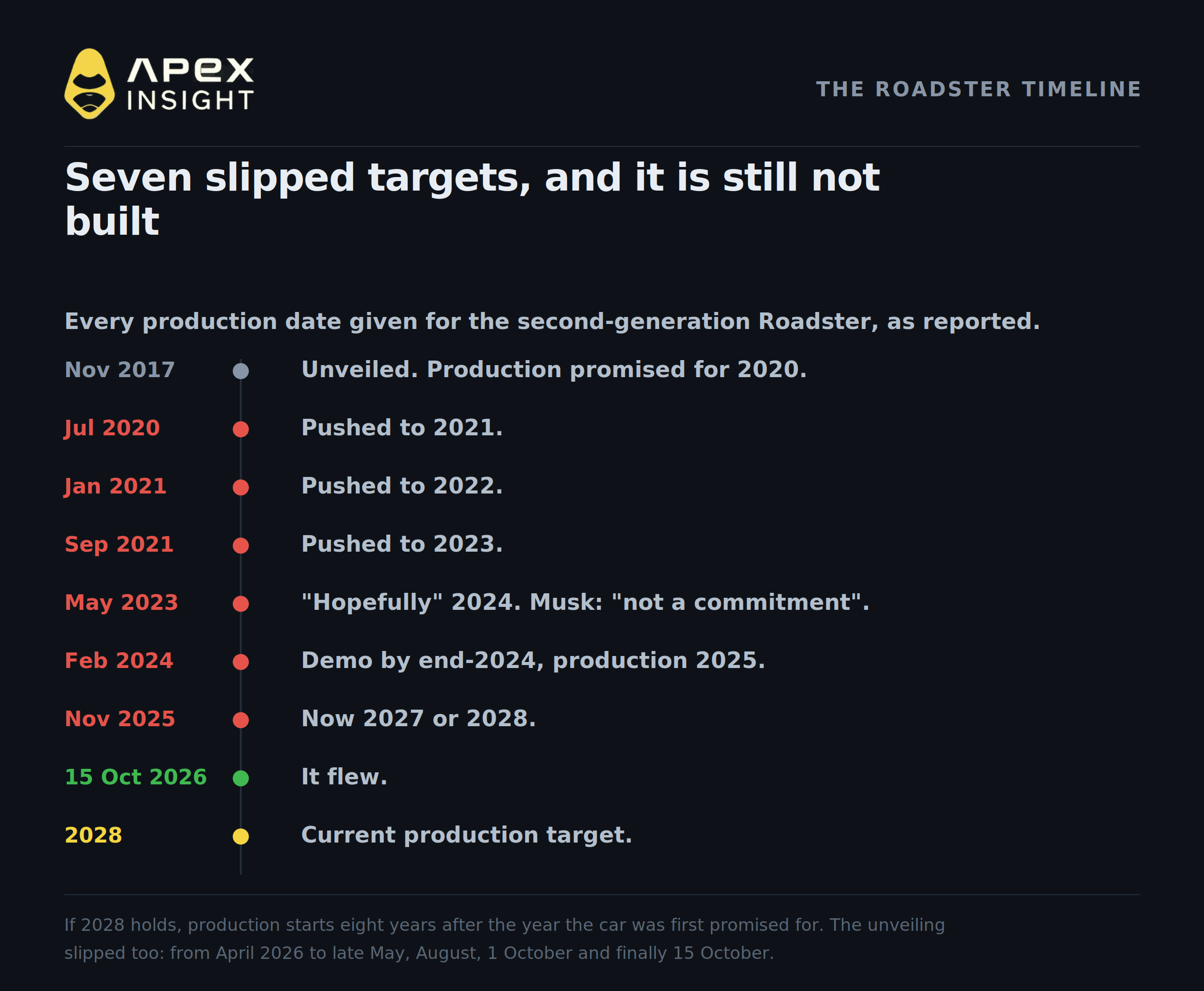
And it has asked for a while. Production was promised for 2020 at the reveal, then pushed to 2021, then 2022, then 2023, then "hopefully" 2024 — a target Musk himself labelled "not a commitment" — then 2025, then 2027-or-2028. That is seven slipped targets before the current one.
The unveiling slipped too, repeatedly, from April through to 1 October, which was scrapped two days out and blamed on weather. Musk reportedly fancied April Fools' Day for the reveal because it gave him "some deniability."
To be fair, this is a halo car. Halo cars exist to make you feel something about the brand, not to make the quarter. Ferrari does not sell many Ferraris either. But Ferrari tells you the price.
4. The stock flew too — and landed before America woke up
Here is the bit almost nobody caught, and it is the most ApeX-shaped detail in the story.
The reveal happened Thursday evening in Texas, with the US stock market shut. So the reaction to the most viral Tesla moment in years played out entirely overnight, in Asian and European hours, on the venues that trade around the clock.
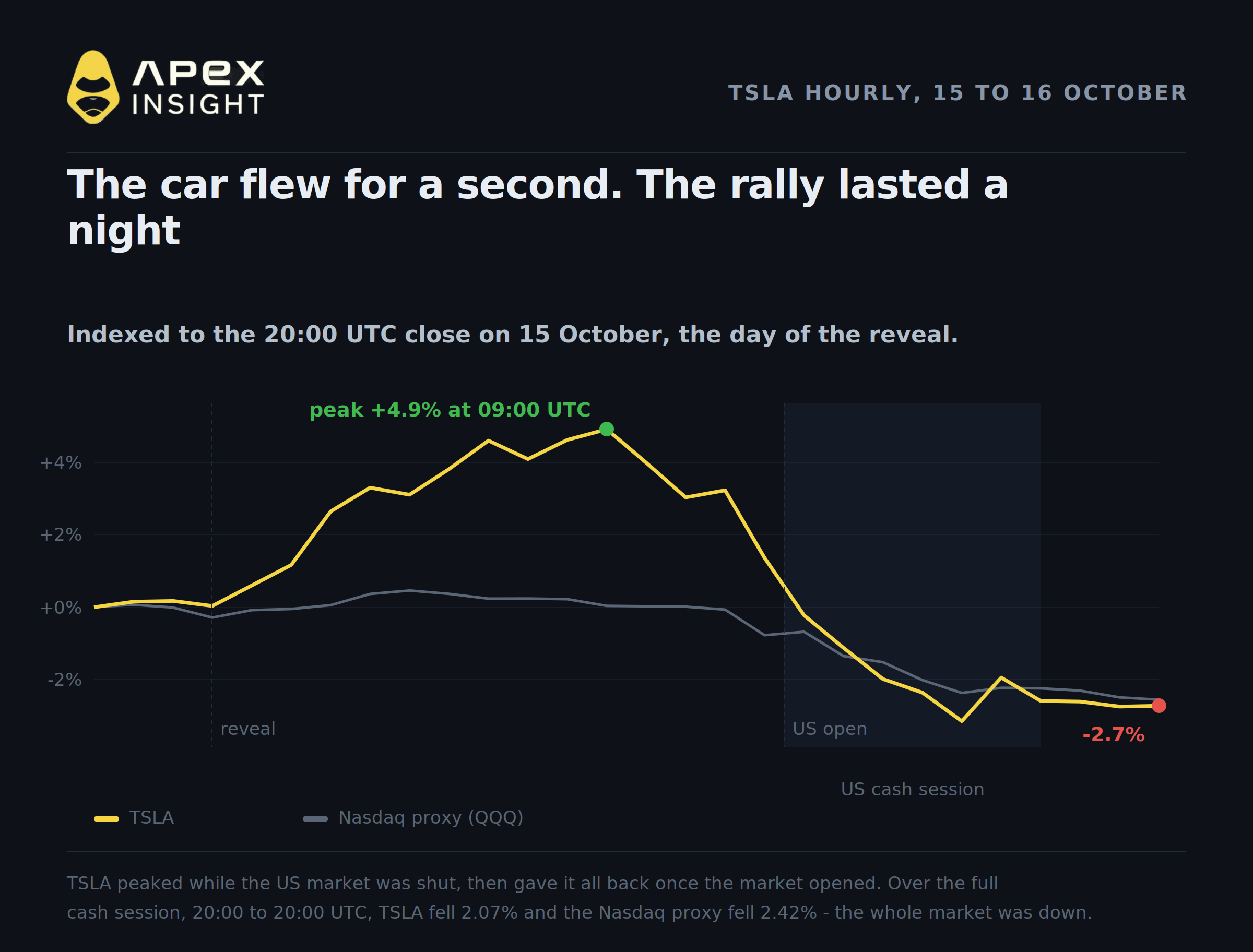
And it ripped. On the ApeX contract, TSLA climbed through the night from its Thursday close, peaking +4.9% at 09:00 UTC on Friday at $382.65 — within 0.14% of its own 90-day high. Over that same stretch the Nasdaq proxy was down. This was not the market lifting Tesla. This was Tesla, on its own, on a video of a car jumping a truck. The share itself did much the same thing in premarket, running up over 5%.
Then New York opened at 13:30 UTC and the whole thing came apart. From that overnight peak to the session low the contract fell 7.7%, and closed Friday at $352.60. The share closed at $354.72, down 2.1% on the day, on roughly double its average volume.
The car flew for about a second. The rally lasted about nine hours.
One honest caveat, because the obvious story is only half right. It is tempting to write "the hype collapsed," and plenty of coverage did. But Friday was ugly for everything — a broad AI and chip selloff, with the Nasdaq Composite down 2.14%. Tesla finished down 2.13%: level with the index, and about a point worse than the S&P 500. The intraday round trip was spectacular and entirely real, but Tesla did not underperform on the day so much as get carried out with everything else.
What is unambiguous is where the move happened. A shareholder who went to bed Thursday never had a chance to trade that overnight 5%. It existed in a window when the share does not trade at all. Hold the perpetual instead and you were in that window whether you wanted to be — which is the whole appeal of a 24-hour contract, and the whole risk of one.
What's actually at stake underneath
The sceptical read on the timing is straightforward: a flying halo car arriving in 2028 does nothing for a delivery number today, and Musk said as much about the revenue needle himself.
Though the "Tesla is shrinking" line needs a date stamp. Deliveries did fall in 2024 and again in 2025, to about 1.64 million. But 2026 has not followed that script: the second quarter was a record at 480,126 vehicles, up 25% year on year, and the third quarter came in at 486,532 — about 2% below last year but ahead of what analysts expected. The business is not obviously still falling. We find out more on Wednesday 21 October, when Tesla reports third-quarter results.
The more interesting thread is corporate. The event was held at a SpaceX facility, and Musk described the car as the culmination of work by Tesla and SpaceX engineers. Barclays analyst Dan Levy has argued a combination could be announced before Tesla's annual meeting, which must be held by 6 December — with SpaceX as the more likely acquirer in an all-stock deal, and Musk holding a controlling vote of the combined company. Prediction-market odds of a deal roughly doubled overnight, to around 56%.
Neither company has confirmed anything. Musk has only allowed that there is "more and more overlap."
But read it that way and a Tesla that flies on SpaceX hardware is not only a car launch. It is an argument, made in carbon fibre and compressed air, that these two companies belong together — which may be the single most Elon Musk sentence ever written, and is also the thing most likely to still matter long after the Cybertruck jump stops going round.
Trade the markets in this story
Every contract below is live on ApeX Omni against USDT, in one account on one margin balance — including through the overnight window where this week's entire Roadster move actually happened.
TSLAUSDT · SPCXUSDT · RKLBUSDT · NVDAUSDT · QQQUSDT · SPYUSDT
Two things to carry in with you. These equity contracts settle against an index rather than the share, and ApeX classifies them in its own contract data as stock contracts rather than perpetuals — worth checking the terms if you are trading one to qualify for a volume promotion written around "perpetual" volume. And they run twenty-four hours while the thing they track does not. Roadster week made that unusually literal: the entire rally happened while the New York Stock Exchange was closed, and the only people trading it were on the other side of the world.
Contract price and return data are from ApeX Omni, as of roughly 09:00 UTC on 17 October 2026, and are labelled as such where they differ from the underlying share. Share prices, index moves and delivery figures are from the sources named inline. Equity contract moves are measured US cash close to close, 20:00 to 20:00 UTC, because ApeX prints calendar-day bars while the underlying shares trade only 13:30–20:00; hourly bars are start-stamped, so the bar stamped 09:00 covers 09:00 to 10:00. Roadster specifications, trim names, reservation amounts and the 2028 production target are Tesla's own claims as presented at the 15 October 2026 event and on its website; none of the performance figures has been independently verified, and the thruster duration estimate is our own order-of-magnitude arithmetic, not a Tesla figure. The 2017 figures are as announced on 16 November 2017. Nothing here is investment advice; tokenised stock perpetuals carry leverage risk and settle against an index rather than the share itself.