


Note: All market prices are as of 19 September 2026. Several sub-markets here carry six figures or less, which is flagged where it matters.
1. The leading answer is none of them
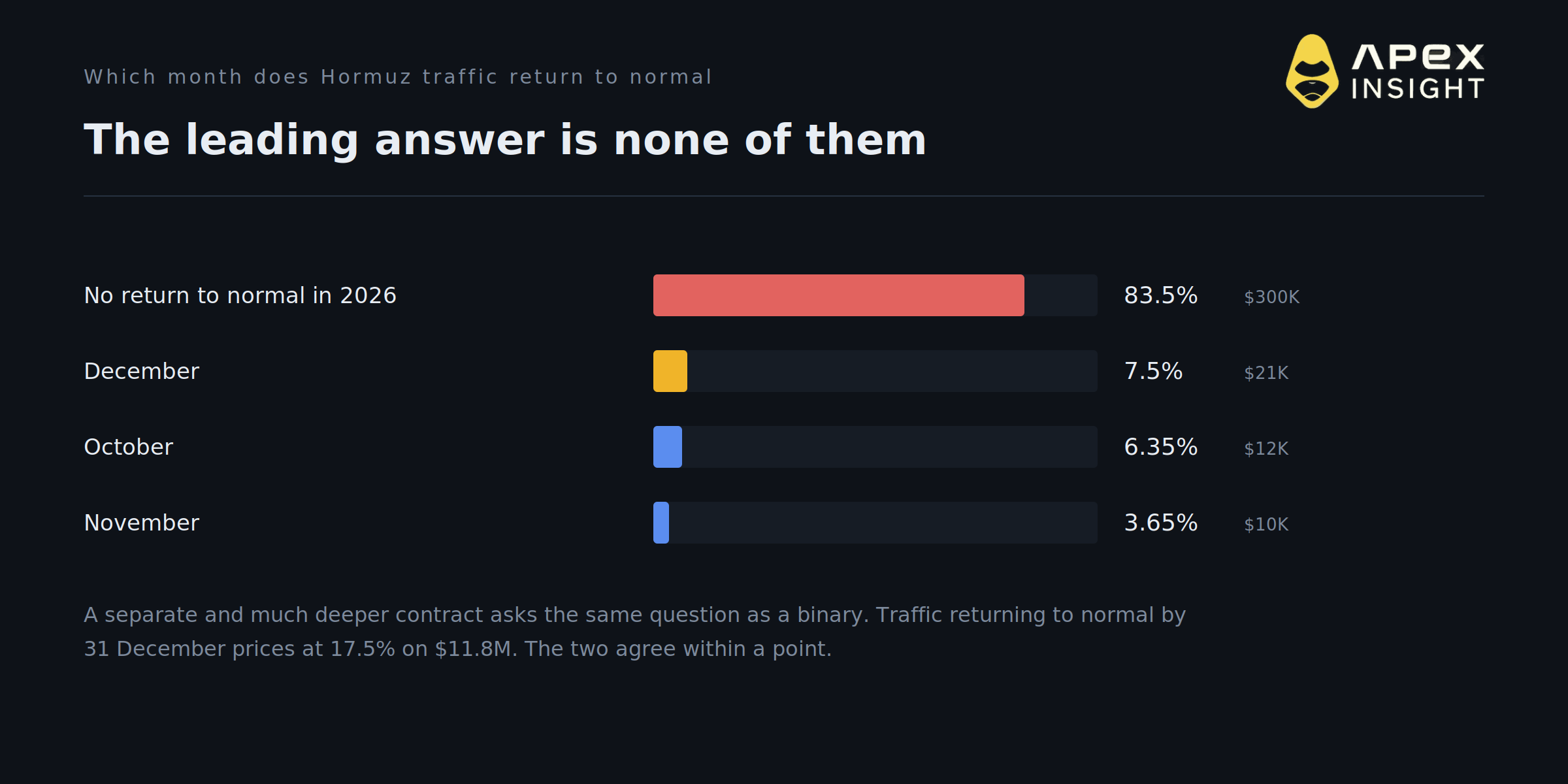
Asked which month traffic returns to normal, the market answers: none. No return in 2026 prices at 83.5 percent. December prices at 7.5 percent, October at 6.35 percent and November at 3.65 percent.
That book is small at $440K, but it does not stand alone. The direct binary on a return by 31 December carries $11.8M and prices at 17.5 percent. Two independently traded markets, one thin and one deep, landing within a point of each other.
The crisis began on 28 February. On the market's reading, it does not end this year.
2. Every date on the ladder is priced out
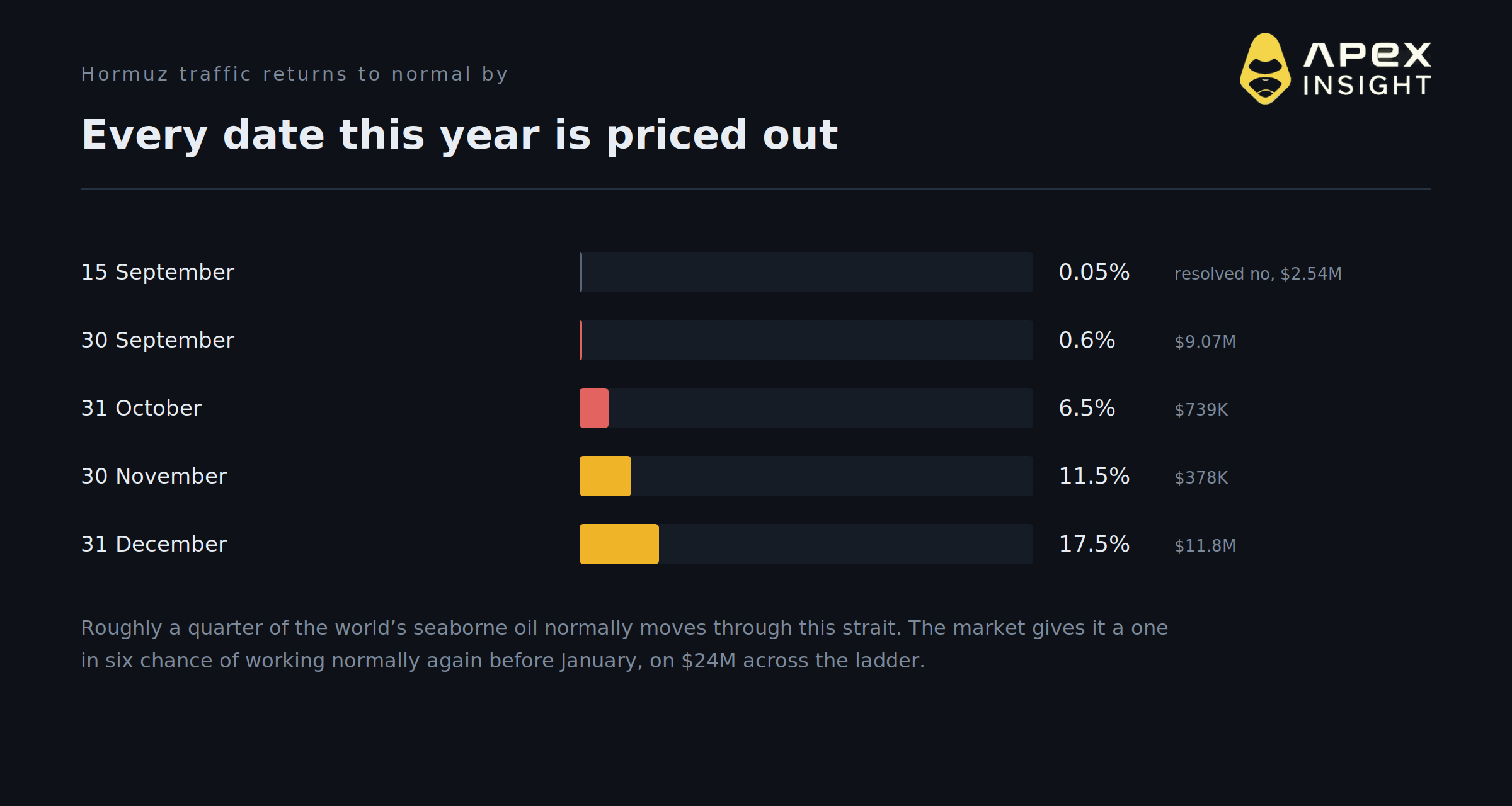
A return by 15 September has effectively resolved no at 0.05 percent, on $2.54M. By 30 September prices at 0.6 percent on $9.07M. By 31 October, 6.5 percent. By 30 November, 11.5 percent. By 31 December, 17.5 percent.
Roughly $24M sits across that ladder, and no rung reaches one in five.
Around a quarter of the world's seaborne oil and a fifth of its liquefied natural gas normally pass through this strait. It has been effectively shut for seven months, and one contract asking whether zero ships would transit on any single date already resolved yes for July. A repeat by 31 October prices at 20.5 percent.
3. The workaround is being priced in
The most interesting contract in this cluster is not about Iran at all.
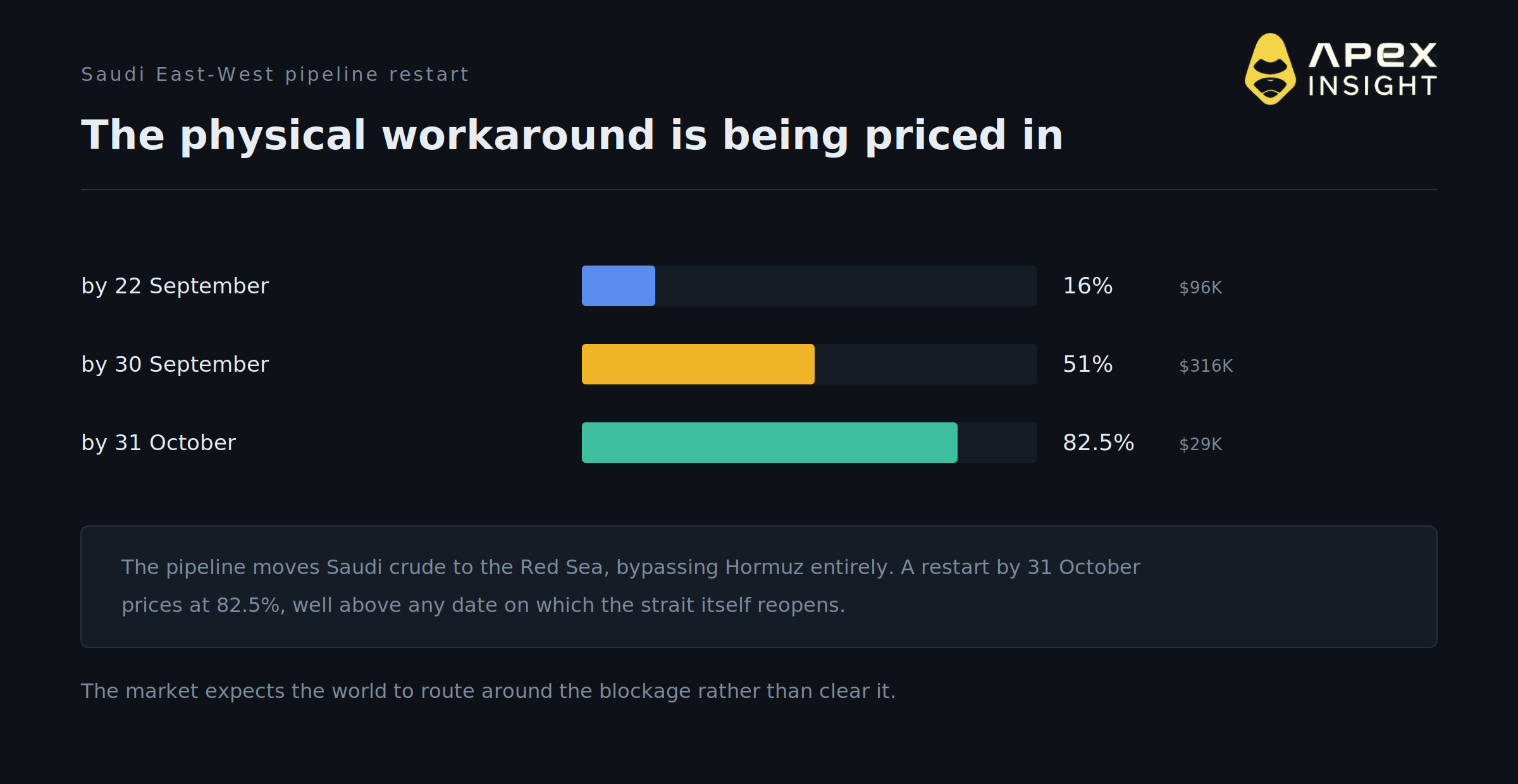
A restart of the Saudi East-West pipeline prices at 16 percent by 22 September, 51 percent by 30 September and 82.5 percent by 31 October. The pipeline moves Saudi crude across the peninsula to the Red Sea, bypassing Hormuz.
Put that next to section one. The physical bypass being operational by 31 October prices at 82.5 percent. The strait itself reopening by 31 December prices at 17.5 percent.
The market is not waiting for the blockage to clear. It is pricing the infrastructure that makes the blockage survivable, which is also the thing that removes the urgency to clear it.
4. A reopening would be administered and charged for
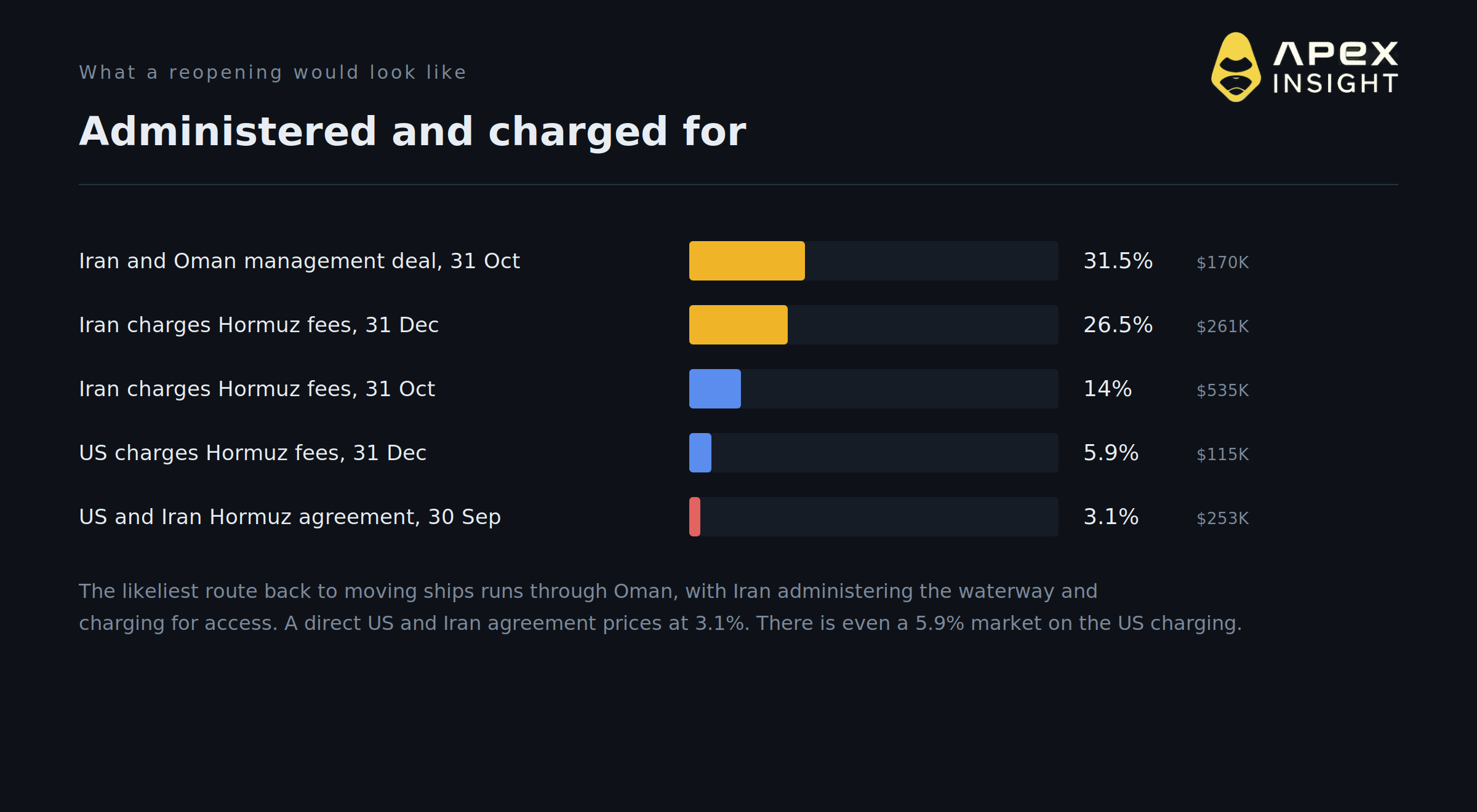
If traffic does resume, the market has a specific view on the terms.
An Iran and Oman management agreement for the strait prices at 31.5 percent by 31 October. Iran charging fees for passage prices at 14 percent by 31 October and 26.5 percent by 31 December. A direct US and Iran agreement on the strait prices at 3.1 percent.
There is even a contract on the United States charging Hormuz fees, at 5.9 percent by year end.
So the likeliest path back to moving ships runs through Omani mediation, with Iran administering the waterway and charging for access. That is a toll booth, not a restoration. A toll is a permanent cost on every barrel rather than a disruption that unwinds, which is why a reopening on those terms relieves the supply shock without relieving the price.
5. Oil has settled above $105 and stopped climbing
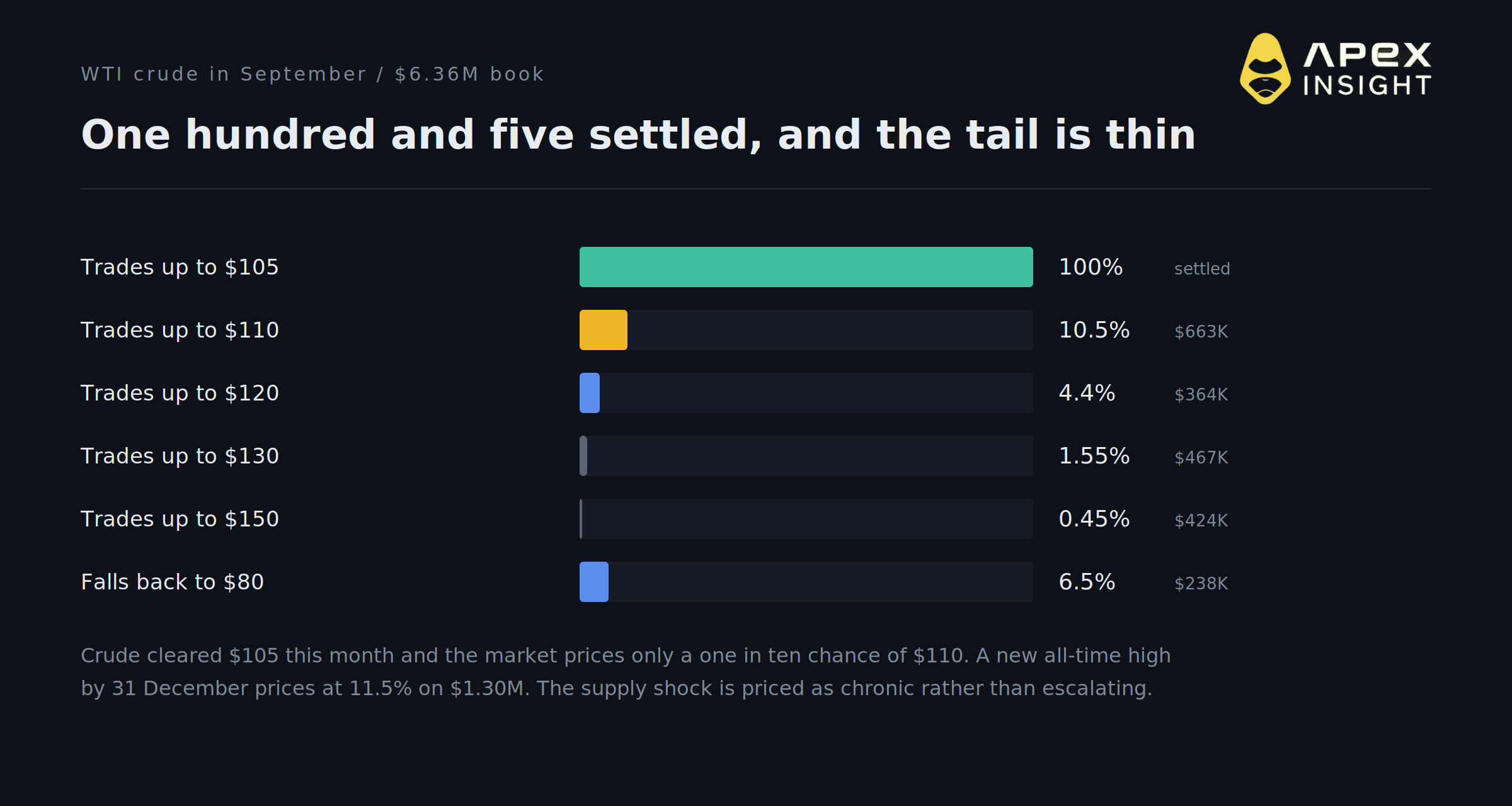
WTI has cleared $105 this month, so every contract up to that level is settled. Above it, $110 prices at 10.5 percent, $115 at 6.05 percent, $120 at 4.4 percent, $130 at 1.55 percent and $150 at 0.45 percent. Falling back to $80 prices at 6.5 percent.
One caveat on this particular book. It contains several duplicate legs at the same strike showing different prices, including three separate entries for falling to $90. The figures above are taken from the deepest leg at each level, and the thin duplicates should be ignored.
A new all-time high in crude by 31 December prices at 11.5 percent on $1.30M.
Eight days ago the $110 contract priced at 30.5 percent. It now prices at 10.5 percent, which is a twenty point fall while the strait stayed shut.
That is the pipeline effect in a number. Supply is being rerouted rather than restored, and the market has moved from pricing an escalating shock to pricing a chronic one. Expensive oil, but not spiralling oil.
The chokepoints, ranked
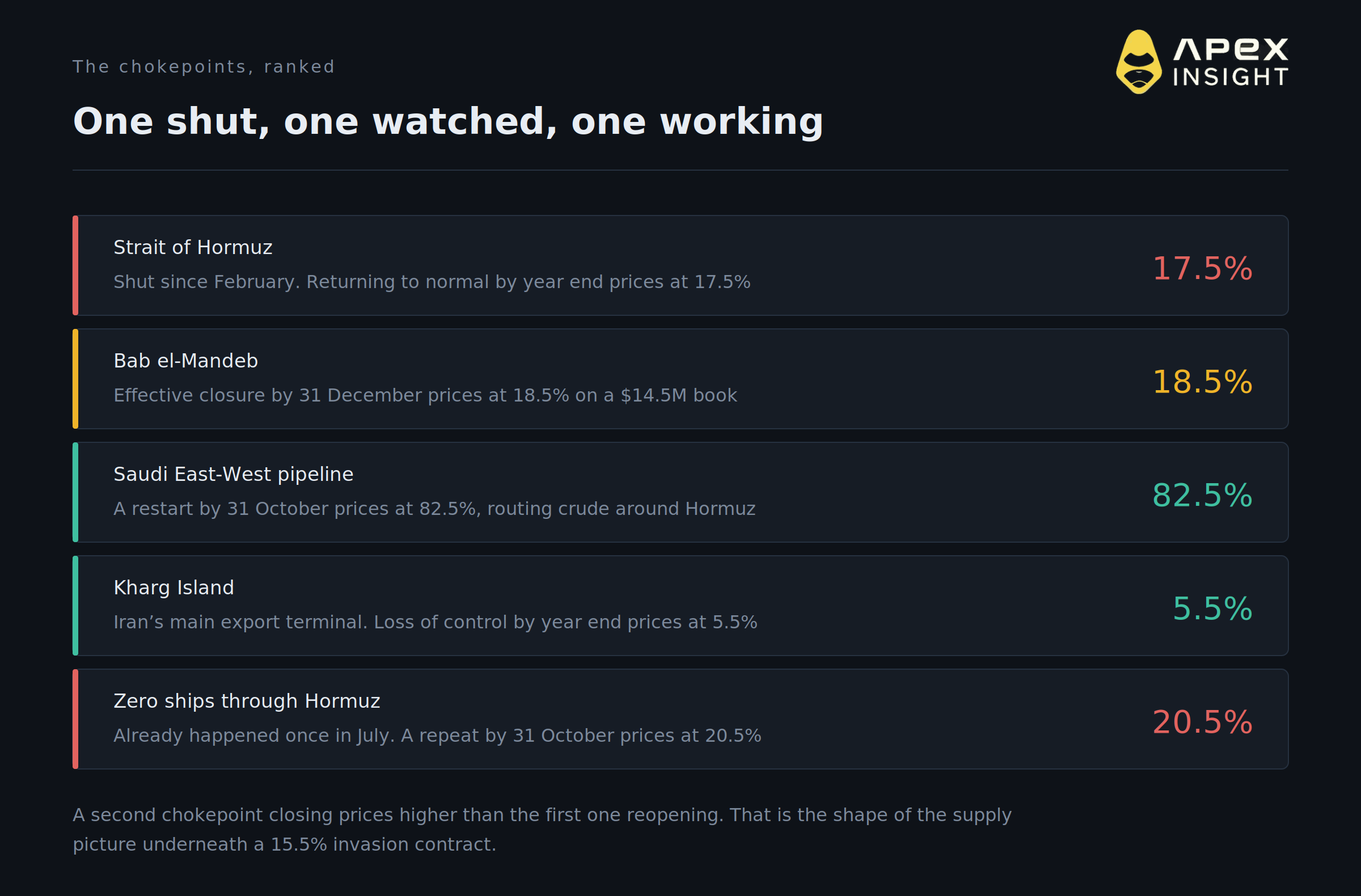
Put the whole supply picture in order and one comparison stands out.
Bab el-Mandeb being effectively closed by 31 December prices at 18.5 percent on a $14.5M book. The Strait of Hormuz returning to normal by the same date prices at 17.5 percent.
A second chokepoint closing is priced marginally higher than the first one reopening.
Alongside them, the Saudi pipeline restart at 82.5 percent, a repeat of zero Hormuz transits at 20.5 percent by 31 October, and Kharg Island falling out of Iranian control at 5.5 percent.
That is the supply picture underneath a 15.5 percent invasion contract: one waterway shut with no reopening priced, a second one watched, a bypass being built, and oil settling into a higher range rather than spiking. It is a conflict being absorbed rather than resolved, which is the same conclusion the diplomacy and succession markets reached in the two previous pieces.
The final piece in this series puts all four layers together and asks what would actually have to change for the invasion contract to move.
Trade it
Political Markets Season is live on ApeX Omni. Four stages, four political markets, a 6,000 USDT prize pool. Stage 2 is the US invasion of Iran before 2027.
Spot prediction trading on Polymarket order books. No leverage, no liquidation, no KYC. Trade the odds, not the outcome.
We appreciate your continued support.
Published by ApeX. For informational and educational purposes only. Not investment advice, and not a forecast or endorsement of any political or military outcome. Trading involves risk, including total loss.