



TL;DR
A trading leaderboard often ranks open profit, the gain on trades that haven't been closed. That money isn't yours until you sell.
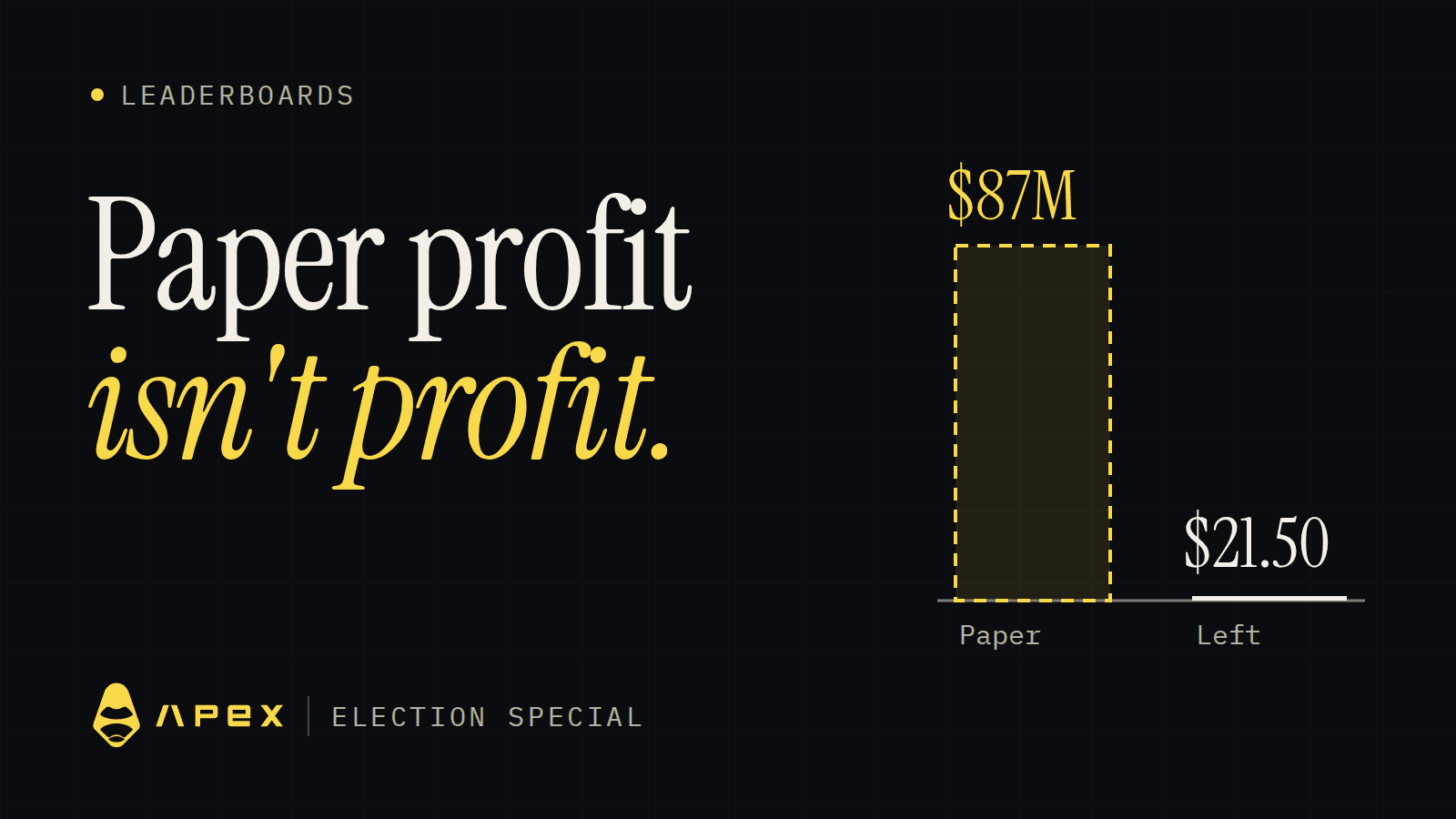
One trader's open profit hit a reported $87 million. Eight days later, his account held about $21.
The honest number is realized PnL, the profit you actually lock in by closing. Here's why.
Up $87 million. Then $21.
In spring 2025, a trader named James Wynn ran a few million dollars into a closely watched crypto account. He traded on an on-chain perpetual futures exchange, where anyone can see every position.
By May 23, his open profit was reported near $87 million. He held bitcoin positions worth over $1 billion at 40x leverage.
Then the market turned. His open profit fell by more than half in a single day. By May 31, after being fully liquidated, the account held about $21.50. By his own count, the whole run ended as a $17.5 million loss.
On May 23, a leaderboard would have shown him as one of the most successful traders alive. None of that profit had been banked.
Paper vs. banked
Every trade has two kinds of profit.
Unrealized PnL (paper profit): what your open position would make if you closed it right now. It changes every second.
Realized PnL (banked profit): what you actually made when you closed. It's locked in.
Think of a house. Its price can rise on paper for years. You only have the money when you sell. And if you wait, the price can fall back.
A leaderboard that ranks open profit is ranking houses nobody has sold.
Three more things a leaderboard hides
Who's missing. A leaderboard only shows who's still standing. In a study of 1,551 people who day traded Brazilian futures for more than 300 days, 97% lost money after fees. The winners you see sit on top of losers you don't.
What it took. Big gains often come from big risk. In a study of fund managers, those behind at mid-year took more risk in the second half. A leaderboard rewards the same urge.
How big. A 500% gain on a $50 account is $250. A 5% gain on $1 million is $50,000. Percent rankings and dollar rankings tell different stories.
A worked example
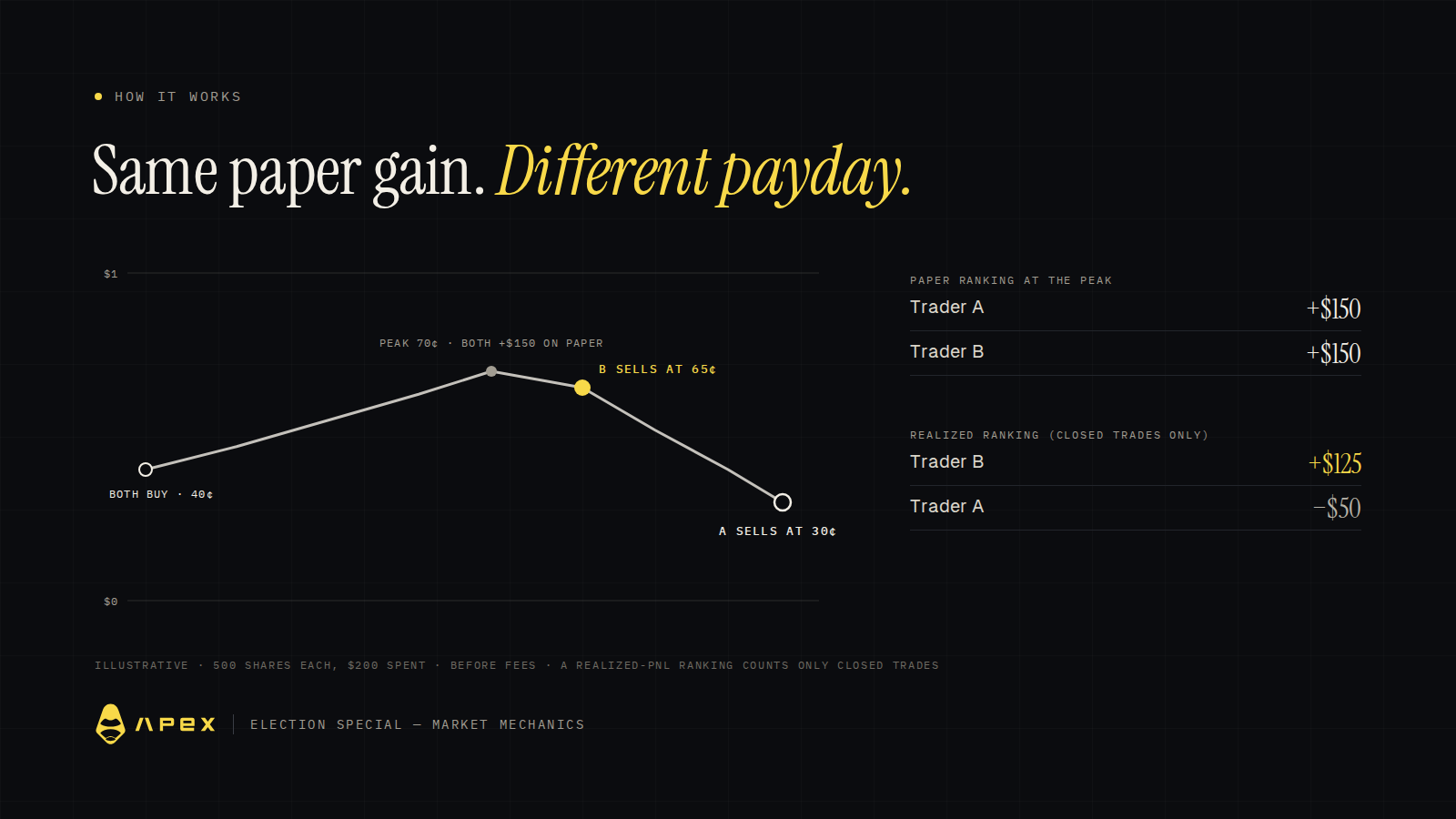
Two traders buy the same prediction share at 40 cents. Each spends $200 for 500 shares. The price climbs to 70 cents.
Trader A | Trader B | |
At 70¢, paper profit | +$150 | +$150 |
What they do | Holds, hoping for $1 | Sells at 65¢ on the way down |
Price falls to 30¢ | Sells in a panic | Already out |
Realized PnL | −$50 | +$125 |
At the peak, a paper-profit leaderboard shows them tied at +$150. A realized-PnL ranking tells the real story: B made $125, and A lost $50.
That's the whole point. Being right on paper is easy. Getting paid means closing the trade.
Go deeper
Unrealized gains swing both ways. Wynn's open profit fell from about $81 million to $38 million between May 23 and May 24, 2025, a drop of 53% in one day.
The base rate is harsh. Across the EU, regulators found that 74% to 89% of retail accounts trading leveraged CFDs lost money. That's not crypto perps, but the mechanics rhyme.
Showing winners changes behavior. In one experiment, seeing others' success made people take more risk, and a one-click copy button pushed it further. The top earners were often the ones who took more risk and got lucky.
Regulators are watching. IOSCO, the global body for securities regulators, lists excessive risk-taking and poor investor outcomes among its concerns about copy trading and leaderboards.
Realized isn't the full picture either. A trader can bank small wins and hold one big loser open. Look at both numbers, plus the worst drop along the way.
What this means for traders
Read the label. Before you trust a leaderboard, check whether it ranks open or closed profit.
Plan your exit before you enter. Pick the price where you take profit and the price where you admit you're wrong.
Bank some, sometimes. Selling part of a winner turns some paper into real money.
Watch size and leverage, not just rank. 40x leverage can turn a hero into a zero in one move.
Count survivors and the missing. For every name on top, many more quietly left.
On ApeX, your open positions show unrealized PnL under Positions and on the chart. Once you close, it moves to realized PnL.
Live now on ApeX Omni: Political Markets Season, Stage 4
ApeX Omni runs prediction shares on Polymarket's order book. They're priced from $0 to $1, with no leverage and no liquidation, and they settle in PUSD.
• Stage 4, US House Elections: Sep 28 to Oct 4, 16:00 (UTC+8). It's the last of four weekly stages.
• Two pools: one for trading volume and one for realized PnL, the profit you lock in by selling. Paper gains on open shares don't count toward it.
• 6,000 USDT across the season, with a 1.5x volume boost on the featured market.
• No registration. Trade, and you're in.
Campaign page · Full rules · How to trade predictions on ApeX
Glossary
Leaderboard: a public ranking of traders by profit or return.
Unrealized PnL: profit or loss on a position that's still open.
Realized PnL: profit or loss locked in when you close a position.
Liquidation: when a leveraged position is closed automatically because losses have used up the margin.
Leverage: trading a bigger position than your own money covers.
Survivorship bias: judging by the winners you can see while missing those who dropped out.
Copy trading: automatically copying another trader's positions.
CFD: a contract for difference, a leveraged bet on a price without owning the asset.
Prediction share: a contract that pays $1 if its outcome happens and $0 if it doesn't.
This article is for education only and is not financial advice. It doesn't favor any party or candidate. Leaderboard results don't predict future returns. Leveraged trading carries a high risk of loss, and prediction shares can lose everything you paid. Prediction markets are restricted in some places, so check the rules where you live. Do your own research.