




Pearl Replaces the Hash With a Matrix Multiplication
Bitcoin miners compute SHA-256 hashes. The work is deliberately useless: its only purpose is to be expensive. Every joule spent securing Bitcoin produces nothing else.
Pearl's claim is that the expensive thing can also be the useful thing. Its miners run GPU matrix multiplication, the operation underneath every forward and backward pass in a neural network. The chain went live on mainnet on April 27, 2026.
The mechanism is called cuPOW. Rather than multiplying matrices A and B directly, a miner computes a noised product where the noise terms derive from a public seed in the block header. The miner records a transcript of intermediate partial sums, hashes it, and compares that hash to a difficulty target. Because the noise is low-rank, recovering the useful output from the noised result costs far less than redoing the multiplication.
Pearl explicitly rejected the obvious alternative. Freivalds' algorithm can verify a matrix product cheaply, but it confirms only that an answer is correct. It has no difficulty parameter and cannot distinguish freshly performed work from a precomputed result, which makes it useless as a consensus mechanism.
The Cryptography Comes From Credible People
This matters, because the space is full of projects where the technical claim collapses on contact.
The founding paper, Proofs of Useful Work from Arbitrary Matrix Multiplication, is by Ilan Komargodski and Omri Weinstein, and Rafael Pass wrote the network's economic analysis. These are established complexity and cryptography researchers rather than pseudonymous developers. Third-party coverage names Weinstein as co-founder and chief executive, though Pearl's own site does not publish a team page. The company is a member of NVIDIA's Inception programme.
The code is public under a permissive ISC licence. The monorepo holds the full node, an HD wallet, an SPV light client using compact block filters, a vLLM GPU miner, post-quantum XMSS signatures and a plonky2 proving system.
Pearl's own benchmarks put the kernel overhead at about 5.1% on Llama 70B across four H200s and about 3.9% on DeepSeek V3.2 across eight. Those are vendor-reported figures, and the security of the whole scheme rests on a stated assumption rather than a proof: that no algorithm recovers the hidden correlations faster than simply doing the honest computation. Pearl calls this its core security assumption and does not claim to have proved it.
Where the Coins Come From
Maximum supply is 2.1 billion PRL, a hundred times Bitcoin's unit count. Mining is the only source. There was no token sale, no venture allocation written into the code, and no token contract, because PRL is a native coin on its own chain rather than an ERC-20.
Parameter | Value |
|---|---|
Max supply | 2.1bn PRL |
Block reward | About 2,257 PRL |
Target block | 194 seconds |
Daily issuance | About 1.0m PRL |
Circulating | About 344m, 16% of cap |
There are no halvings. The subsidy declines slightly with every block on a smooth curve, from about 3,230 PRL at block one to about 2,257 today. Roughly half the supply is expected to be mined by the end of 2029.
One wrinkle sits in the launch. About 121.7m PRL, roughly 35% of everything mined to date, was minted in the first 40,000 blocks, around six days. Difficulty started low by design. The whitepaper says this was partly intended to fund core team research and development, which implies the team mined during that window. Its holdings are not disclosed.
Be careful with the market capitalisation figure you use. CoinMarketCap has shown a self-reported circulating supply of about 226m, while a recalculation from the subsidy formula and the block height gives about 344m. CoinGecko now reports the larger figure, and it is the one that reconciles: the gap between a code-derived 331.9m on October 2 and 344.2m today works out at almost exactly the daily issuance rate. Every number below uses that basis.
A Year of Mining Issues More PRL Than the Market Is Worth
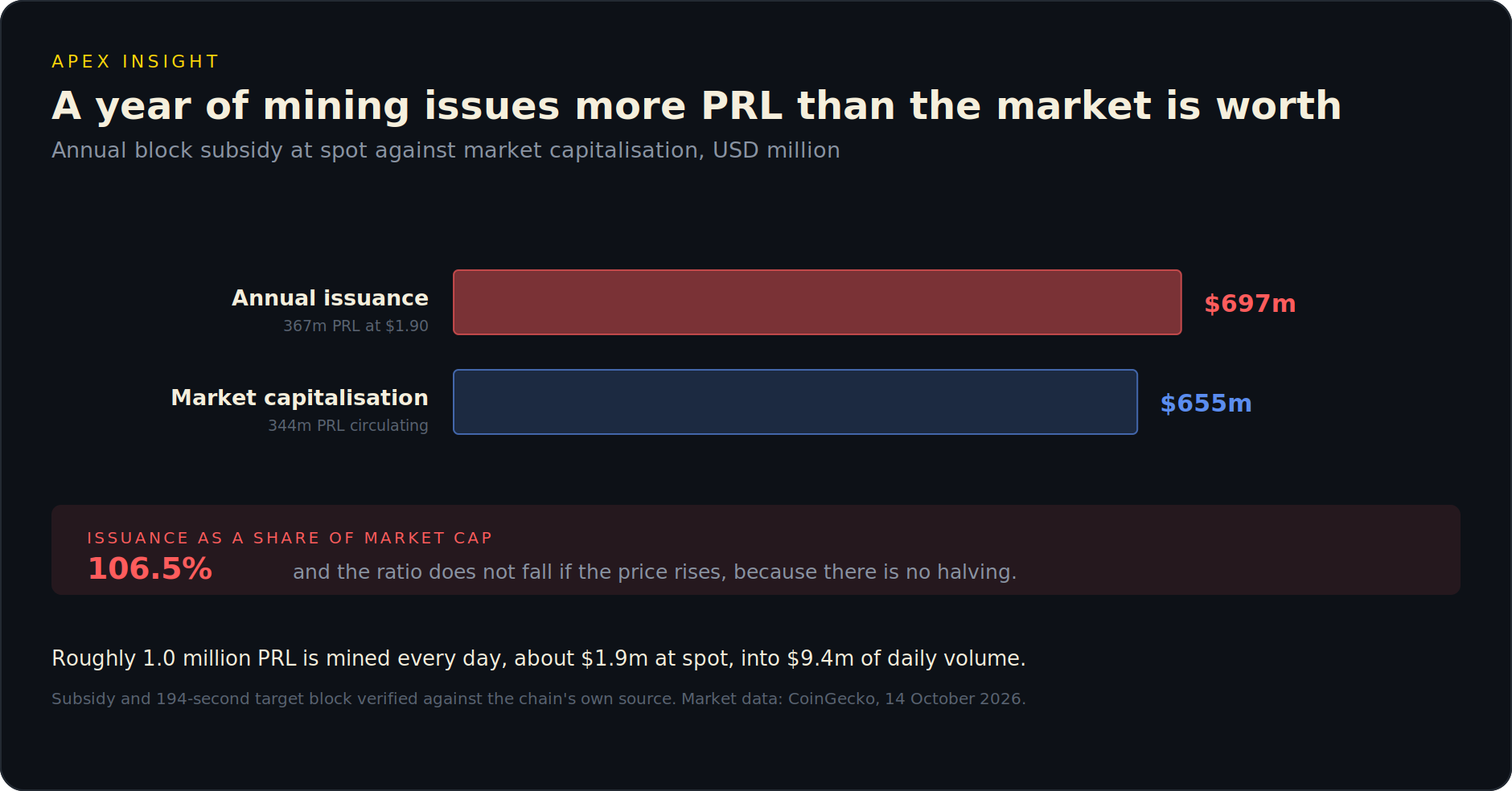
This is the single most important number in the piece.
At a 2,257 PRL subsidy and a 194-second target block, the network mines about 445 blocks and just over one million PRL a day. Annualised, that is roughly 367m PRL. At $1.90 it is about $697m of new supply a year, against a market capitalisation of about $655m.
Issuance is therefore around 106% of the market capitalisation annually, and about the same again as supply inflation in the first year measured against coins already circulating.
Because there is no halving, that ratio is invariant to price. A rally does not relieve the pressure, it scales it: at $3.40 the network would issue about $1.25bn a year against a $1.17bn capitalisation. The only things that reduce it are the slow decline in the subsidy and genuine demand.
Set that against liquidity. Daily issuance is about $1.9m at spot, into roughly $9.4m of daily reported volume. Mined coins alone are equivalent to about a fifth of everything that trades, and miners renting GPUs have to sell to cover costs.
Mining Is a Treadmill That Caps the Price
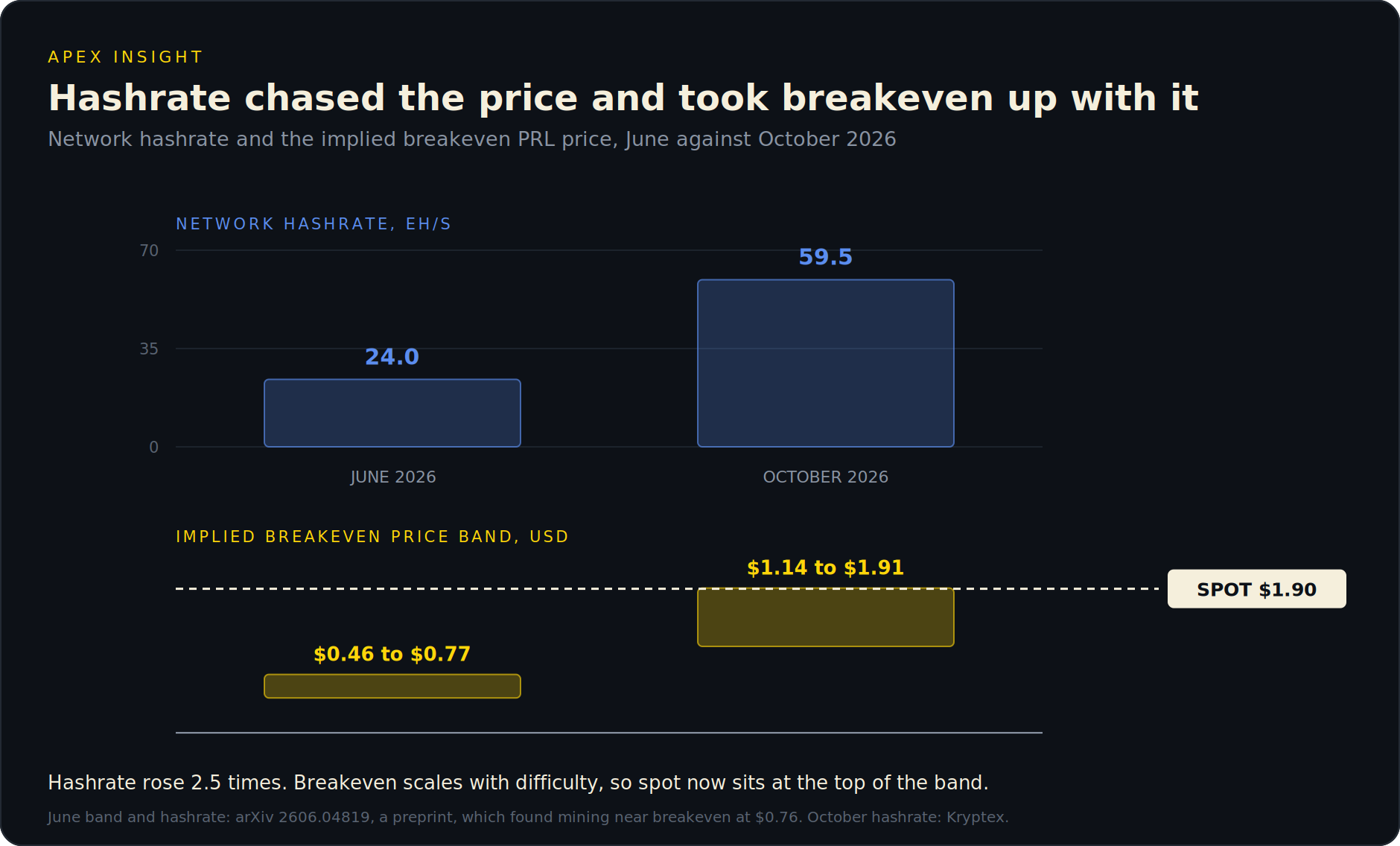
Proof-of-work economics are self-correcting in a way that is easy to miss when a chart is going up.
A June 2026 preprint measured network hashrate at roughly 24 EH/s and found mining near breakeven for most hardware at a PRL price of $0.76, with returns ranging from minus 1% to plus 67% depending on the GPU tier. That implies breakeven somewhere between about $0.46 and $0.77 across tiers.
Today the network runs at about 59.5 EH/s, roughly two and a half times that. Mining costs are fixed in dollars while coins earned per GPU fall in proportion to difficulty, so breakeven scales with hashrate. Applying that ratio moves the band to roughly $1.14 to $1.91.
Spot is $1.90. Scaling the paper's own near-breakeven price of $0.76 by the same ratio gives $1.88. The marginal miner is, on this approximation, close to breakeven again despite the coin having risen more than tenfold from its low.
That is the treadmill. A higher price attracts hashrate, hashrate raises difficulty, and difficulty pushes breakeven back up toward the price. Observed block times are currently running near 181 seconds against the 194-second target, which is what a network still absorbing new hashrate looks like.
Two caveats on that calculation. The scaling assumes miner cost structures have not changed, and they have: community miner software has improved hashrate per watt, which pushes breakeven down. And the original breakeven figures are one author's cost assumptions, not an audited industry survey. Treat the band as an order of magnitude, not a precise floor.
Does the Work Actually Get Used?
This is the contested part of the story, and it deserves to be set out carefully rather than resolved glibly.
Pearl's position is that each PRL is mined through GPU matrix multiplications that serve a real inference request.
A preprint posted to arXiv on June 3, 2026 by Abhinaba Basu disputes this. It reports that the dominant mining binary contained none of the inference-related strings the author searched for, that its runtime profile is consistent with pure matrix multiplication, and that the protocol accepts randomly generated matrices by design. The author's conclusion is that cuPOW guarantees computational hardness but not computational utility.
Several things should temper how much weight that carries. It is a single-author preprint marked as under review and is not peer reviewed. The author describes the string-based method as inconclusive, acknowledges that one hardware classification step is circular, and flags that several network-wide figures are extrapolations. Some tables in the paper do not reconcile with its own text.
What is not really in dispute is the narrower structural point, which Pearl's documentation and third-party research both support. The protocol rewards valid blocks. It does not currently distinguish a miner serving a paying customer from a miner multiplying matrices for nobody. Whether useful work happens is, at present, a function of who is mining rather than something consensus enforces.
The Company Has Customers. The Token Does Not.
Pearl Research Labs runs a live inference platform with OpenAI-compatible endpoints across seven models, including DeepSeek, Gemma, Qwen and GLM variants, sold as serverless, managed and on-premise tiers. That is a real business with real customers paying real money.
None of that money reaches PRL holders.
The flagship arrangement is with Together AI, which launched an exclusive serverless endpoint for a Pearl-tuned Gemma 4 31B checkpoint on May 15, 2026, priced at least 25% below standard rates. Read Together's own description of how that discount is funded: it is offset by the future value of crypto emissions. The discount is not evidence of demand for PRL. It is emissions being spent to buy adoption.
There is no marketplace where a buyer pays PRL to receive inference. Pearl's documentation treats compute contracts settling on chain as a future direction. Until something like that exists, PRL is a mining reward with no claim on the revenue the technology generates, and its price is a function of speculation, cost of production and float.
Concentration Sits on Both Sides of the Market
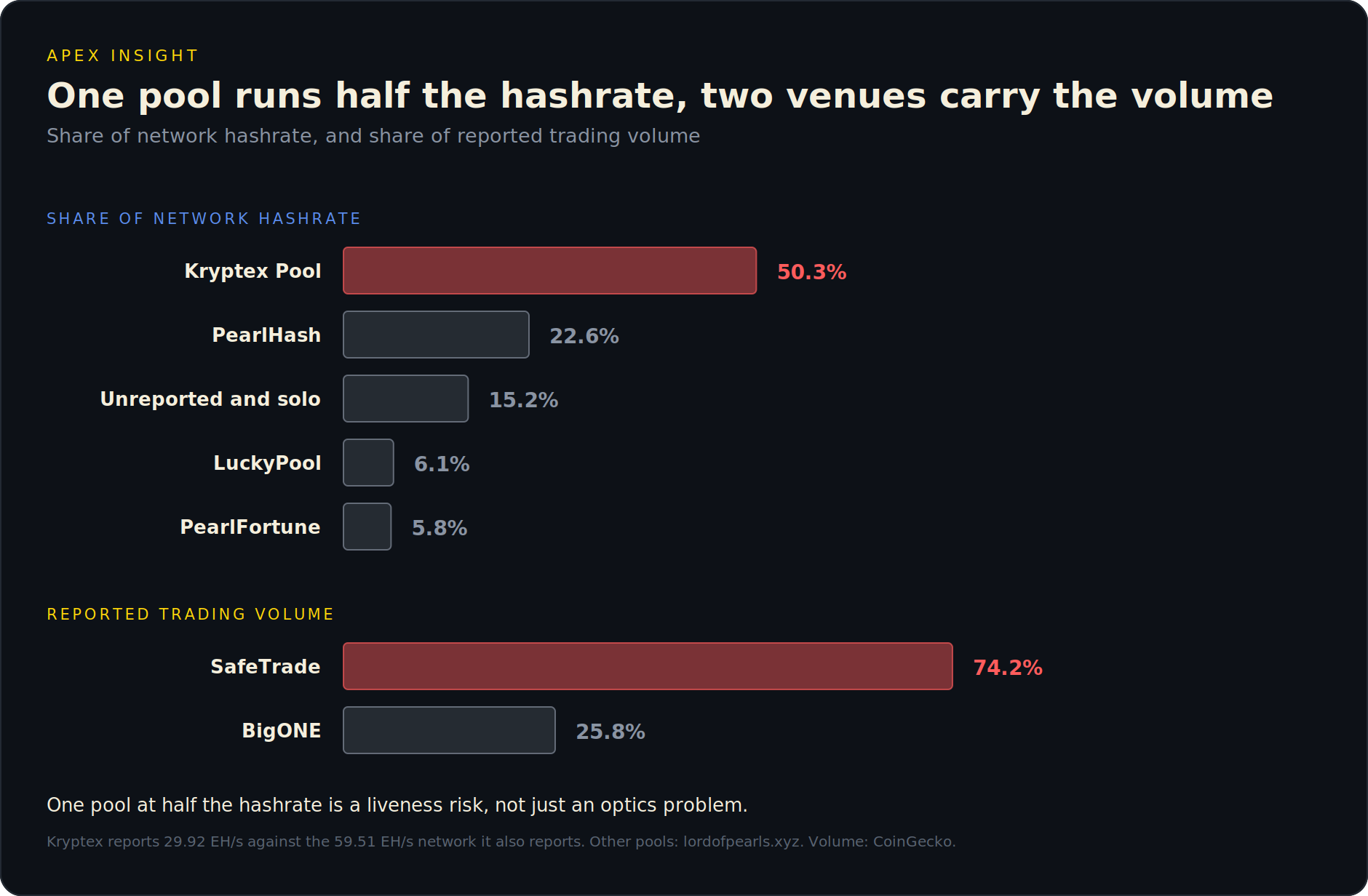
Two concentrations are worth knowing about before sizing anything.
The first is mining. Kryptex reports 29.92 EH/s on its own pool page, against the 59.51 EH/s network hashrate it also publishes. That puts a single pool at roughly half the network, with close to 20,000 miners behind it. A third-party tracker's 24-hour block counts point the same way or slightly higher. A pool at or near a majority is a liveness and reorganisation risk rather than merely an optics problem, and these are snapshots rather than sustained averages.
The second is trading. Essentially all reported volume sits on two exchanges, SafeTrade and BigONE, with SafeTrade carrying roughly 74%. A $655m asset whose price discovery happens almost entirely on two venues is a different risk profile from its market capitalisation alone.
There is also an operational record worth reading. The project's public issue tracker carries a months-long cluster of desktop wallet reports: sync stalls, RPC timeouts, failed transfers and one report of funds missing after using multiple receive addresses. One open issue, posted by a user, states that wallet 2.0.5 still had sending and receiving suspended roughly a month after a hack affecting some mining pools, and no maintainer response appears on the thread. These are user reports rather than confirmed incidents, and the pool hack has no independent confirmation we could find, but the volume and persistence of the reports is itself information.
Where the Price Could Go
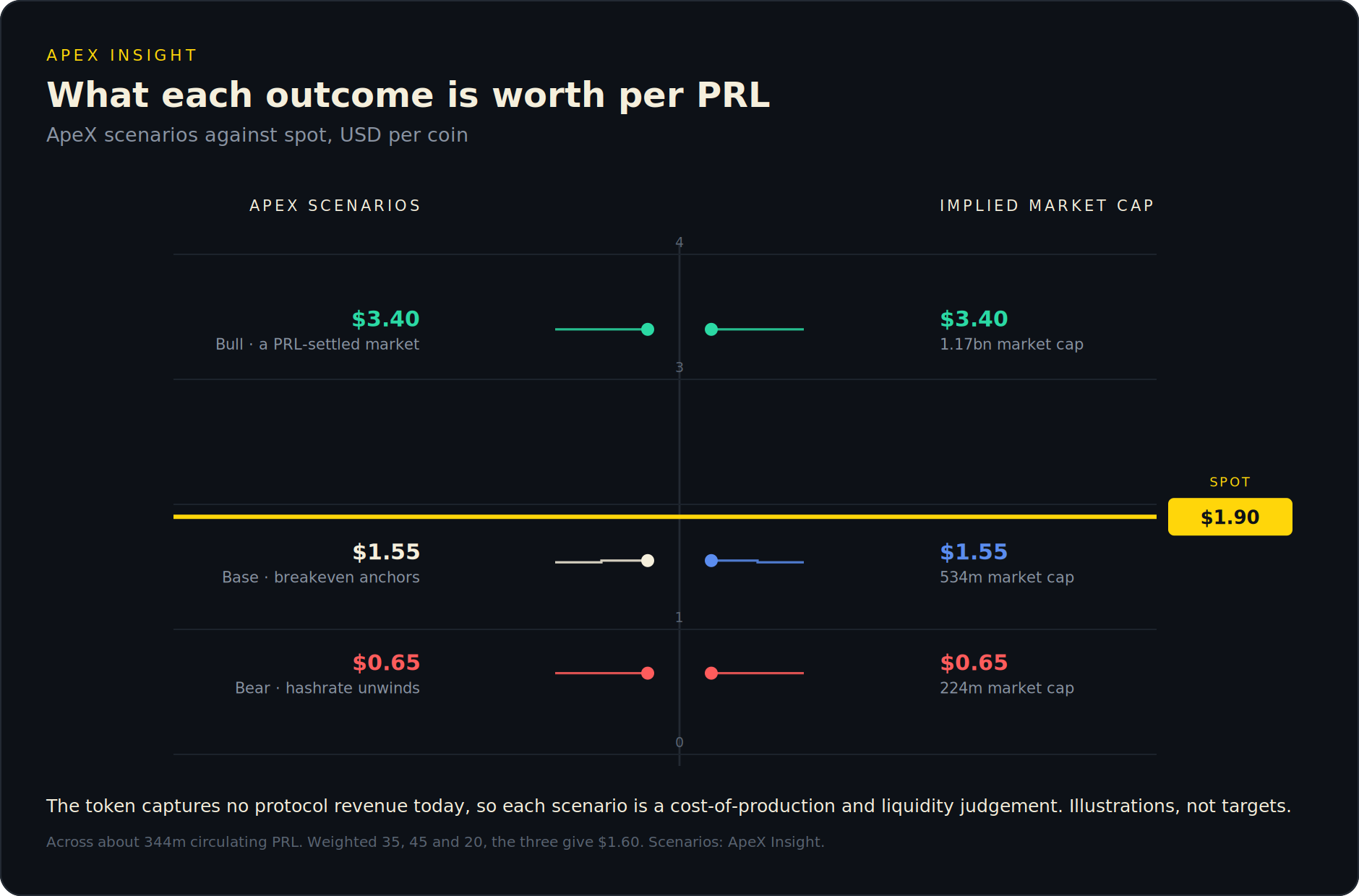
The token captures no protocol revenue, so a revenue multiple is not available. Each scenario is instead a judgement about cost of production and liquidity. These are illustrations of what different worlds imply, not price targets.
Scenario | Working | Implied |
|---|---|---|
Bear | Hashrate unwinds | $0.65 |
Base | Breakeven anchors | $1.55 |
Bull | PRL-settled market | $3.40 |
Bear assumes emissions keep clearing into thin bids, the AI mining narrative cools, and hashrate unwinds. Difficulty falls with it, dropping breakeven and letting price find a lower floor. PRL traded near $0.98 as recently as this month, so this does not require anything exotic.
Base assumes the current structure persists. Hashrate holds, breakeven anchors price in the upper half of its band, and the coin trades around the cost of producing it. That is $1.55, modestly below spot.
Bull assumes the missing piece arrives: a marketplace where inference buyers settle in PRL, or Together's stated intention to pass emissions through to customers becoming a real demand channel. That would give the coin an actual claim on a growing business and justify a premium to production cost.
Weighting those at 35, 45 and 20 gives about $1.60, roughly 16% below spot.
We would rather say that plainly than dress it up. On our read the coin is priced slightly ahead of what the current structure supports, within a day of an all-time high, and the honest version of this analysis is more cautious than the price action. That cuts both ways for a trader, which is the point of a market with two sides.
Key Risks
Annual issuance exceeds the market capitalisation, with no halving to relieve it.
No marketplace exists where buyers pay PRL for inference, so the token captures no revenue.
The usefulness claim is contested by a preprint and is not enforced by consensus.
One pool runs roughly half the network hashrate.
Essentially all reported volume sits on two exchanges.
Persistent user reports of wallet sync and transfer failures on the public issue tracker.
About 35% of mined supply was minted in the first six days, and team holdings are undisclosed.
Aggregators disagree materially on circulating supply and volume, so headline multiples vary by source.
Realised volatility is extreme: a 44% drawdown and a 96% rally inside three weeks.
What to Watch Next
Any announcement of a PRL-settled compute marketplace. This is the single thing that would change the valuation framework.
Whether Together AI extends the arrangement or passes emissions through to customers directly, and whether other inference providers adopt the protocol.
Network hashrate and difficulty. Rising hashrate into a flat price squeezes miners toward capitulation.
Block times returning to the 194-second target, which would signal hashrate growth has stabilised.
Pool share. Kryptex falling well below half the network would remove a real structural risk.
Resolution of the wallet transfer issues, and any official statement on the reported pool incident.
Listings on deeper venues, which would reduce dependence on two exchanges for price discovery.
How to Trade It Either Way
Most routes into PRL are long-only and awkward. Spot sits on two small exchanges, self-custody runs through a wallet with an unresolved queue of sync and transfer reports, and mining it requires GPUs and a view on difficulty.
You can take either side with the PRL-USDT perpetual on ApeX Omni, with up to 3x leverage, long or short, no KYC and full self-custody.
Note that cap. Three times is a fraction of what the same venue offers on large-cap markets, and it is the correct read on this asset rather than a limitation. PRL fell 44% from its September high to its October low, then rallied 96% to a new high in the past day. A 3x position is liquidated by a 33% adverse move, and this market has delivered larger moves than that twice in three weeks.
A credible piece of cryptography, a real company, a token with no claim on it, and more issuance per year than the whole thing is worth. Size accordingly, because leverage magnifies losses as fast as gains.
This article is market commentary for informational purposes only. It is not investment advice, and nothing here is a recommendation to buy or sell any token. Scenarios are illustrative, not price targets. Figures are as of October 14, 2026. Emission figures are derived from the subsidy function in Pearl's own source code and cross-checked against the block explorer; market data is from CoinGecko and network data from Kryptex. These move quickly. Do your own research.
We appreciate your continued support.