



What Oura Actually Sells
Oura makes a titanium ring with no screen. It tracks sleep, heart rate, body temperature and activity continuously, runs about a week on a charge, and syncs to an app that turns the raw signal into daily scores for readiness, sleep and activity.
The hardware is the entry point, not the business. The Oura Ring 5 sells for $399 to $499 and full insights require a membership at $5.99 a month. That second line is where the economics live, and the rest of this piece is mostly about it.
From a Finnish Town to a Nasdaq Listing
The company was founded in Finland in 2013, in Oulu, and shipped its first consumer rings to a niche of quantified-self enthusiasts long before the category had a name.
Year | Milestone |
|---|---|
2013 | Founded in Oulu, Finland |
2021 | Oura Ring 3 launches |
2024 | Ring 4, plus two acquisitions |
2025 | 5.5m rings sold to date |
2026 | Redomiciles to US, Ring 5, IPO |
Two threads matter. The first is acquisition: Proxy in 2023 for digital identity, then Veri for metabolic health and Sparta Science for enterprise health analytics, both in 2024. Oura has been buying its way from a sleep tracker toward a broader health platform.
The second is institutional validation. Oura raised more than $900m led by Fidelity with ICONIQ, Whale Rock and Atreides. It supplies the US Department of Defense health programme, is the official wearable of Team USA and the LA28 Games, and holds a SAFE from Eli Lilly that converts to common stock at listing. Those are not consumer-gadget relationships.
In 2026 the company redomiciled to the United States as Oura Inc., a holding company for the Finnish operating entity, while committing to keep engineering in Oulu. That move is what made a Nasdaq listing straightforward.
Why Did Oura Report a $924 Million Loss?
Because of an accounting entry, not the business. This is the single most misreported number in the filing and it is worth being precise about.
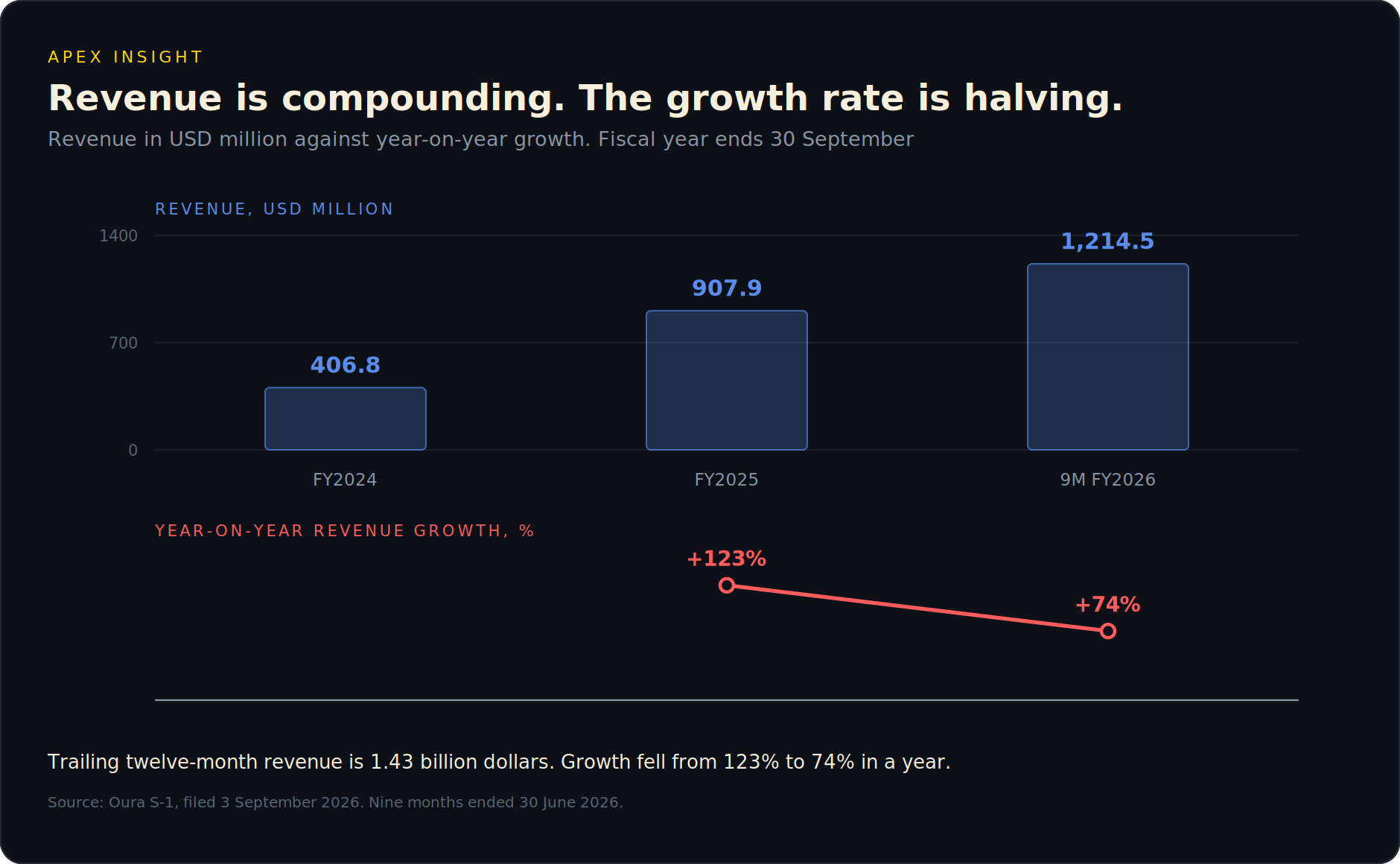
For the nine months to June 2026, Oura reported revenue of $1,214.5m and net income of $60.8m, against $1.6m a year earlier. The company is profitable.
The $924.3m figure is net loss attributable to common stockholders. It reflects a deemed dividend of roughly $985m to holders of redeemable convertible preferred stock, tied to a pre-IPO buyback of about $1.09bn from early backers. It is a transfer between share classes recorded before listing, not money the operating business lost.
Anyone comparing that $924m to the prior year's $182.8m loss and concluding the business deteriorated has the story backwards. Operating cash flow over the same nine months was $328.0m.
The Mix Is the Entire Investment Case
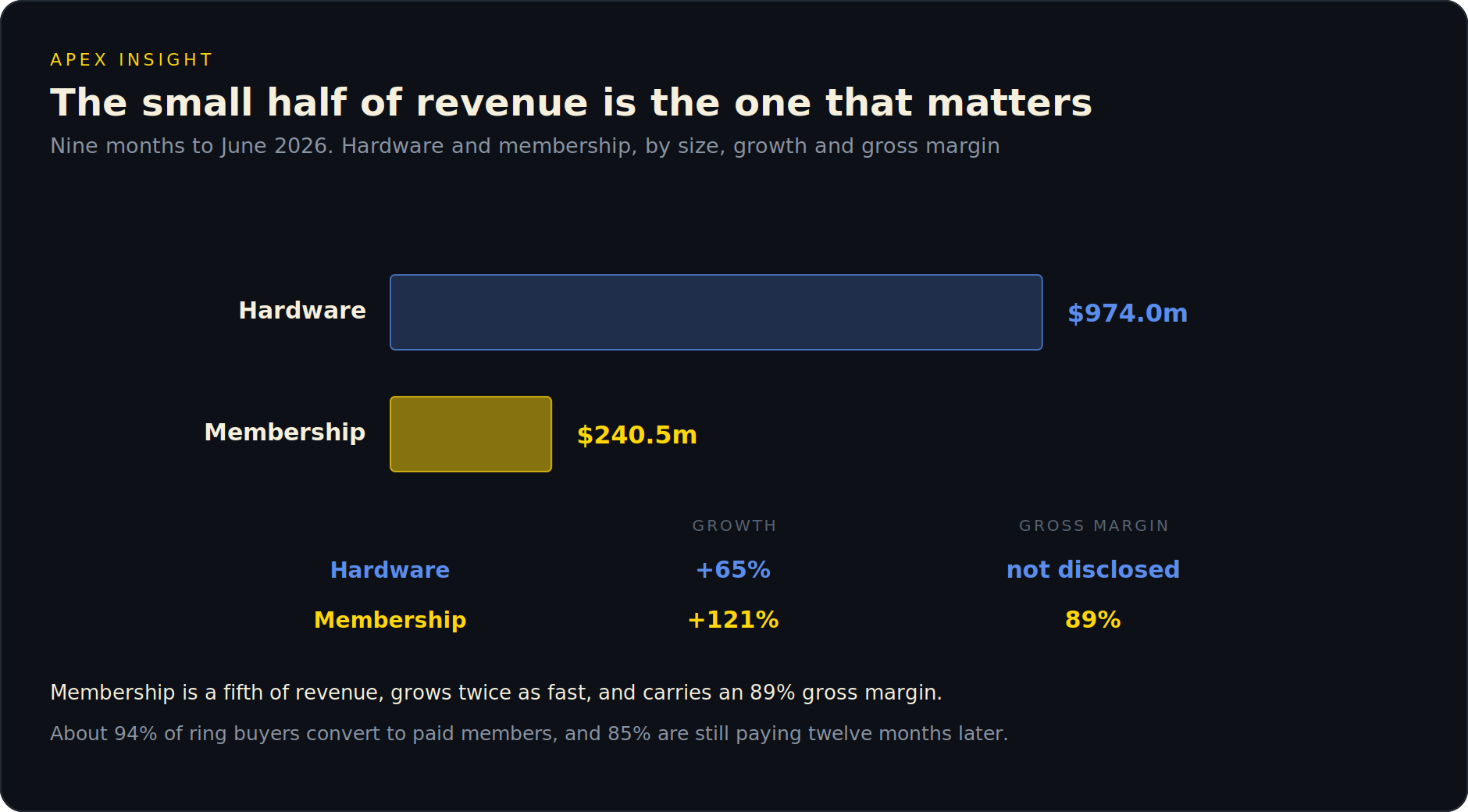
Split the nine months to June 2026 and two different companies appear.
Segment | Revenue | Growth |
|---|---|---|
Hardware | $974.0m | +65% |
Membership | $240.5m | +121% |
Hardware is four-fifths of the revenue and grows fast. Membership is a fifth, grows twice as fast, and carries an 89% gross margin.
The supporting metrics are unusually good. Roughly 94% of ring buyers convert to a paid membership. About 85% are still paying twelve months later. Around 63% start on an annual plan, which is why deferred revenue grew roughly 56% in fiscal 2025 and another 59% in the following nine months.
That is a subscription business hiding inside a hardware business. If membership keeps compounding at this rate, the mix shifts, blended margins rise, and today's multiple looks reasonable. If ring sales carry the growth instead, an investor is paying a software price for a consumer-electronics company.
What Are You Paying For?
At the $40 to $44 range across roughly 320.9 million post-IPO shares, the arithmetic is straightforward.
Price | Market cap | Multiple |
|---|---|---|
$40 | $12.8bn | 9.0x sales |
$42 | $13.5bn | 9.4x sales |
$44 | $14.1bn | 9.9x sales |
On trailing net income of about $59m, the midpoint is roughly 228 times earnings. That number is close to meaningless for a company that only reached profitability this year, which is exactly why the price-to-sales figure is the one to argue about.
Nine times sales is a software multiple. Consumer hardware companies rarely clear two or three. The gap between those two worlds is the bet, and the underwriters have priced it as though the membership line settles the argument.
The Competitive Squeeze Nobody Prices
Oura dominates today. Estimates of its share cluster around three-quarters of the global smart ring market, and the company has defended that position aggressively in court.
In September 2025 the International Trade Commission found that Ultrahuman and RingConn infringed an Oura patent on ring construction, with exclusion orders effective that October. Circular settled and now pays Oura a royalty, as does RingConn. That is a real moat, and it is why Oura's share climbed while rivals were locked out.
The moat is now under attack from two directions. Ultrahuman redesigned its Ring Pro and US Customs ruled in March 2026 that the new design falls outside the order. And in January 2026 the ITC agreed to investigate Samsung's own complaint seeking restrictions on certain Oura Ring imports. The patent holder is now also a defendant.
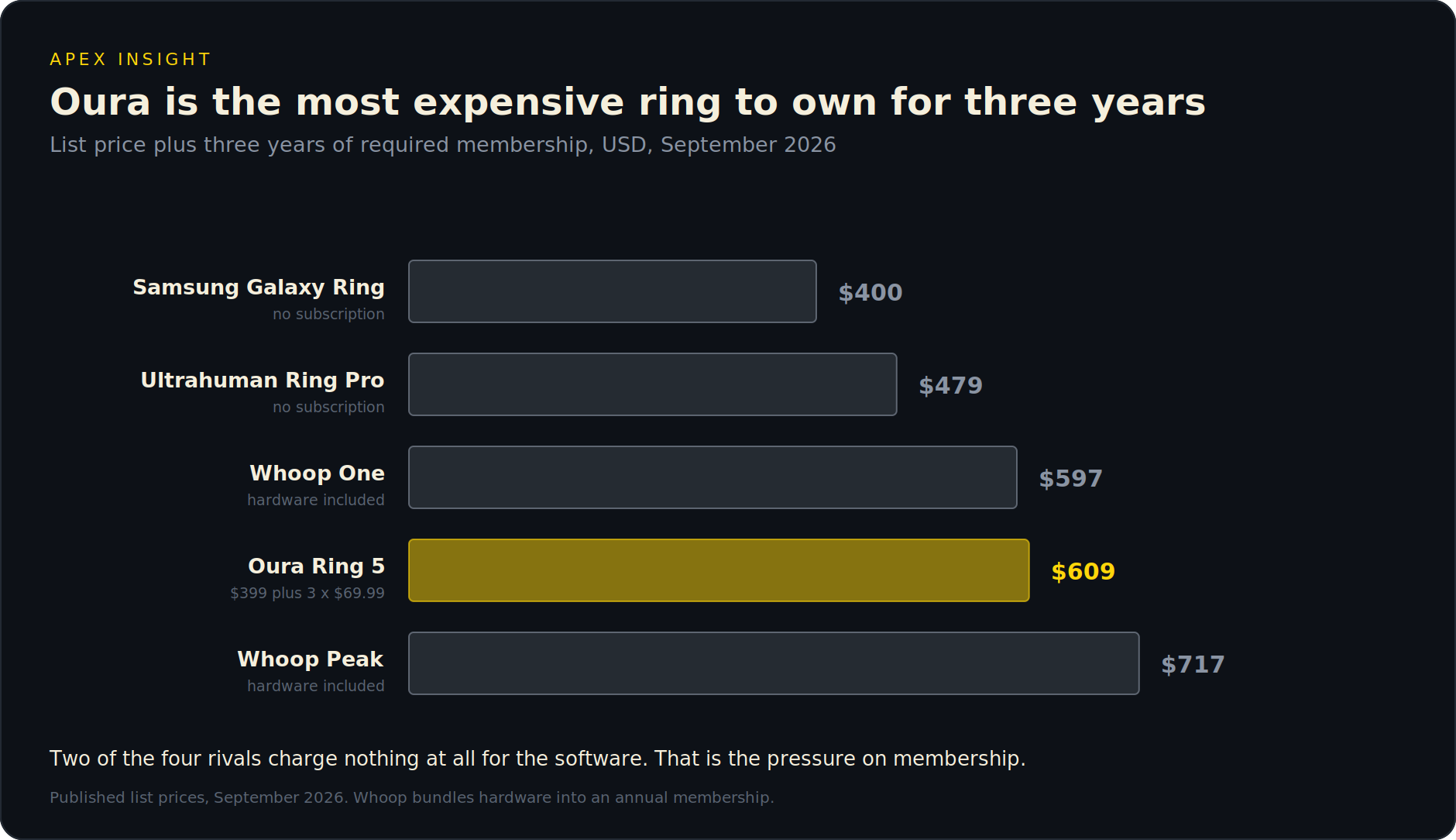
Then there is the pricing structure. Over three years an Oura costs about $609. A Samsung Galaxy Ring costs $400 and requires no subscription at all. Ultrahuman's Ring Pro is $479, also with no subscription. Oura's own filing warns that rivals may discount hardware or drop subscription fees entirely.
That is the vulnerability. The membership line is the reason for the multiple, and it is the exact line competitors are attacking by giving the software away.
Where the Price Could Go
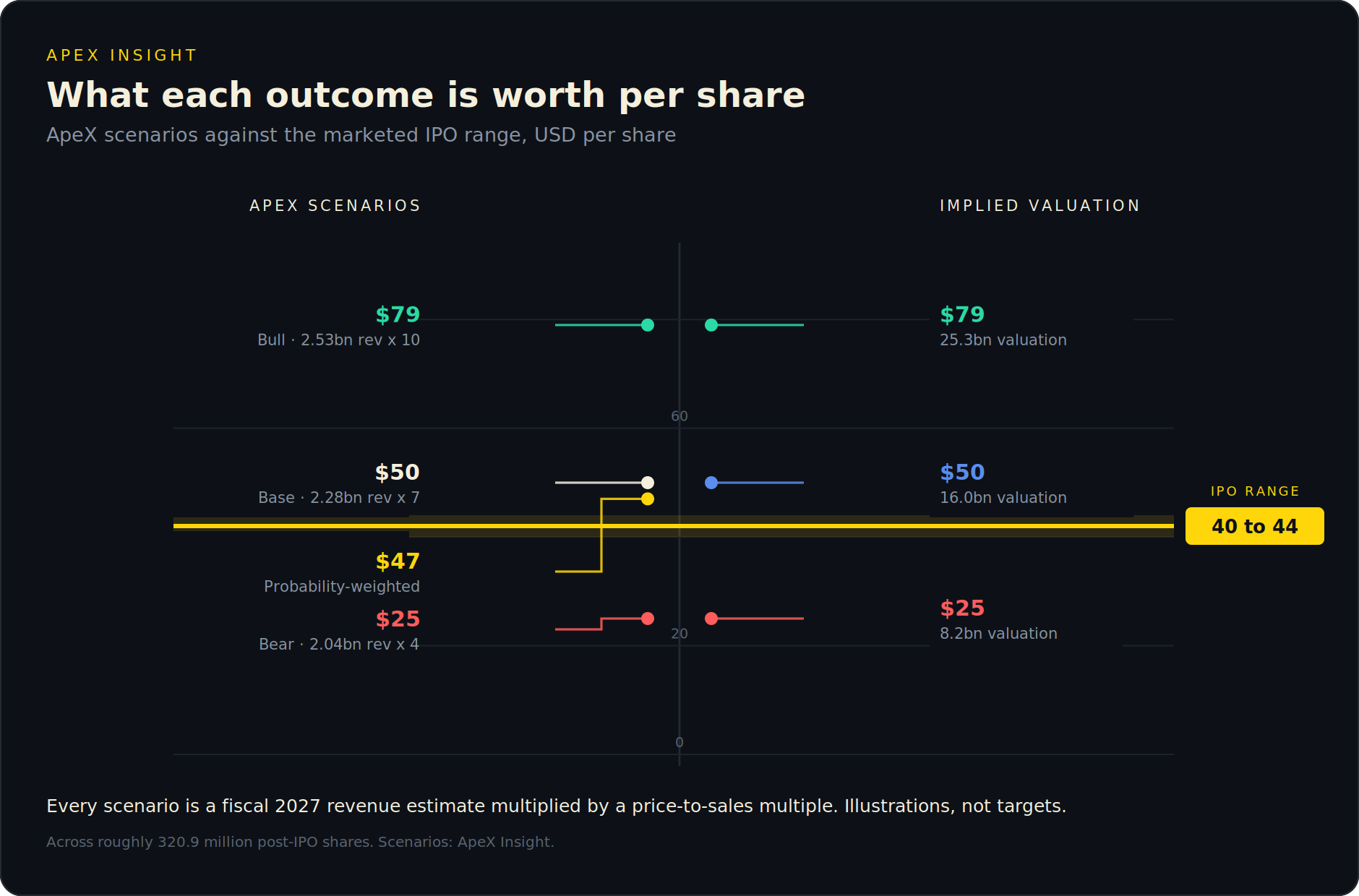
Earnings multiples are not usable on a company this early into profitability, so each scenario is a fiscal 2027 revenue estimate multiplied by a price-to-sales multiple. These are illustrations of what different worlds imply, not price targets.
Scenario | Working | Implied |
|---|---|---|
Bear | $2.04bn x 4 | $25 |
Base | $2.28bn x 7 | $50 |
Bull | $2.53bn x 10 | $79 |
Bear assumes growth normalises toward 25%, subscription-free rivals take share, and the market decides this is a hardware company after all. Four times sales is still generous for consumer hardware.
Base assumes revenue grows about 40% and the multiple holds around seven, a discount to the listing price but a large premium to hardware peers. That produces roughly $50, about 18% above the midpoint.
Bull assumes membership compounds toward a third of revenue, blended margins rise, and the market pays ten times sales for a health-data platform rather than a ring maker.
Weighting those at 35, 45 and 20 gives about $47 a share, roughly 12% above the $42 midpoint. On the marketed range the deal looks fairly struck rather than cheap, which is what a well-run book is supposed to produce.
Key Risks
Rivals selling comparable rings with no subscription, attacking the highest-margin line directly.
Samsung's ITC complaint against Oura, which inverts the patent moat.
Customer concentration: two retailers accounted for about 22% of revenue, and four customers roughly 83% of receivables at September 30, 2025.
An $84.4m warranty expense in fiscal 2025 tied to battery defects.
Active class action litigation over claims about sleep stage detection accuracy.
Dependence on third-party AI models from OpenAI, Anthropic and Google for interpretation features, disclosed as a risk in the filing.
A stockholders' deficit following the pre-IPO buybacks, and profitability the company itself describes as recent.
What to Watch Next
Final pricing and the first day of trading. A deal priced above range signals demand the scenarios above do not assume.
Membership as a share of total revenue in the first reported quarter. This is the single number that decides the multiple.
Twelve-month retention, currently about 85%. Any slippage hits the thesis immediately.
The Samsung ITC proceeding and any further Ultrahuman customs rulings.
Whether the Eli Lilly and defence relationships convert into disclosed revenue rather than validation.
Lock-up expiry, roughly 180 days out, into a float that starts small.
How to Trade a Listing Before It Lists
Oura has not traded yet. The IPO allocation route is closed to nearly everyone, and the first public price will be set in a few minutes on listing day by a book most readers cannot join.
Pre-IPO perpetuals exist for exactly this gap. You can take either side with the OURA-USDT perpetual on ApeX Omni, long or short, no KYC and full self-custody, trading around the clock rather than only when Nasdaq is open.
Two things to understand before you do. The contract tracks an implied share price and confers no equity, no shares and no IPO allocation. And pre-IPO contracts are thin by nature, so the price can diverge from where the stock eventually opens. Read the contract above $44 as the market expecting a deal priced above range, and below $40 as the opposite.
A first-day print is the most violent pricing event a stock ever has. Size accordingly, because leverage magnifies losses as fast as gains.
We appreciate your continued support.
This article is market commentary for informational purposes only. It is not investment advice, and nothing here is a recommendation to buy or sell any security or derivative. Scenarios are illustrative, not price targets. Figures are from Oura's S-1 and amended filings as of September 28, 2026, and IPO terms may change before pricing. Do your own research.