



Note: All contract prices, percentage moves and range positions are ApeX Omni order book data as of 7 October 2026. Company results, contract price forecasts and analyst estimates are as published by the respective companies, TrendForce and major data providers as of the same date. Range positions are measured from each contract's listing date on ApeX Omni, which differs by instrument. Markets move continuously and all figures will differ by the time you read this.
Micron's Record Quarter Wasn't Enough: 6 Memory Markets and the One Trade They Share
On September 30 Micron reported the best quarter in its own history, and one of the largest any memory manufacturer has ever posted.
Revenue of $54.23 billion against $50.45 billion expected. Earnings of $33.42 a share against $31.16. A gross margin of 87%, up from 45.7% a year earlier. Guidance for the current quarter above consensus at $61.5 billion, at a gross margin near 86.25%, which management described as the floor for fiscal 2027. More than 75% of fiscal 2027 output is already committed, and the company said it has no line of sight to when supply and demand return to balance.
The stock fell about 3% the next day.
That reaction is the most useful thing on the memory board right now, because it tells you what the market has already decided. Today the entire complex is red again while logic chips rally: AMD is up 3.14%, Marvell up 4.59%, Broadcom up 2.91%, and every memory contract on ApeX Omni is lower.
Here is why, and the six instruments it applies to.
All prices are ApeX Omni marks as of 7 October 2026.
The number that explains all six
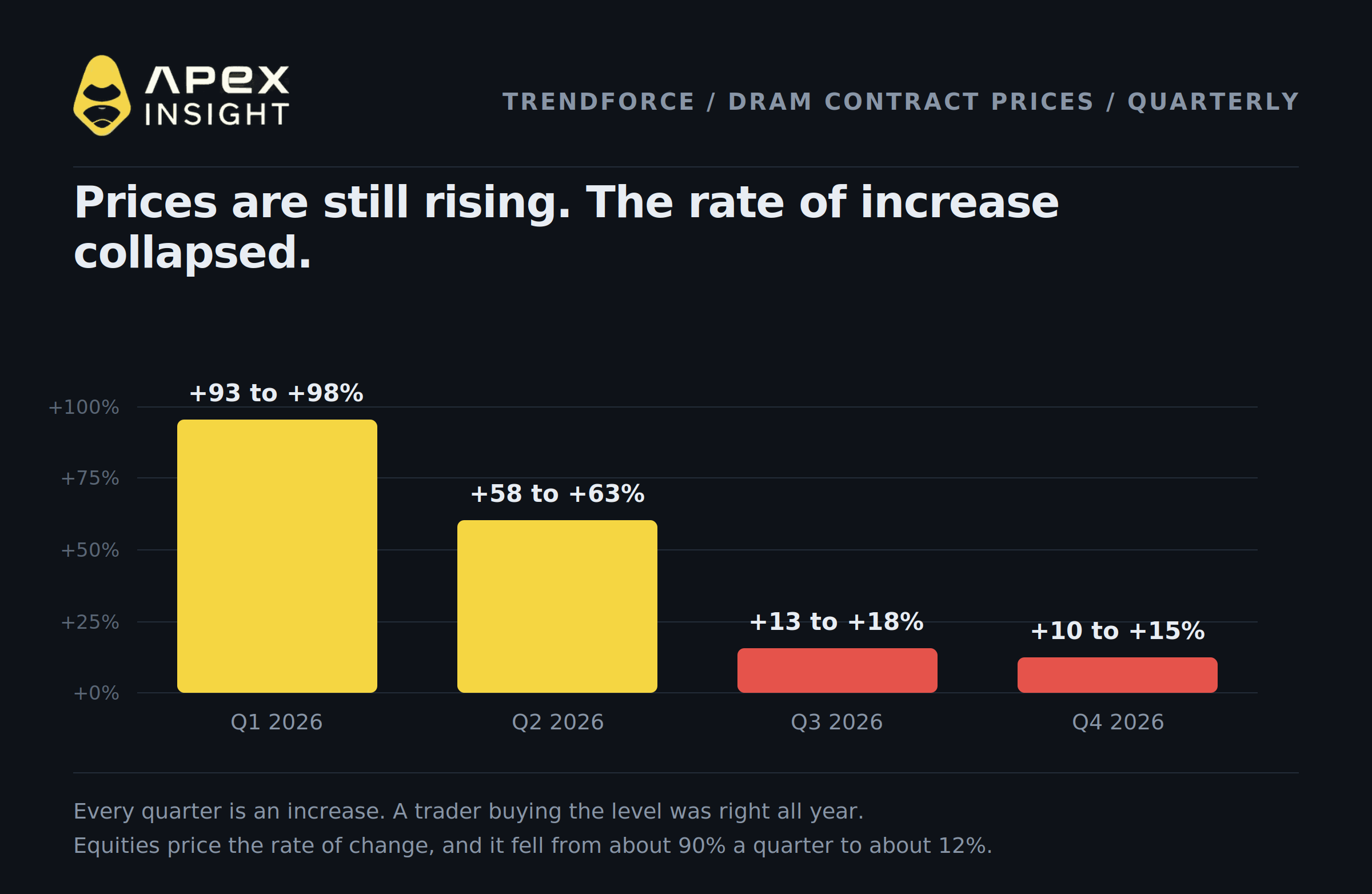
Memory contract prices are still going up. That is not the issue. The issue is how fast.
TrendForce's quarterly contract price changes for conventional DRAM:
Quarter | DRAM contract price change | NAND |
|---|---|---|
Q1 2026 | +93% to +98% | — |
Q2 2026 | +58% to +63% | +70% to +75% |
Q3 2026 | +13% to +18% | +10% to +15% |
Q4 2026 | +10% to +15% | +15% to +20% |
Prices are rising in every one of those quarters. A trader who bought the level would have been right all year. But equities price the rate of change, and the rate of change has fallen from roughly 90% a quarter to roughly 12% in three quarters.
Micron's own results are the clearest illustration. Revenue grew about 379% year on year and gross margin went from 45.7% to 87%. Almost all of that is price rather than volume. When price stops accelerating, so does that arithmetic, and there is nothing in the volume line to replace it.
This is also why the money rotated into logic today. AMD, Marvell and Broadcom are volume stories that are still accelerating. Memory is a price story whose second derivative has already rolled over.
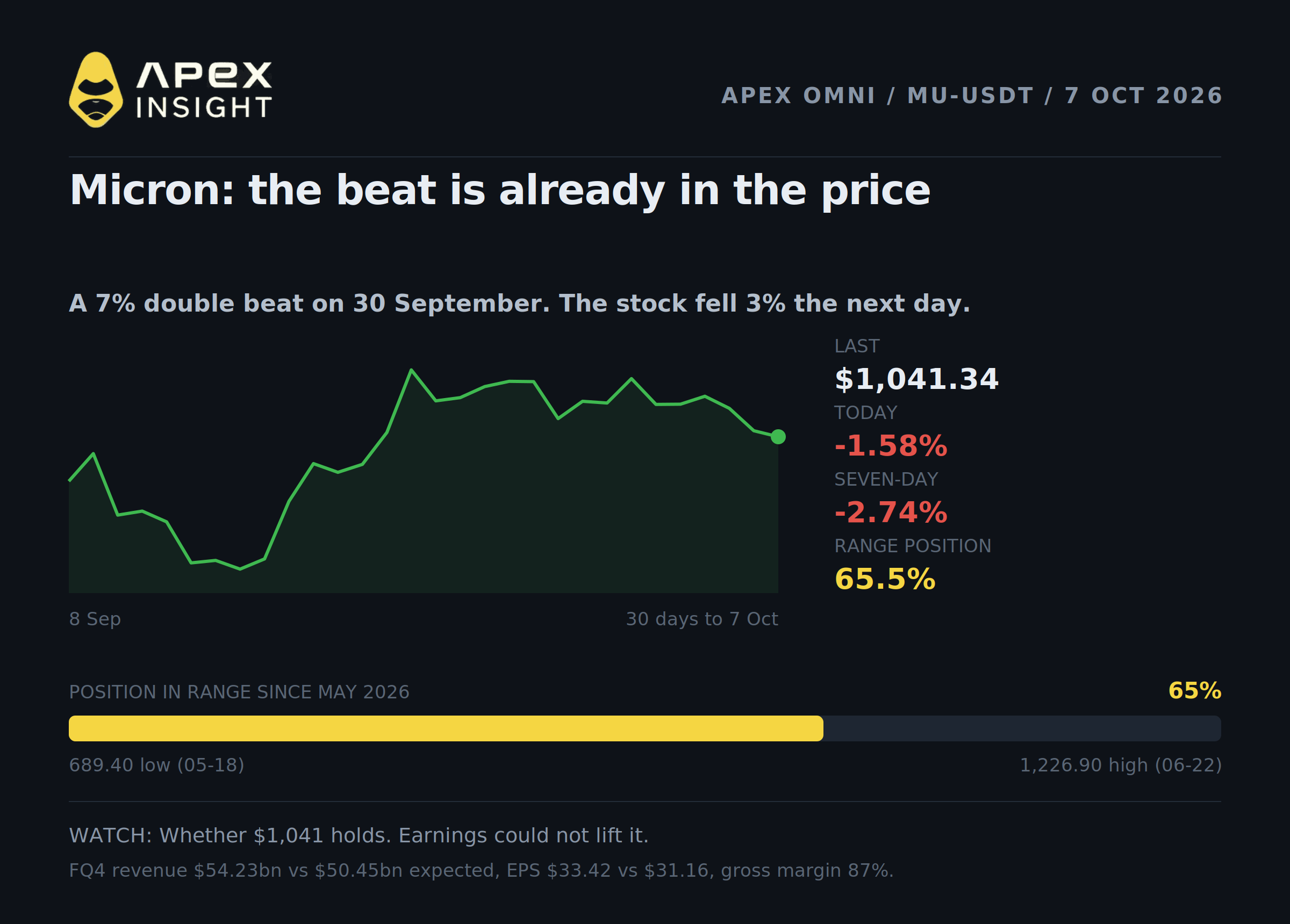
1. Micron: the beat is in the price
MU-USDT, $1,041.34, down 1.58% on the day, 50x maximum leverage
The contract sits at 65.5% of its range since May and is down 2.74% over seven days, which means it has given back ground since the record print rather than extending.
What the quarter actually contained is worth knowing, because the bull case did not weaken. DRAM prices rose in the high teens sequentially and NAND rose about 30%. Micron has 26 strategic customer agreements covering more than 35% of revenue out to 2030, with roughly $32 billion of customer financial commitments behind them. About three quarters of that agreement revenue sits inside a defined pricing framework, and most of those frameworks carry floor and ceiling bands. Most of next year's high bandwidth memory volume is already sold.
The problem is that all of it was expected. When a company beats by 7% on both lines, raises guidance, and the stock falls, the market is telling you the information was already discounted. Analysts kept raising targets afterwards, with Rosenblatt going to $1,900, and the stock still did not hold the gain.
One detail from the call that got less attention than it deserved: management said high bandwidth memory margins are narrower than conventional DRAM margins at current prices. That caps how much the mix shift toward AI memory can lift the blended number, and it is a reasonable part of why the beat did not re-rate the stock.
Watch: whether $1,041 holds. A record quarter that cannot lift a share price usually means the next move is decided by something other than earnings.
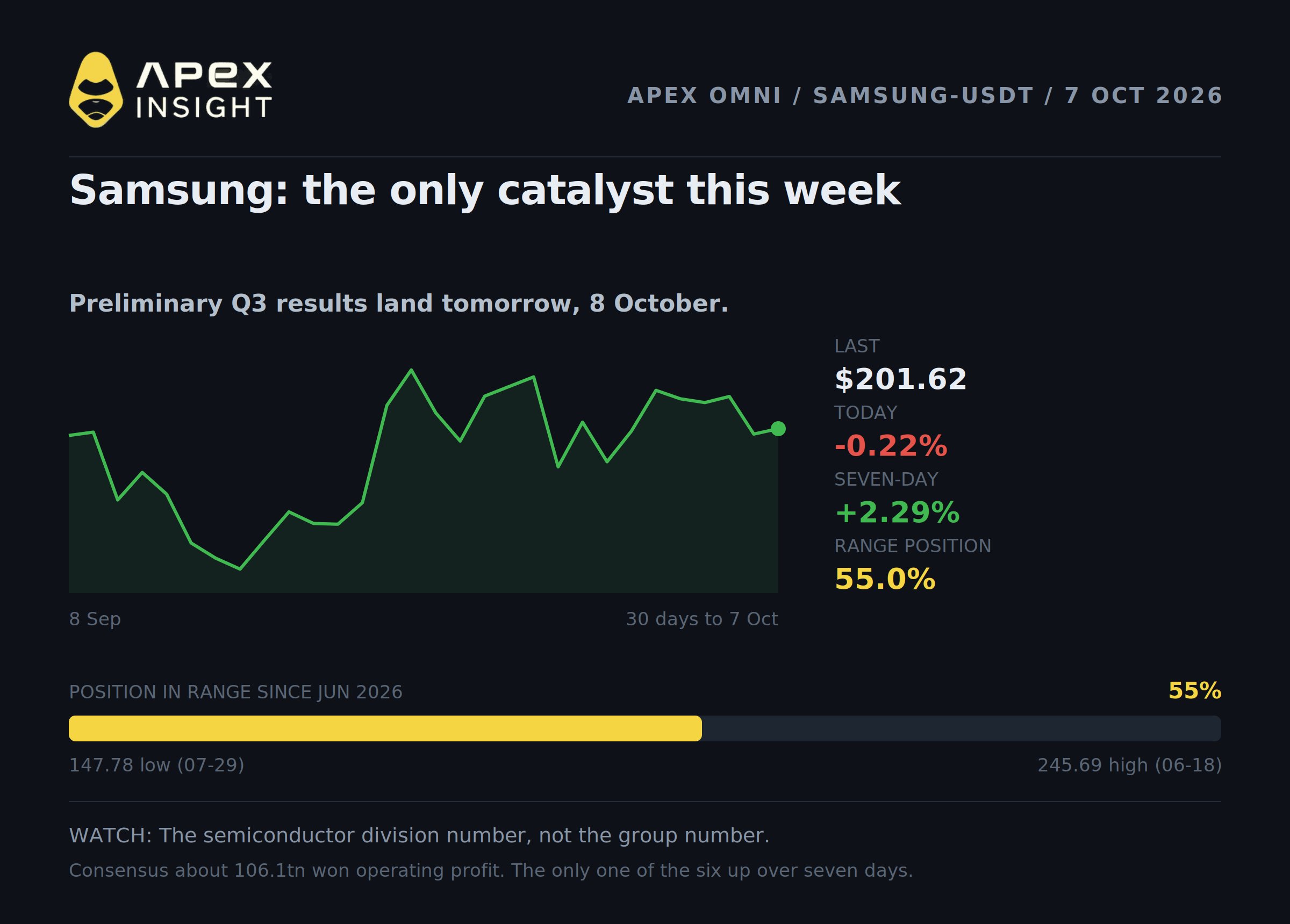
2. Samsung: the only one with a catalyst tomorrow
SAMSUNG-USDT, $201.62, down 0.22% on the day, 50x maximum leverage
Samsung publishes preliminary third quarter results on Thursday October 8. That is the single scheduled memory catalyst inside this campaign week, and it is the reason the complex is trading cautiously rather than the reason it is falling.
Consensus is for roughly 106.1 trillion won of group operating profit, with sell-side estimates for the semiconductor division alone running near 110 trillion won. Sell-side assumptions for the quarter put DRAM average selling prices up in the mid to high teens sequentially.
Samsung is also the only name in this group that is up over the past seven days, by 2.29%, and it sits mid-range at 55.0%. That is an unusual combination going into a print: relative strength without an extended position.
Two things make this more interesting than a normal earnings day. Samsung cleared Nvidia's HBM4 certification in June, and JPMorgan expects its share of the high bandwidth memory market to rise to about 34% this year from 20%. Against that, Goldman has flagged four events converging on October 8: preliminary earnings, semiconductor ETF rebalancing, options expiry and the completion of a buyback. That combination mechanically pushes fund flows around the stock regardless of what the numbers say.
Watch: the semiconductor division number rather than the group number, and whether the stock can hold its seven-day outperformance through the print.
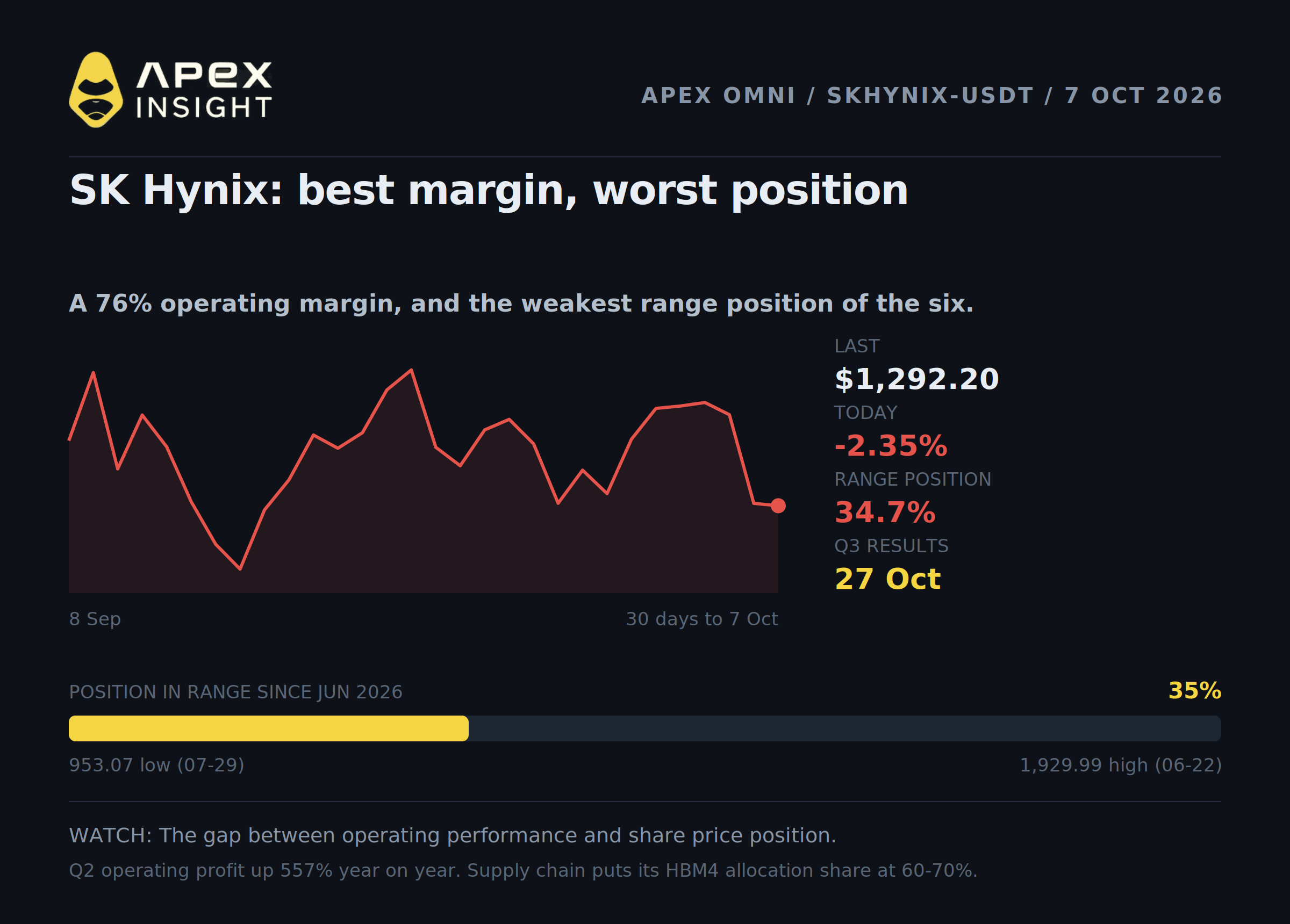
3. SK Hynix: a 76% operating margin at the bottom of its range
SKHYNIX-USDT, $1,292.20, down 2.35% on the day, 50x maximum leverage
This is the one that does not look like the others. SK Hynix sits at 34.7% of its range, the weakest position of all six, despite reporting what may be the most profitable quarter of any large manufacturer anywhere.
Second quarter revenue was 79.32 trillion won, up 257% year on year. Operating profit was 60.54 trillion won, up 557%, for an operating margin of 76%. Net income rose 1,242%.
It also has the strongest competitive position in the group. SK Hynix began mass shipments of HBM4 in the second quarter, and while Nvidia certified all three majors for its Vera Rubin platform in June, supply chain estimates put SK Hynix's share of HBM4 allocation at 60% to 70%. The company has said HBM4 demand exceeds its capacity for the next three years.
So why is it at the bottom of its range? Two reasons worth separating. It listed ADRs on Nasdaq in July in a raise of up to $29 billion, a record for an ADR offering, which expanded the float considerably. And it is the last major memory supplier to report third quarter results, on October 27, which leaves it carrying event risk for three weeks longer than its peers.
Watch: this is the widest gap in the group between operating performance and share price position. That gap either closes or it is telling you something the margin does not.
4. SanDisk: the biggest faller and the biggest winner
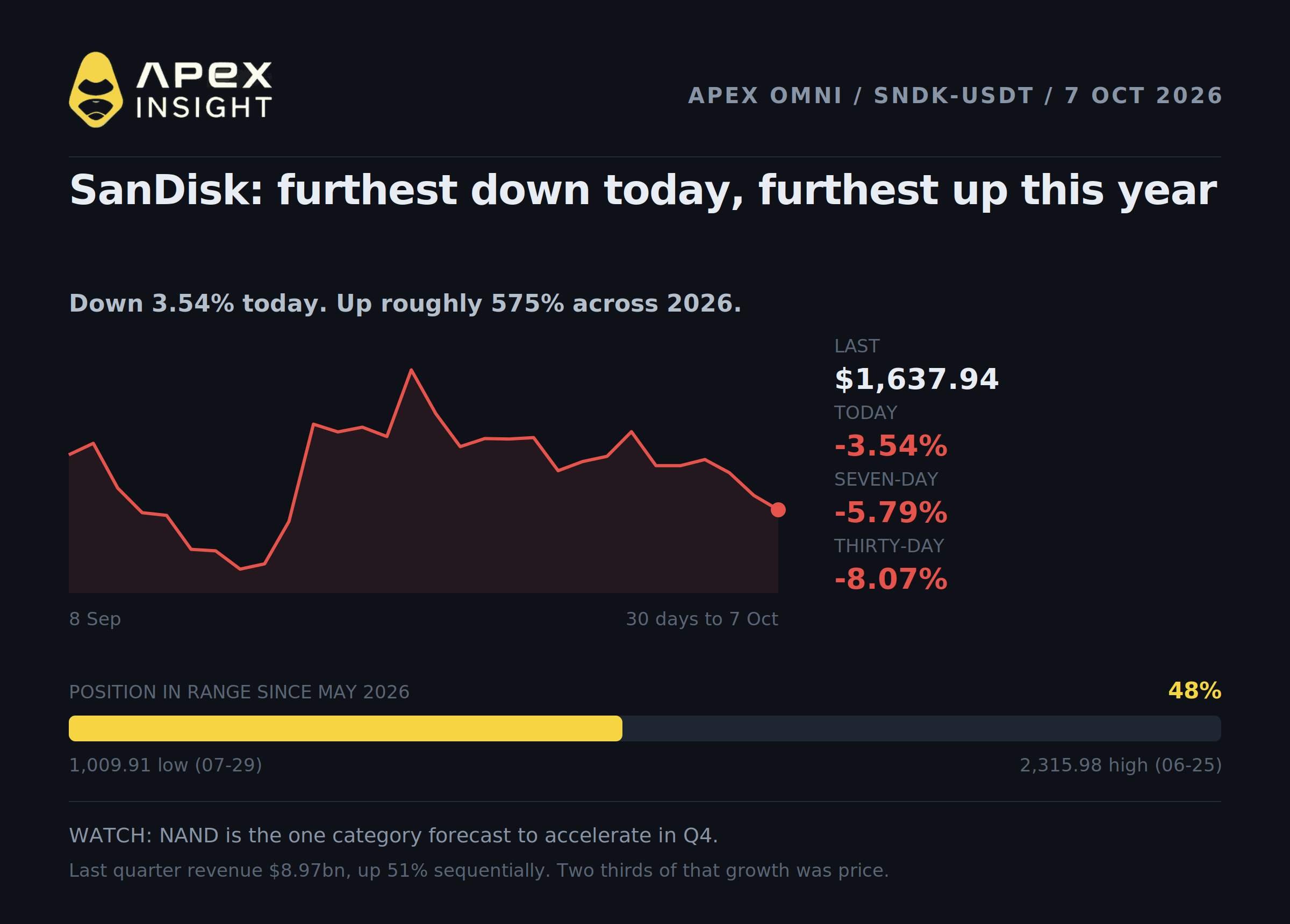
SNDK-USDT, $1,637.94, down 3.54% on the day, 50x maximum leverage
SanDisk is down the most of the six today, down 5.79% over seven days and 8.07% over thirty, and sits at 48.1% of its range.
It is also up roughly 575% across 2026.
Its most recent quarter produced $8.97 billion of revenue, up 51% sequentially, with guidance for $10.3 to $10.8 billion this quarter at an 83% to 85% gross margin. Roughly two thirds of that sequential growth came from price and one third from volume, which is the cleanest expression in this group of how dependent the sector is on pricing rather than units.
That dependence is why SanDisk falls hardest when the pricing narrative wobbles. It is the most levered name here to the one variable that is decelerating.
There is a second overhang specific to NAND. Kioxia's chief executive said in September that memory prices have risen enough, that he had instructed his sales team not to push significant further increases on data centre operators, and that pushing too hard would damage long term demand. Samsung, SK Hynix and Micron did not follow, so the restraint is unilateral and probably ineffective, but it is the first public statement from a major supplier that the price run has a ceiling.
Watch: NAND is the one category where Q4 contract price growth is forecast to accelerate, at 15% to 20% against DRAM's 10% to 15%. If that holds, SanDisk is mispriced relative to the group. If it does not, it falls furthest.
5. The DRAM ETF: three quarters of it is already on this list
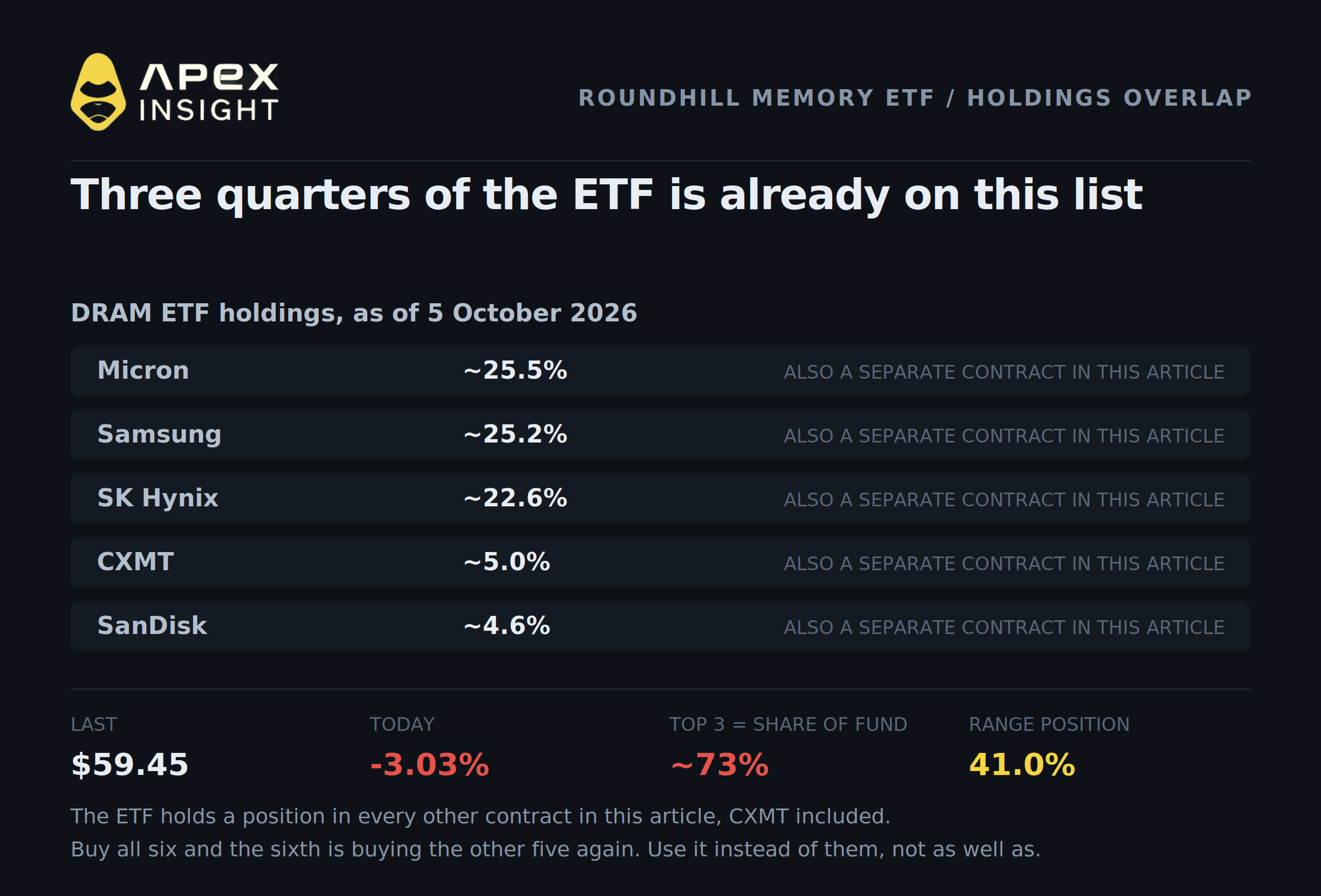
DRAM-USDT, $59.45, down 3.03% on the day, 50x maximum leverage
This one needs a disclosure rather than a pitch.
DRAM is the Roundhill Memory ETF, launched in April 2026, holding companies that derive at least half their revenue or profit from memory. On its holdings file dated October 5, Micron is the largest position at about 25.5%, Samsung is about 25.2% and SK Hynix about 22.6%. Those three alone are roughly 73% of the fund.
Which means that if you are long Micron, Samsung, SK Hynix and the DRAM ETF, you do not have four positions. You have one position, sized four times, with the last leg quietly re-buying the first three.
It goes further than that. The same October 5 file shows SanDisk at about 4.6% and CXMT at about 5.0%, which means the ETF now carries a position in every single one of the other five contracts in this article. Buy all six and the sixth one is buying the other five again.
That matters for a volume campaign specifically. Spreading 5,000 USDT across five memory contracts feels diversified and is not. One adverse headline on DRAM contract pricing moves all of them together, and a trader holding the full basket at leverage discovers the correlation at the worst possible moment.
The ETF is a reasonable instrument if you want the sector in a single line and do not want to pick between the three Korean and American majors. It is a poor instrument to hold alongside them.
Watch: use it instead of the single names, not as well as.
6. CXMT: the only one of the six that is a different bet
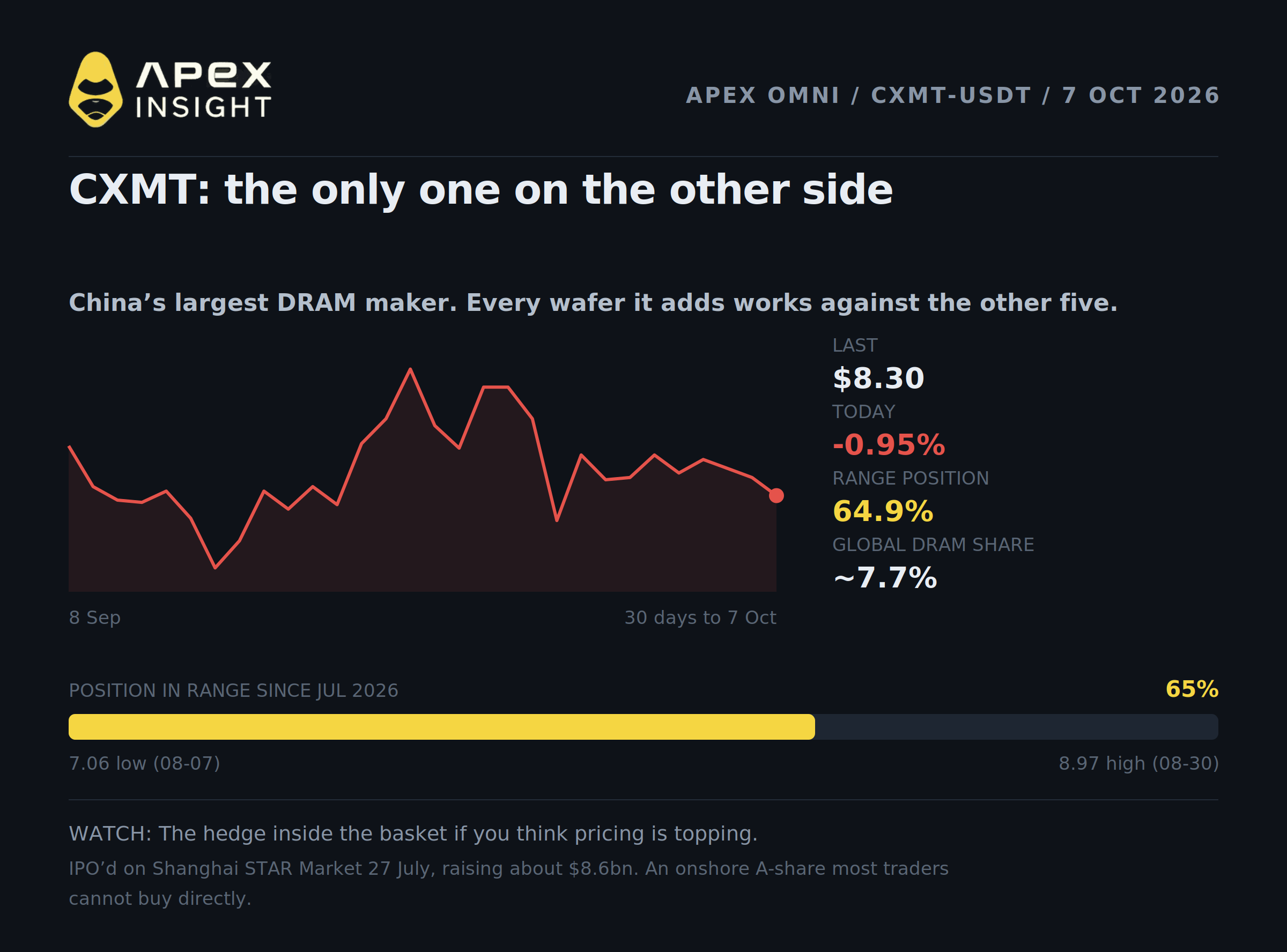
CXMT-USDT, $8.30, down 0.95% on the day, 50x maximum leverage
ChangXin Memory Technologies is China's largest DRAM manufacturer. It listed on Shanghai's STAR Market on July 27 this year, raising about $8.6 billion in Asia's largest IPO of 2026, and opened about 465% above its offer price.
It is the only contract in this group that is not substantially the same trade as the other five, for two reasons. The caveat from the previous section applies: the DRAM ETF now holds about 5% in CXMT, so the two legs are not fully independent of each other either.
The first is structural. CXMT is an onshore A-share. Most traders outside China cannot buy it directly. A perpetual contract is one of the few ways to express a view on it at all, which is a more defensible reason for a tokenised contract to exist than simply mirroring a stock you could already buy.
The second is that it is on the opposite side of the trade. CXMT held roughly 7.7% of the global DRAM market in 2025, making it the world's fourth largest DRAM maker, and is expanding aggressively. It runs around 300,000 wafer starts per month across three fabs, with further capacity being built near Shanghai and Hefei and a sixth fab planned for Beijing. IPO proceeds are earmarked for DDR5 and high bandwidth memory capacity. Every wafer CXMT adds is supply that works against the pricing power the other five names depend on.
The constraint is real: export controls prevent Chinese manufacturers from acquiring the equipment needed for 18 nanometre class DRAM and below. CXMT has nonetheless demonstrated DDR5-8000 and LPDDR5X-10667 parts, which is further than most expected.
At $8.30 the contract sits at 64.9% of its range since July and is the second smallest faller of the six today.
Watch: this is the hedge inside the basket. If you believe the pricing cycle is topping, it is the only one of the six that benefits from being right.
What is actually coming this week
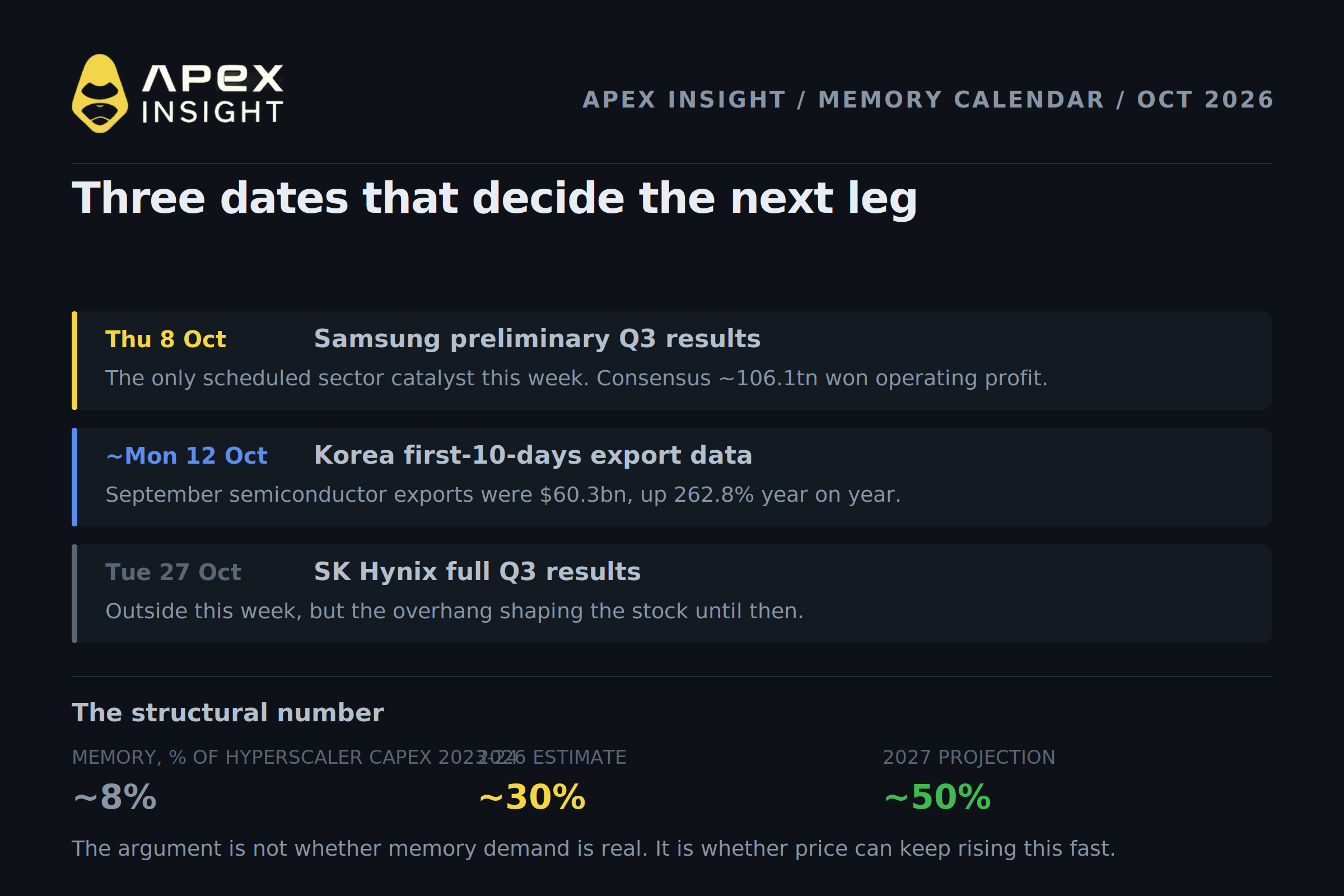
Three things worth having in the calendar.
Thursday October 8. Samsung preliminary third quarter results. The only scheduled sector catalyst inside this week.
Around Monday October 12. Korean customs publishes export data for the first ten days of October, typically on the 11th to 13th. September's figures were extraordinary: total exports of $120.94 billion, the first month above $120 billion, with semiconductors at $60.3 billion, up 262.8% year on year and accounting for 49.9% of everything South Korea sold abroad. Memory specifically rose 358.6%. The ten-day print is the earliest read on whether that is continuing.
Tuesday October 27. SK Hynix full third quarter results. Outside this week, but it is the overhang shaping how the stock trades until then.
One number for the longer view. Memory was about 8% of hyperscaler capital expenditure in 2023 and 2024. SemiAnalysis estimates it reaches about 30% this year, and some projections put it near 50% by 2027. That is the structural case, and nothing in this week's price action contradicts it. The question these six contracts are arguing about is not whether memory demand is real. It is whether the price of it can keep rising at the rate already in the share prices.
Trade it
All six contracts are live on ApeX Omni with up to 50x leverage.
While you are on the board, the Daily Trading Check-In is running and pays you for showing up.
Register on the campaign page.
Trade perpetuals. Reach 5,000 USDT in perpetual volume inside a single UTC day.
Earn 10 USDT. Each qualifying day pays a 10 USDT Perpetual Trading Bonus.
The campaign runs until October 10 at 24:00 UTC, so there are four check-ins left including today. The total pool is 3,000 USDT, daily rewards are limited and allocated first come, first served, and daily volume resets at 00:00 UTC with no carry-over. Completing your check-in early in the UTC day is the difference between collecting and missing the allocation.
Note that the check-in counts eligible Perpetual volume. If you intend to clear it on a stock contract rather than a crypto one, confirm with ApeX support that it qualifies before relying on it.
We appreciate your continued support.
Published by ApeX. For informational and educational purposes only. Not investment advice. Trading involves risk, including total loss. Leveraged trading carries additional risk of liquidation.