



TL;DR
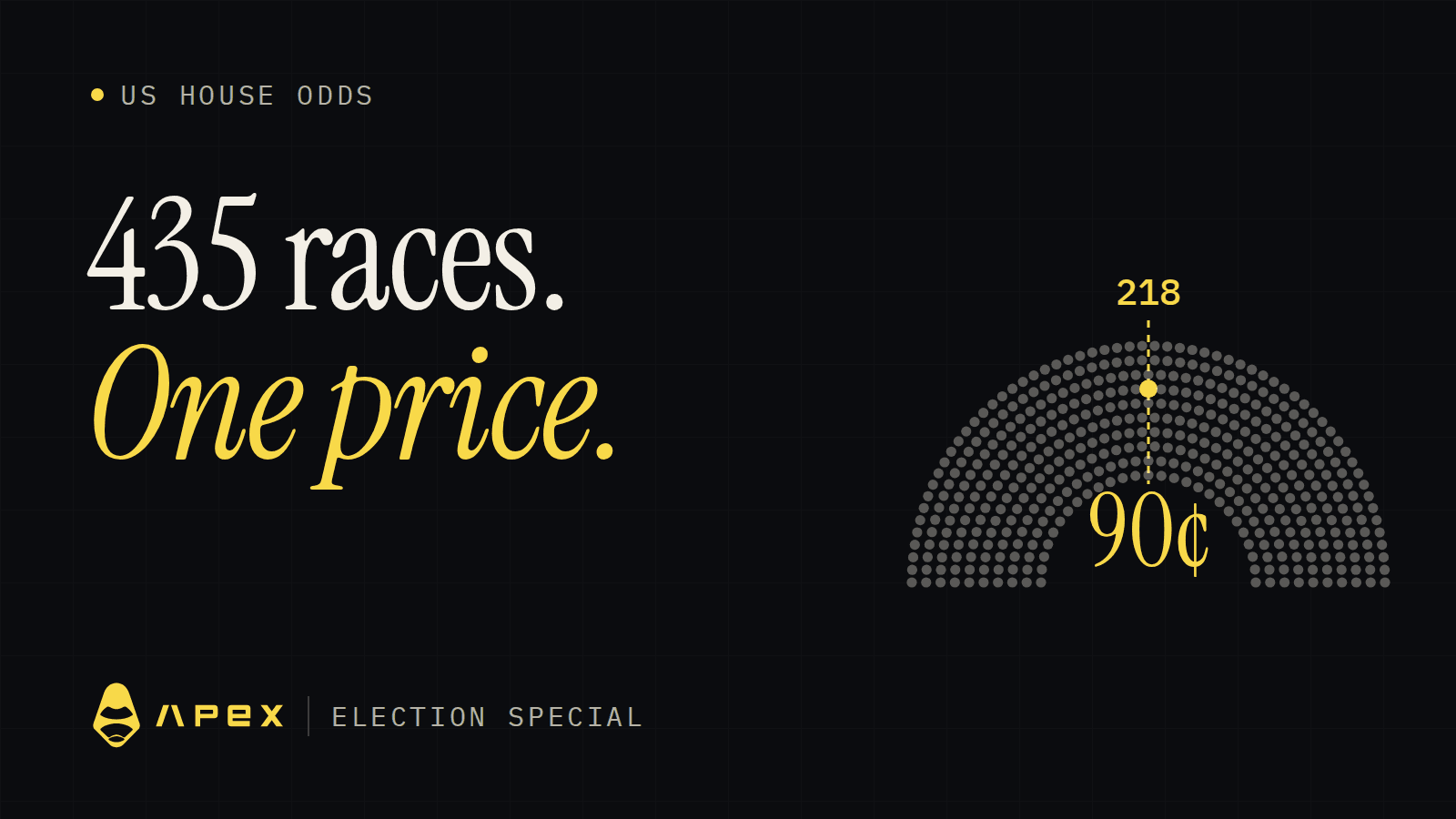
On a prediction market, "Which party wins the House?" is one share priced between $0 and $1. That price sums up 435 separate races.
It moves before anyone votes: new maps, who runs, the national mood, money and news all push it.
A 90-cent favorite can still lose, and a small price move can mean a big percentage gain or loss. Size by what you could lose.
A price that climbed with no votes cast
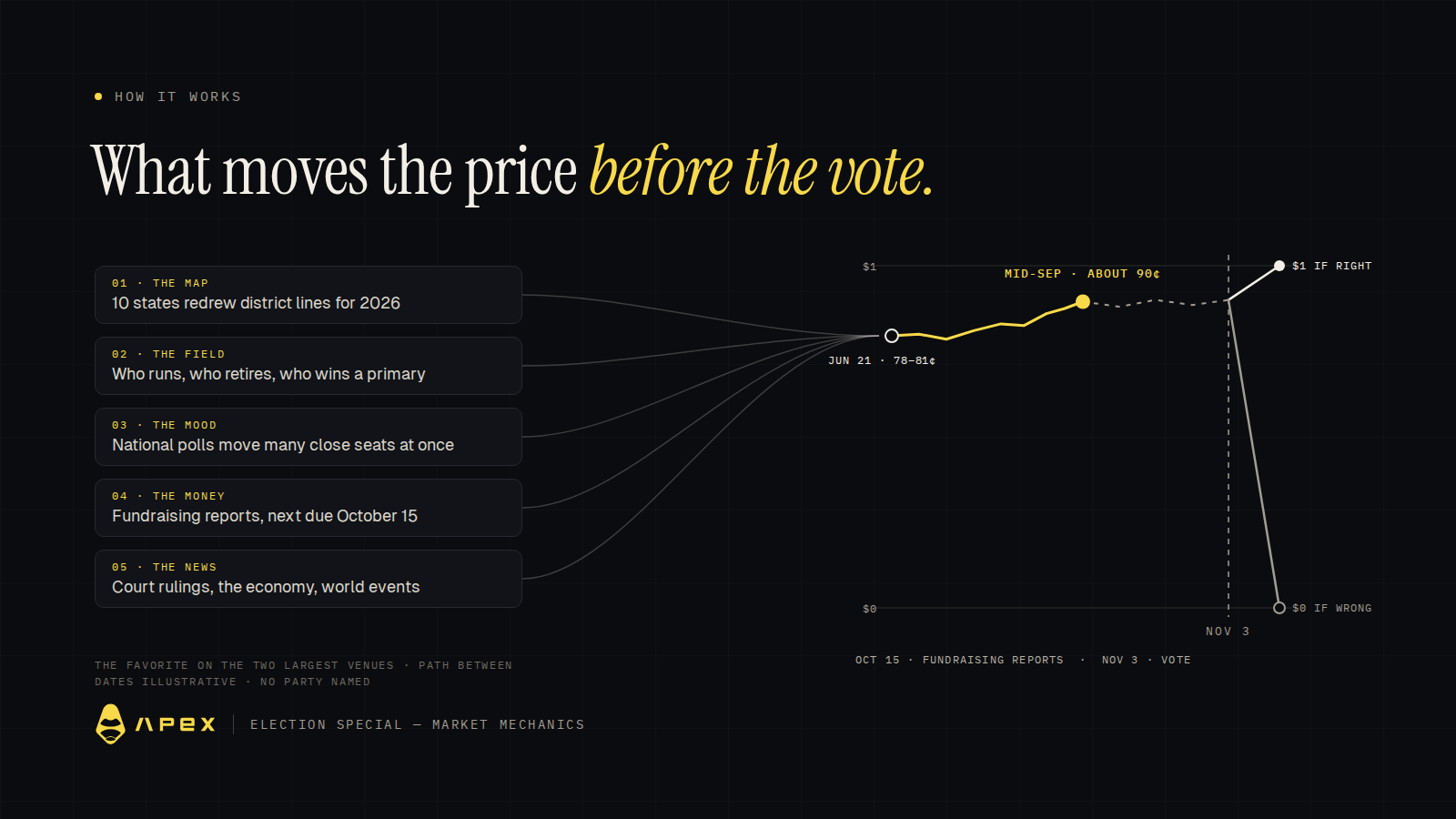
On June 21, 2026, the favorite to control the US House after the midterms traded at 78 cents on one of the two biggest prediction markets and 81 cents on the other.
By mid-September, the same share was near 90 cents. On one of those markets it set a record.
Not one ballot had been counted. Election Day is November 3. The price moved anyway, week after week, because traders kept learning things.
That's the idea behind this piece. The House isn't decided on one night. It gets priced every day until then.
What you're actually buying
A House-control market asks one question: which party will hold a majority after the election? Each "yes" share pays $1 if that party wins control and $0 if it doesn't.
So the price reads like odds. A share at 90 cents means traders, as a group, see about a 90% chance. It's like a weather app saying "90% chance of sun." Most days you'll be right. Some days it rains.
Here's what makes the House special. There are 435 seats, and every one is up for election every two years. A party needs 218 to control the chamber.
So one price is really a summary of 435 contests. Think of a class average: one number, but it rises and falls with every student's grade.
What moves House odds before anyone votes
Five things do most of the pushing.
The map. District lines decide who votes in each race. Normally they're redrawn once a decade. For 2026, 10 states drew new maps, and those states hold about two in five House seats.
The field. Who runs matters. A popular member retiring, or a weak candidate winning a primary, can turn a safe seat into a close one.
The mood. National polls ask which party people plan to vote for. When that shifts, many close races shift together.
The money. Campaigns report their fundraising on a set schedule. The next reports cover the quarter ending September 30 and are due October 15.
The news. Court rulings, scandals, the economy and world events can move a whole chamber's odds in a day.
None of these needs a single vote. Each one changes what traders expect, so they buy or sell, and the price moves.
A worked example
Say the favorite trades at 90 cents and the underdog at 10 cents. You put $100 on one side. Here's how it can play out, before fees:
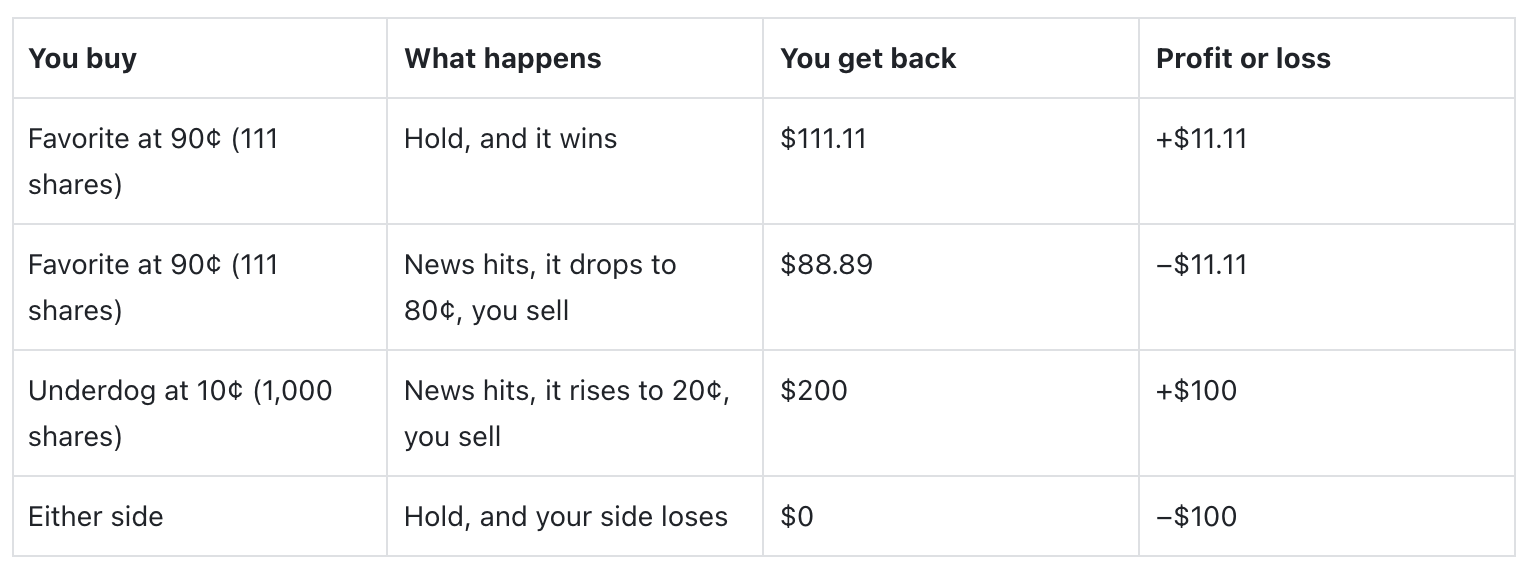
Look at the same 10-cent move. For the favorite, it's an 11% loss. For the underdog, it doubles the money.
That doesn't make the underdog a better buy. If 10 cents is the right price, it loses about nine times in ten. A cheap share isn't a bargain, and an expensive share isn't safe. The price already holds the crowd's view. You only have an edge if you know something it doesn't.
Go deeper
Control vs. seat markets. A control market only asks whether a party reaches 218. Seat-count markets split the outcome into ranges, like "220 to 224 seats." Together they show how lopsided or close traders expect the result to be.
Races move together. If 30 close races were separate coin flips, one party sweeping most of them would be rare. But the same national mood hits them all at once. That shared swing is why a control price can be far more one-sided than any single district.
The long-shot tilt. Studies of horse-race betting have long found that long shots tend to be overpriced and favorites slightly underpriced (Snowberg and Wolfers, 2010). Whether election markets share the tilt is debated, but a 10-cent share may carry less real chance than 10%.
Time costs money. A 90-cent share that pays $1 on November 3 ties up your cash for weeks. Part of that last 10 cents pays for the wait, not just the risk.
Read the resolution rules. Close House races can take days or weeks to call. Each market says which source decides it and when. Check before you trade.
What this means for traders
Watch the map, not just the polls. A redrawn district can change a seat before any campaign ad runs.
Know what your share pays on. Control, seat ranges and single districts are different bets that can move in different ways.
Size by the dollar downside. A 90-cent share feels safe, but it can still go to zero.
Mark the calendar. Fundraising reports (October 15), big polls and court rulings are when odds tend to jump.
Count what you lock in. A gain only becomes real when you sell. Paper gains can vanish before election night.
Live now on ApeX Omni: Political Markets Season, Stage 4
ApeX Omni runs prediction shares on Polymarket's order book. They're priced from $0 to $1, with no leverage and no liquidation, and they settle in PUSD.
• Stage 4, US House Elections: Sep 28 to Oct 4, 16:00 (UTC+8). It's the last of four weekly stages.
• Two pools: one for trading volume and one for realized PnL, the profit you lock in by selling.
• 6,000 USDT across the season, with a 1.5x volume boost on the featured market.
• No registration. Trade, and you're in.
Campaign page · Full rules · How to trade predictions on ApeX
Glossary
House of Representatives: the larger chamber of the US Congress, with 435 voting seats.
Majority: 218 or more seats, enough to control the House.
Prediction market: a market where people buy and sell shares on whether an event will happen.
Share: a contract that pays $1 if its outcome happens and $0 if it doesn't.
Implied odds: the chance the market gives an outcome, read from its price (90 cents means about 90%).
Redistricting: redrawing the lines of voting districts.
Seat-count market: a market on how many seats a party wins, split into ranges.
Long shot: an outcome with a low price, and so low implied odds.
Realized PnL: profit or loss you've locked in by closing a position.
This article is for education only and is not financial advice. It doesn't favor any party or candidate. Prediction market prices can move fast, and you can lose everything you pay for a share. Prediction markets are restricted in some places, so check the rules where you live. Do your own research.