


TL;DR
On a prediction market, each election outcome has a share priced between $0 and $1.
That price is the crowd’s odds, and it moves every day as news lands, long before anyone votes.
You can buy and sell as the odds change, but odds swing both ways, and you can lose all you paid.
A price that moved with no votes cast
In February 2026, traders on the two biggest prediction markets had a clear favorite to control the US Senate after the midterms. That side’s share traded at about 60 cents.
By September 23, the favorite had flipped. On Polymarket, the other side’s share traded near 66 cents, up from 59 cents a week earlier.
Not one vote had been cast. Election Day is November 3. What changed was the news: a war that began in late February, then months of new polls and forecasts.
That’s the part most people miss. You don’t have to wait for election night to make or lose money on an election. The trade happens every day in between.
What you’re actually buying
A prediction market asks a yes-or-no question, such as “Will Party A win the House?” Each “yes” share pays $1 if the answer is yes and $0 if it’s no.
So a share always costs between $0 and $1, and its price works like odds. A share at 30 cents means traders, as a group, see about a 30% chance. It’s like a weather forecast that says “30% chance of rain”, except people back this one with their own money.
When news arrives, people buy or sell, and the price moves. A strong poll, a debate, a candidate dropping out or a court ruling can shift the odds within minutes.
That gives you two ways to be right:
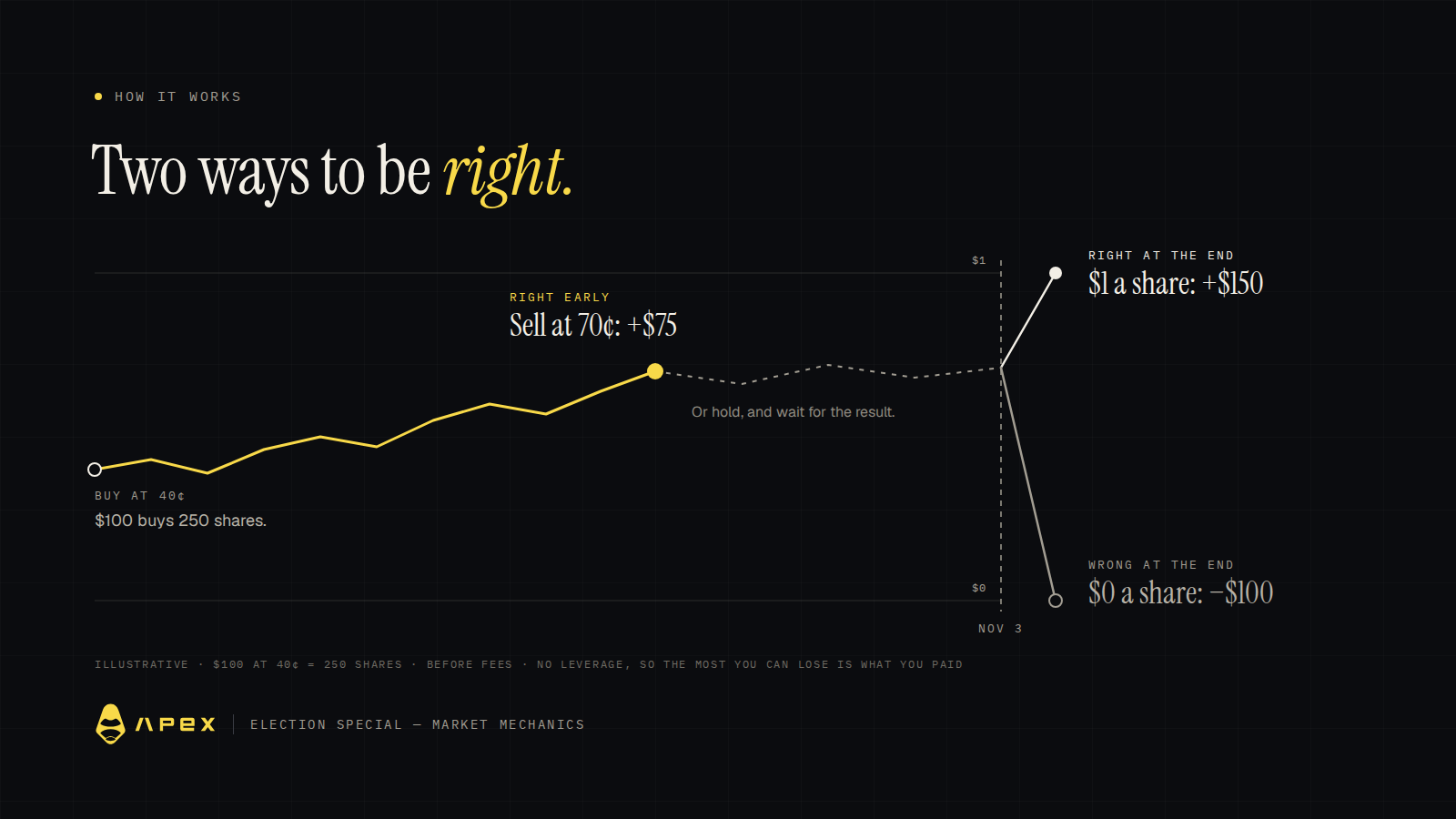
Right at the end. Hold until the result. If your side wins, each share pays $1.
Right early. Buy before the crowd changes its mind, then sell after it does. The election doesn’t need to happen yet.
Being early also frees your money. Hold until November, and your cash sits in the market for weeks. Sell when the odds move, and it’s yours again.
A worked example
Say a share trades at 40 cents and you think the real chance is higher. You put in $100, which buys 250 shares. Here’s how four endings play out, before fees:
What happens | You get back | Profit or loss |
Odds rise to 70 cents; you sell | $175 | +$75 |
You hold, and your side wins | $250 | +$150 |
Odds fall to 25 cents; you sell | $62.50 | −$37.50 |
You hold, and your side loses | $0 | −$100 |
Two things stand out. The 70-cent sale made money weeks before any result. And the worst case is losing the $100 you paid. There’s no leverage, so nothing more can be taken. But losing all of it is a real outcome.
Go deeper
Price is close to probability, not equal to it. A price also carries the trading fee, the gap between buy and sell prices, and the cost of waiting. A 95-cent share that pays $1 in six weeks earns about 5.3% for tying up the money. So 60 cents means “about 60%”, not exactly 60%.
Both sides add up to about $1. Yes and no on the same question should sum to roughly $1. Anything above that is the spread you pay to trade.
Odds are not promises. A 66-cent favorite still loses about one time in three. In 2026, prediction markets heavily favored a candidate who then lost a primary for Wisconsin governor. The polls missed that race too.
Venues disagree. On September 16, Polymarket priced one side of the Senate race at 59%. Another large prediction market priced the same outcome near 55%. Different traders, different money, different prices.
Read the rules. Each market states what counts as “yes”, which source decides it, and when. Two markets with similar titles can pay out on different events.
What this means for traders
Treat the price as the crowd’s guess, not the answer. Ask what you know that the price doesn’t.
Plan both exits before you buy. Pick the price you’d sell at if you’re right early, and the price you’d sell at if you’re wrong.
Mark the calendar. Debates, big poll releases and deadlines are when odds can jump.
Size it as money you can lose. Your loss stops at what you paid, but that can be all of it.
Live now on ApeX Omni: Political Markets Season
ApeX Omni runs prediction shares on Polymarket’s order book. They’re priced from $0 to $1, with no leverage and no liquidation, and they settle in PUSD. The Political Markets Season rewards trading the odds before events resolve.
Stage 4, US House Elections: Sep 28 to Oct 4, 16:00 (UTC+8). It’s the last of four weekly stages.
Two pools each stage: one for trading volume and one for realized PnL, the profit you lock in by selling.
6,000 USDT across the season, with a 1.5x volume boost on the featured market.
No registration. Trade, and you’re in.
Glossary
Prediction market: a market where people buy and sell shares on whether an event will happen.
Share: a contract that pays $1 if its outcome happens and $0 if it doesn’t.
Implied odds: the chance the market gives an outcome, read from its price (40 cents means about 40%).
Resolution: the moment a market is settled and winning shares pay out.
Spread: the gap between the best price to buy and the best price to sell.
Realized PnL: profit or loss you’ve locked in by closing a position, as opposed to gains on paper.
Liquidity: how easily you can buy or sell without moving the price.
PUSD: the dollar-pegged token these prediction shares settle in.
This article is for education only and is not financial advice. It doesn’t favor any party or candidate. Prediction market prices can move fast, and you can lose everything you pay for a share. Prediction markets are restricted in some places, so check the rules where you live. Do your own research.