





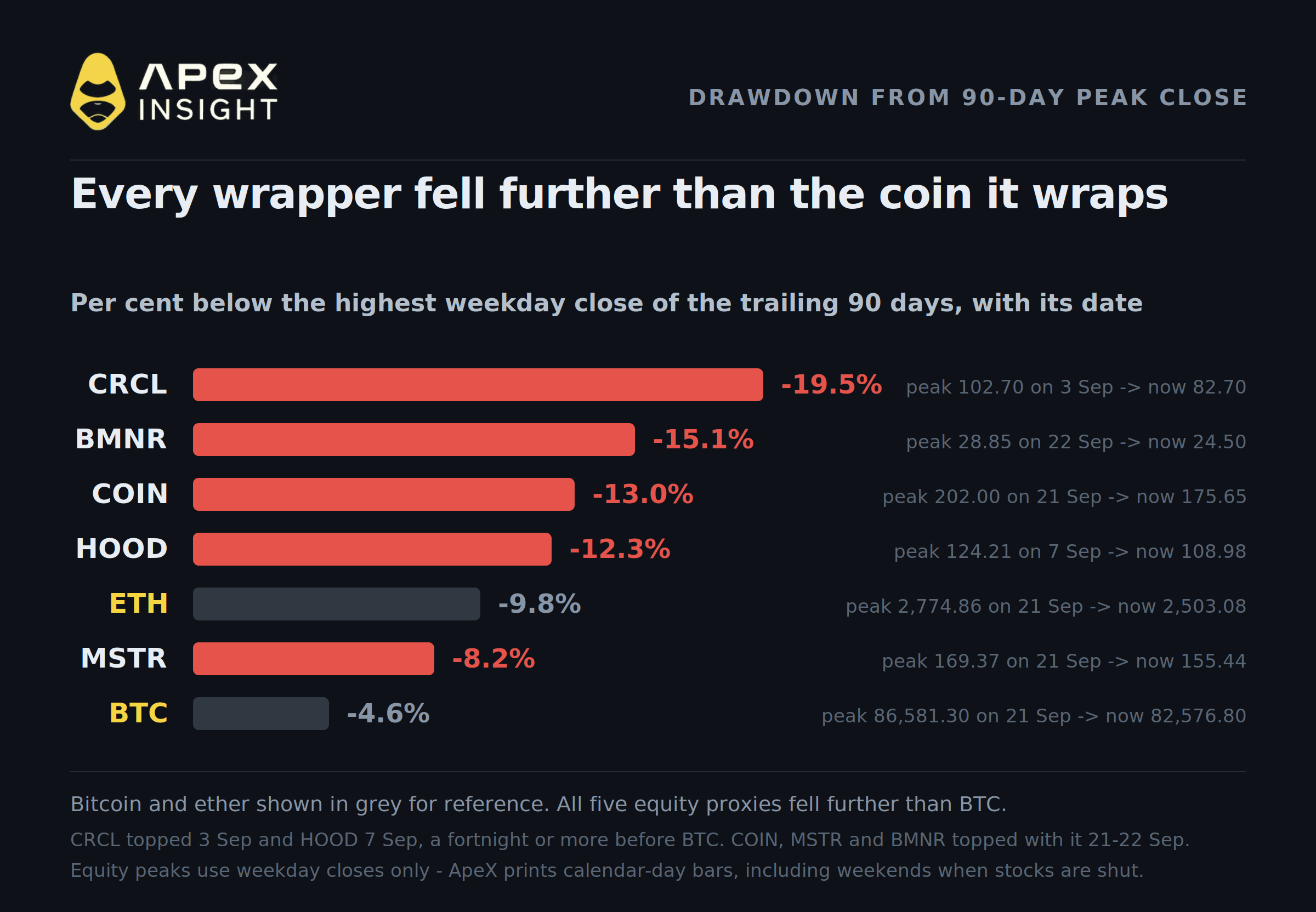
Bitcoin closed at $86,581 on 21 September. As of midday UTC on 9 October it is changing hands around $82,577 on the ApeX index — 4.6% off that high, which is barely a scratch in an asset that has moved 39% annualised over the last month.
Now look at the five equities that exist mainly to give investors exposure to that asset. Every single one of them is further from its own September peak than bitcoin is from its:
Contract | Peak close | Date | Now | From peak |
|---|---|---|---|---|
CRCL | $102.70 | 3 Sep | $82.70 | −19.5% |
BMNR | $28.85 | 22 Sep | $24.52 | −15.1% |
COIN | $202.00 | 21 Sep | $175.75 | −13.0% |
HOOD | $124.21 | 7 Sep | $108.98 | −12.3% |
MSTR | $169.37 | 21 Sep | $155.67 | −8.2% |
BTC | $86,581 | 21 Sep | $82,577 | −4.6% |
ETH | $2,774.86 | 21 Sep | $2,503.08 | −9.8% |
Peaks are the highest weekday close. ApeX prints calendar-day bars on these contracts, so weekend prices exist even though the underlying equity market is shut, and two of these five names set their nominal highs on Sunday 6 September. Those prints are real and tradeable, but they are thin, so every peak above is measured on a session when the underlying was open.
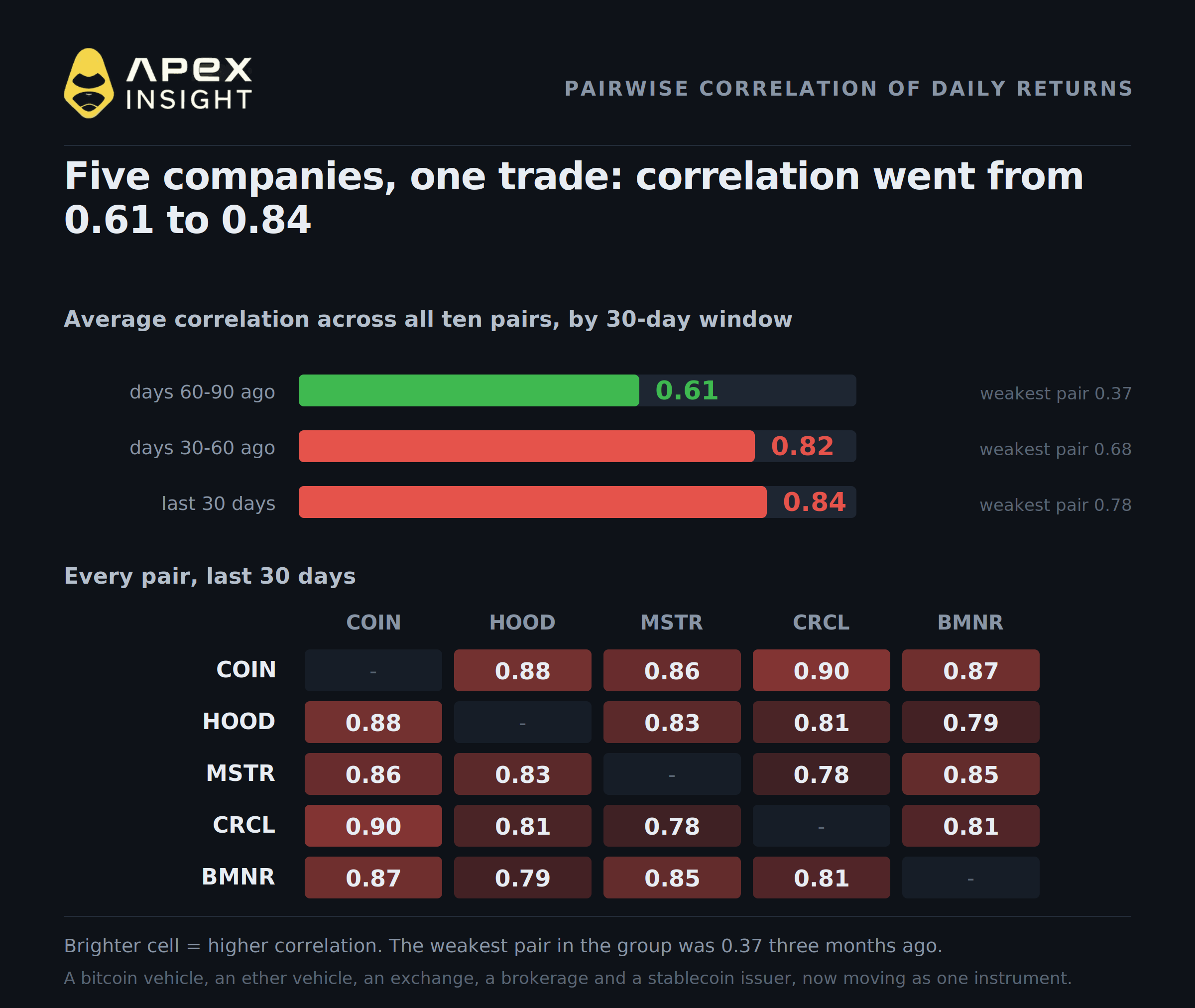
That is the whole article in one table. The coins held. The wrappers broke. And they broke together: over the last thirty days the average pairwise correlation between these five names is 0.84, up from 0.61 in the thirty-day window sixty to ninety days ago. The loosest pair in the group sixty to ninety days ago was BitMine against Robinhood, at 0.37; that pair now sits at 0.79, and the weakest link anywhere in the basket is 0.78.
So the market is treating five companies — a bitcoin holding vehicle, an ether holding vehicle, an exchange, a brokerage and a stablecoin issuer — as a single instrument, at exactly the moment when each one's individual mechanism for generating a premium has stopped working. Those are two separate facts and the second one is the tradeable one.
Here is what actually broke, name by name, ordered by how hard the catalyst is.
1. MSTR — the only one with a date on the calendar
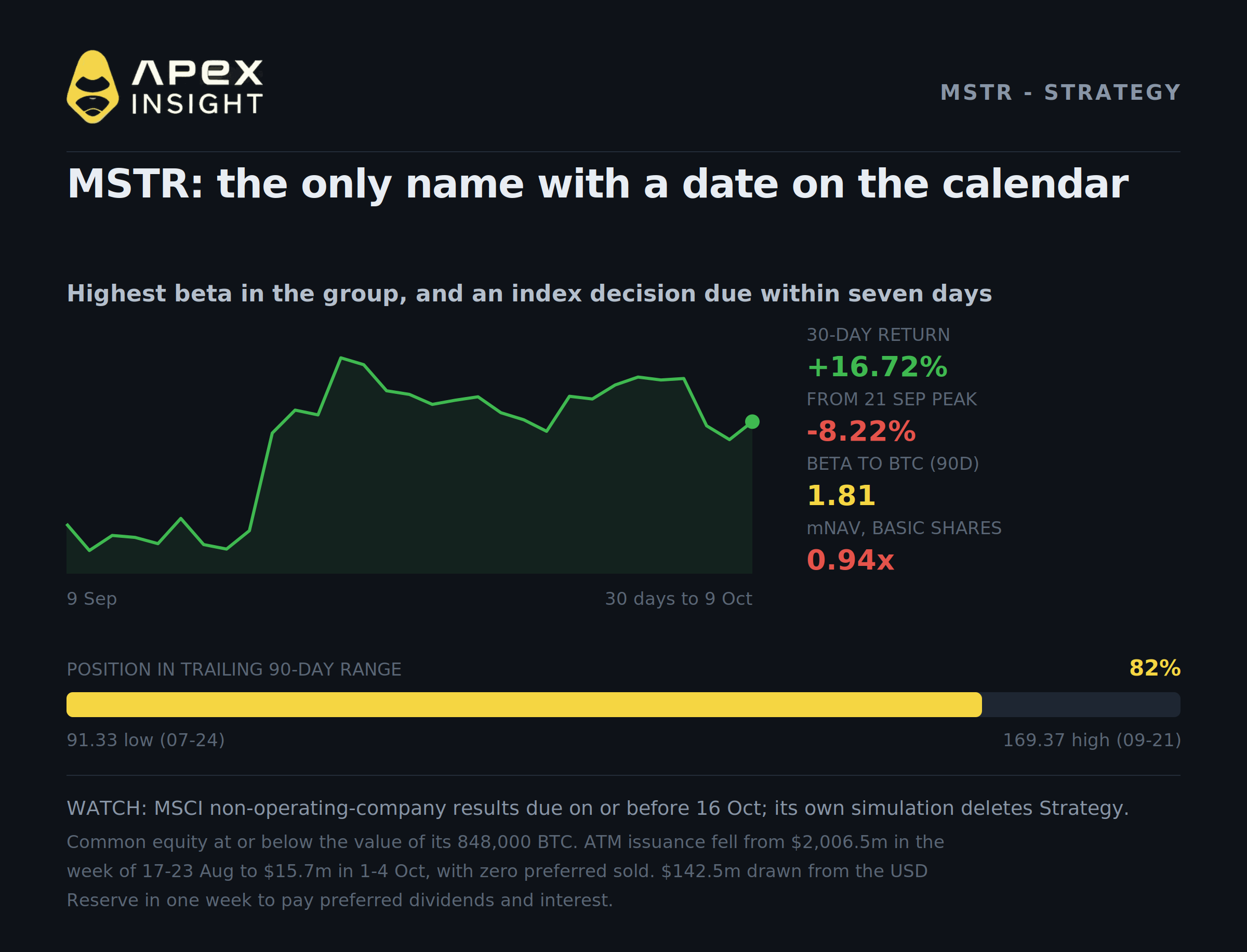
$155.67 · +1.37% on the day · $59,164 turnover · 90-day beta to BTC 1.81
Strategy is the highest-beta, highest-correlation name in the group: 1.81 beta to bitcoin on 90 days of daily returns, and a 30-day correlation of 0.898 that has risen from 0.825 in the prior month. It is also, by range position, the healthiest-looking chart of the five — sitting at 82.2% of its trailing 90-day range against bitcoin's 83.5%, and down only 8.2% from its peak.
That surface calm is hiding the single hardest catalyst in this entire complex.
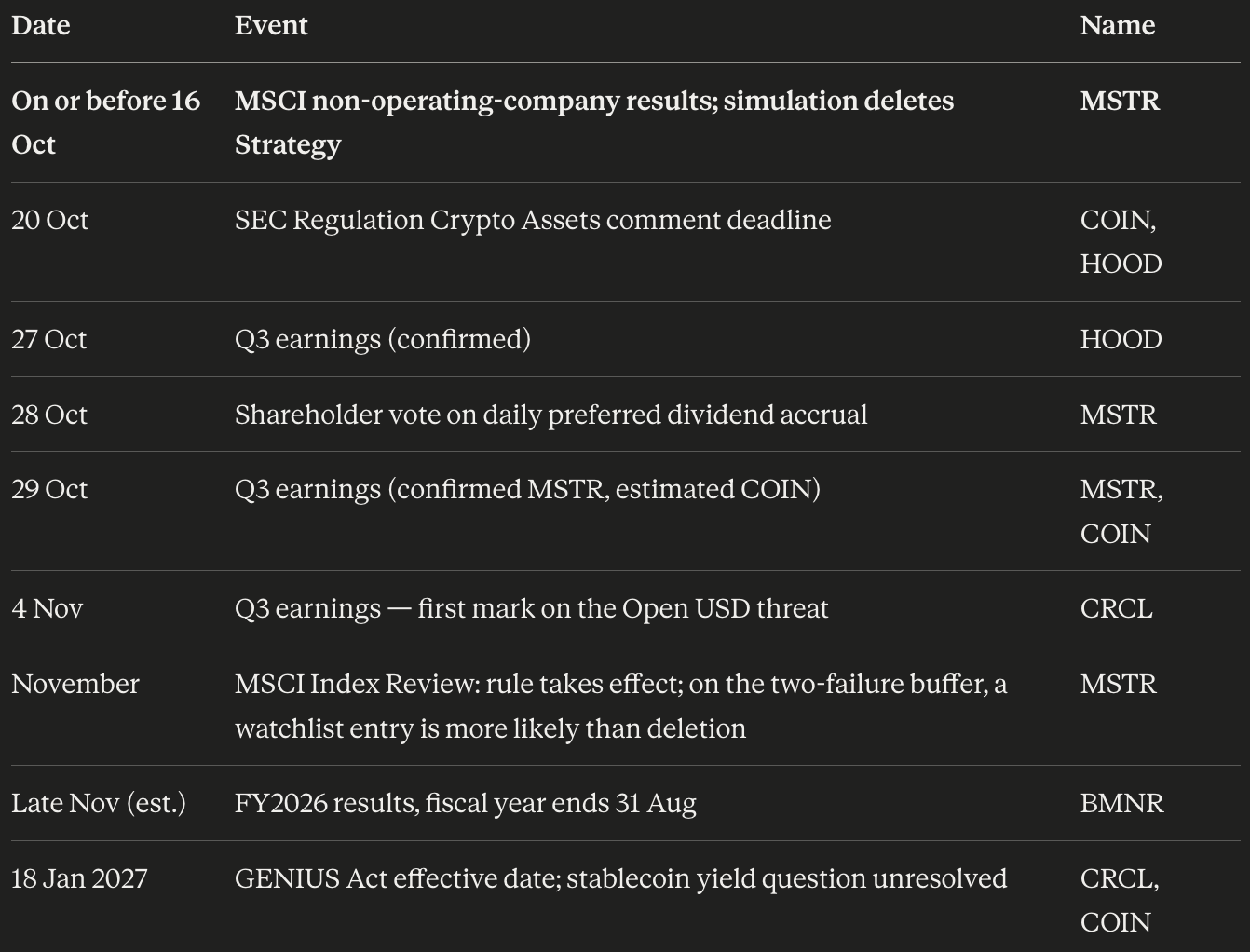
MSCI's consultation on the eligibility of non-operating companies closed on 30 September. Results are due on or before 16 October — seven days from now. MSCI's own published simulation deletes Strategy from the Global Investable Market Indexes. The screen is a two-step test: pass if operating assets exceed 50% of total assets, otherwise get flagged on four of five ratios covering operating-asset intensity, expense intensity, operating cash flow, fair-value intensity and capital dependence. A company holding 848,000 bitcoin against $122.4m of quarterly software revenue fails that test by construction, not by accident.
Worth knowing: MSCI ran this once before. An October 2025 consultation proposed excluding issuers with 50%-plus of assets in digital assets, and on 6 January 2026 MSCI declined to implement it — MSTR rose about 6% on the news. The interim treatment it adopted instead was to leave the treasury companies in but freeze any increases to share counts and float factors. The August 2026 consultation is the broader, tougher version, and existing constituents need two consecutive annual failures before deletion, so the 16 October announcement sets a clock rather than firing a gun. Implementation would run through the November Index Review.
What has already fired is the de-rating. Using ApeX's own BTC index price of $82,577 against Strategy's disclosed 848,000 bitcoin (8-K of 5 October, aggregate cost $63.97bn, average $75,441):
BTC net asset value: $70.0bn
Market cap on 422.07m basic shares: $65.7bn → 0.94x NAV
Market cap on the company's own 451.67m assumed diluted share count: $70.3bn → 1.00x NAV
Strategy's common equity is trading at or below the value of the coins it holds — and it already was at the September top. On the same method, at the 21 September peak close of $169.37 with bitcoin at $86,581, basic mNAV was 0.97x and diluted 1.04x. There was no premium left to lose by then; the de-rating had already happened. Add the ~$6.7bn of converts and ~$15.2bn of preferred and enterprise mNAV is 1.25x — the distinction matters, because the discount is on the common, not on the capital structure sitting above it.
And that discount has switched the machine off. The weekly 8-K filings are unambiguous:
Week | Common sold via ATM | Net proceeds |
|---|---|---|
17–23 Aug | 18,261,118 sh | $2,006.5m |
21–27 Sep | 1,469,165 sh | $246.2m |
28–30 Sep | 0 | $0 |
1–4 Oct | 92,894 sh | $15.7m |
From two billion dollars in a single August week to fifteen million in the first week of October, with zero preferred issuance across any of the four series. This is deliberate: the Digital Credit Capital Framework of 29 June states the company will be "disciplined in issuing common equity, especially when the stock trades at or near 1x mNAV per share." It is now buying its preferred back instead — $328.0m of STRC across the last three reported weeks, against $547.2m of capacity left under the digital-credit repurchase programme as a whole.
The obligation does not pause with the issuance. Preferred dividends plus debt interest run roughly $1.74bn a year, and in the week of 28 September to 4 October the company drew $142.5m from its USD Reserve to service them. Liquidity stands at $5.71bn, down from $6.69bn in late August — roughly 39 months of cover against a board policy requiring twelve. It has also now sold bitcoin for this purpose twice: 3,588 BTC around the turn of June and July, and 1,638 BTC in late July and early August.
What to watch: the MSCI announcement on or before 16 October, Q3 earnings on 29 October (with a pre-announced ~$20.9bn fair-value gain), and the 28 October shareholder vote on moving the preferreds to daily dividend accrual. Sell-side positioning is long into this: Citi raised its target from $136 to $240 on 2 October, and the most recent cut on record is Bernstein's from $450 to $350 on 26 August.
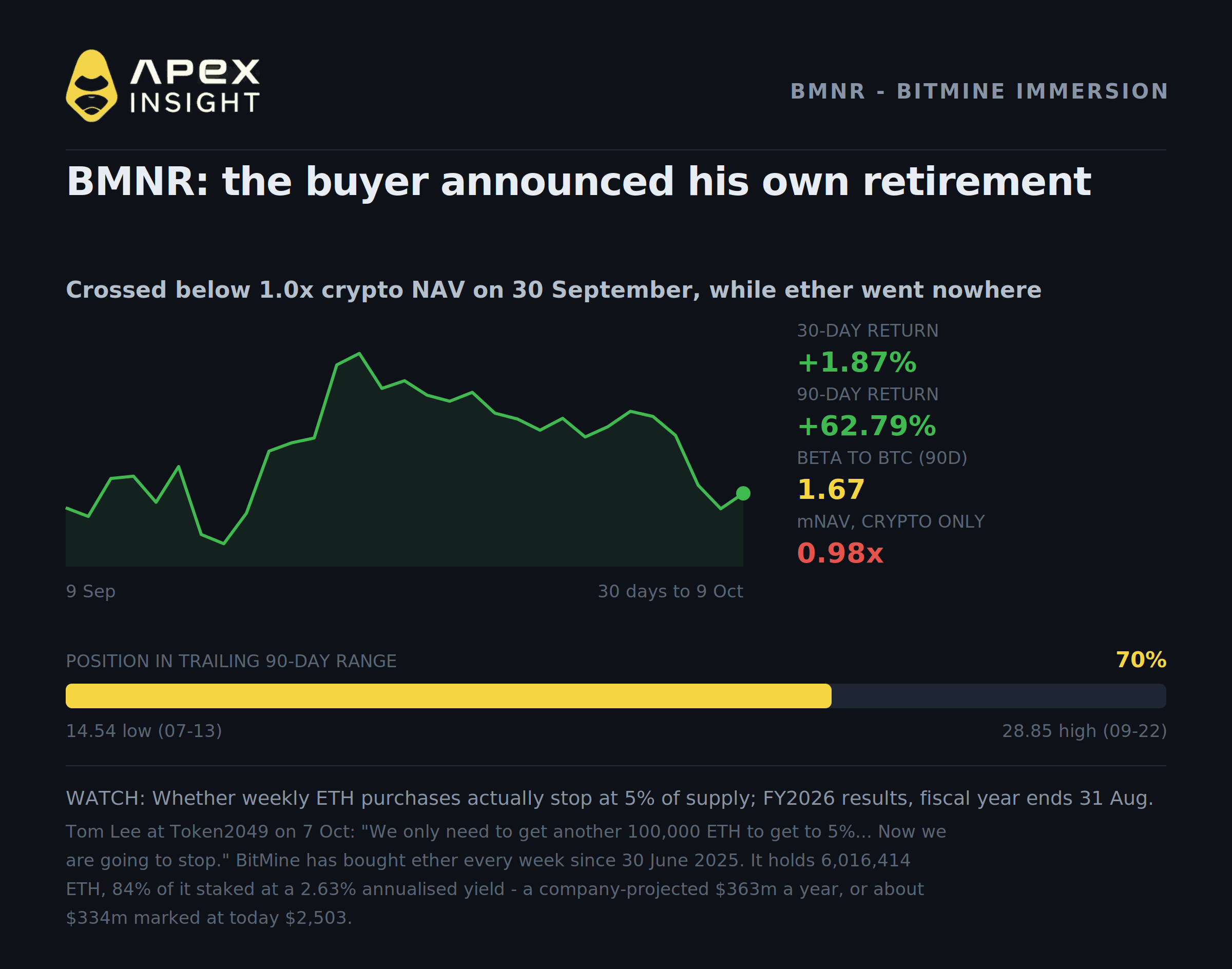
2. BMNR — the buyer announced his own retirement
$24.52 · −0.37% on the day · $21,482 turnover · 1,298 contracts open interest
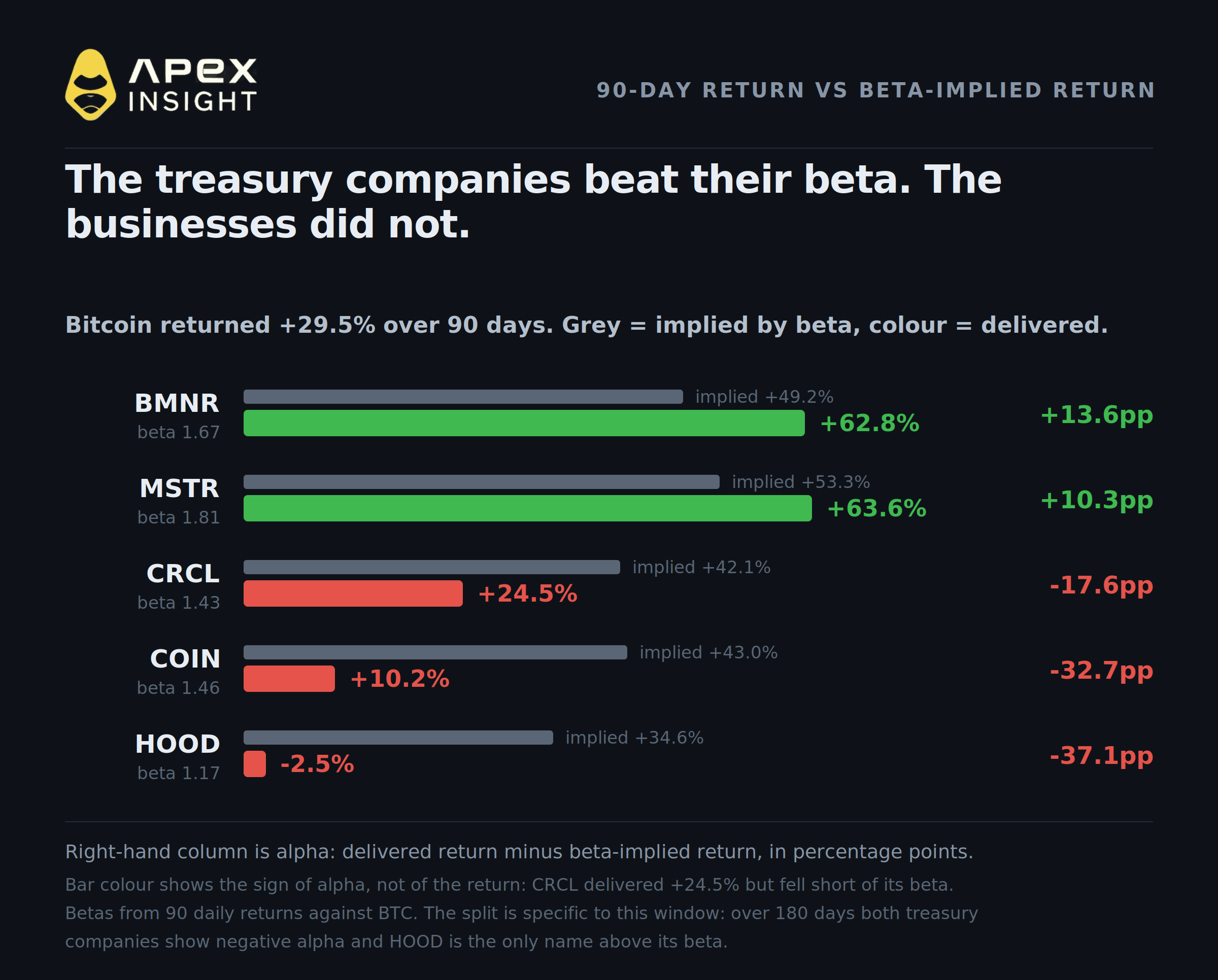
BitMine is the second-highest beta in the group at 1.67 and the second-best performer over 90 days at +62.8% against ether's +40.1%. On a beta-adjusted basis it and MSTR are the only two names in the complex that have beaten what their bitcoin sensitivity implied. Everything below this line has badly lagged.
Then two things happened in sequence, and the order is the point.
First the premium went. On crypto holdings alone BMNR crossed below 1.0x NAV on 30 September; counting the cash pile as well, it had already crossed on 25 September. Either way it did so while ether went nowhere: on ApeX closes ETH was $2,683 on 23 September and $2,696 on 6 October — up 0.5% — while the stock fell from $27.76 to $26.30, down 5.3%. That first leg of the decline was pure de-rating, not a move in the underlying. Marking it with ApeX's own index prices against the company's 4 October disclosure of 6,016,414 ETH, 214 BTC and $643m of cash and marketable securities, against 603.23m shares:
Crypto only: $15.08bn NAV → 0.98x
Including cash: $15.72bn → 0.94x
Including the $117m Eightco and $180m Beast stakes: $16.02bn → 0.92x
Below par on every reasonable denominator. Note that BitMine has never disclosed an aggregate cost basis; the widely circulated ~$3,300 average purchase price is third-party data, and if it is right the position carries roughly $4.8bn of unrealised loss at $2,503.
Then the bid left. At Token2049 Singapore on 7 October, chairman Tom Lee said: "We only need to get another 100,000 ETH to get to 5%… Now we're going to stop." BitMine has bought ether every single week since inception on 30 June 2025 — 15,112 ETH in the week to 4 October alone, roughly $41m. At that pace the remaining 85,000-100,000 tokens take six or seven weeks, and then the most reliable marginal buyer of ether in public markets stops buying by its own announcement. The stock fell 5.9% that day and 8.7% across the two sessions to 8 October.
Unlike Strategy, BitMine has no preferred, no converts and no dividend to service, and it has spent the year shrinking: 21 million shares retired for $350m between 14 July and 17 August, against a $4bn authorisation expanded at the April NYSE uplisting. It also earns something — 5,067,309 ETH staked, about 84% of the stash, at a 7-day annualised 2.63%, which the company projects at $363m of annual staking revenue — about $334m marked at today's $2,503 rather than the richer ether price behind the company's own figure. That yield is compressing as the base grows: it was 2.73% on 4,718,677 ETH staked at the end of May.
What to watch: whether weekly purchases actually stop at 5% of supply, and the fiscal year-end report. BitMine's year ends 31 August, so the next print is a full-year FY2026 filing with no confirmed date — third-party estimates point at late November. BMNR is not on MSCI's simulated deletion or watchlist, though that simulation used May 2026 data when the company was considerably smaller.
3. CRCL — a rates trade that rates cannot fix
$82.70 · +2.77% on the day · $7,630 turnover · 830 contracts open interest
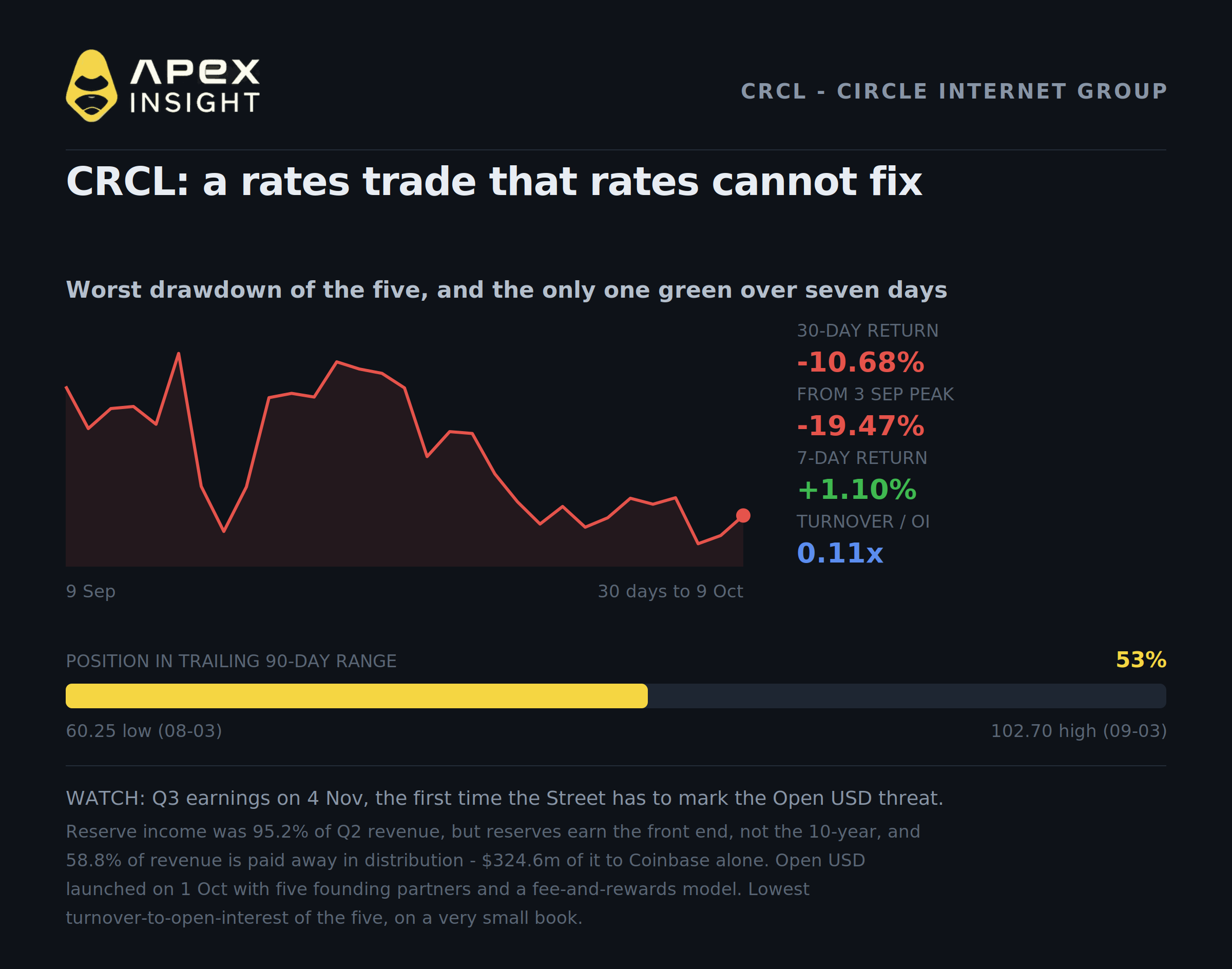
Circle is the worst performer in the group over thirty days and from the September top: −19.5% from its 3 September peak and −10.7% over thirty days, both the deepest of the five. Over ninety days it is actually up 24.6% and ahead of COIN and HOOD, and it is the only one of the five that is green over the last seven days, barely, at +1.1%. The damage is recent and concentrated.
The setup should be favourable. Circle's revenue is overwhelmingly interest on the reserves backing USDC — $667.7m of $701.3m in Q2 2026, or 95.2% of the top line. The Fed raised rates 25bp on 16 September, its first hike since 2023, taking the target to 3.75-4.00%. More reserve yield on the same float is more revenue. The long end has gone further still, with the 10-year around 5.28% and the 30-year at 5.67%.
Three reasons the stock does not care.
The curve doesn't help where Circle lives. Reserves sit in short-dated bills and repo, so Circle earns the front end — the 3-month bill at 4.05%, effective fed funds at 3.88% — not the 10-year. With 10s-3m at roughly 123bp, a record-high long bond passes through to Circle's reserve income essentially not at all. Its realised reserve return rate in Q2 was 3.5%, down 66bp year on year.
It only keeps a minority of what it earns. Distribution, transaction and other costs were $412.5m in Q2, 58.8% of revenue, of which $324.6m went to Coinbase alone — 46.3% of Circle's entire top line. Coinbase keeps 100% of the reserve interest on USDC held on its own platform and half the residual on USDC circulating elsewhere. That agreement auto-renewed through 2029 on original terms, confirmed on the 5 August earnings call. Every incremental basis point of Fed policy is shared; the competitive pressure is not.
And the take rate is now under direct attack. On 1 October, Open USD (OUSD) went live — a consortium stablecoin issued by Open Standard with Coinbase, Mastercard, Shopify, Stripe and Visa as founding partners, more than $1bn of committed initial liquidity, over 100 participating institutions, reserves at BNY, Lead Bank and BlackRock, and an economic model that charges a small transaction fee and rewards partners for the supply and activity they bring rather than retaining reserve yield at the issuer. That is a direct inversion of Circle's model. Mizuho put numbers on it back on 14 July when it cut CRCL to Underperform with a $50 target, raising its 2027 distribution-cost assumption to 73% from 64% and cutting 2027 adjusted EBITDA to $699m from $1.09bn — about 25% below consensus — while explicitly assuming higher rates. The whole point of that note is that reserve yield does not offset pricing pressure.
Supporting evidence that the float itself has stalled: USDC in circulation went $77.0bn at end-March, $73.3bn at end-June, $74.1bn on 5 October. Six months flat, against management's 40% CAGR framing. USDC holds roughly 23% of a ~$308-321bn stablecoin market against Tether's ~59%, and Tether earned $1.04bn in Q1 2026 on that float while Circle earned $48.2m in Q2 — because Tether pays almost nothing for distribution.
Then the housekeeping: a CFO transition announced in late September with Jeremy Fox-Geen leaving on 31 December, Binance's $100m private placement at a 5% discount to market on 22 September, and heavy insider selling through early October including roughly $5.2m of Class A stock from the CEO around 5 October. On 7 October Circle announced a deal with Tereina, an SAP-backed payments company, to bring USDC and EURC into SAP Cloud ERP — and the stock fell about 4%. Good news has stopped working.
Positioning tell on ApeX, with one caveat: CRCL carries 830 units of open interest — about $68,700 of notional — against $7,630 of 24-hour turnover, a turnover-to-open-interest ratio of 0.11x and by far the lowest of the five. Whoever is in this contract is sitting in it rather than trading it. These are small books, so treat it as a texture read and not a positioning signal. Earnings land 4 November, and we can find no published sell-side note on CRCL since Open USD launched on 1 October. That print is the first time the Street has to mark the threat.
4. COIN — down 13% with nothing to point at
$175.75 · −1.29% on the day · $98,702 turnover — the most-traded of the five
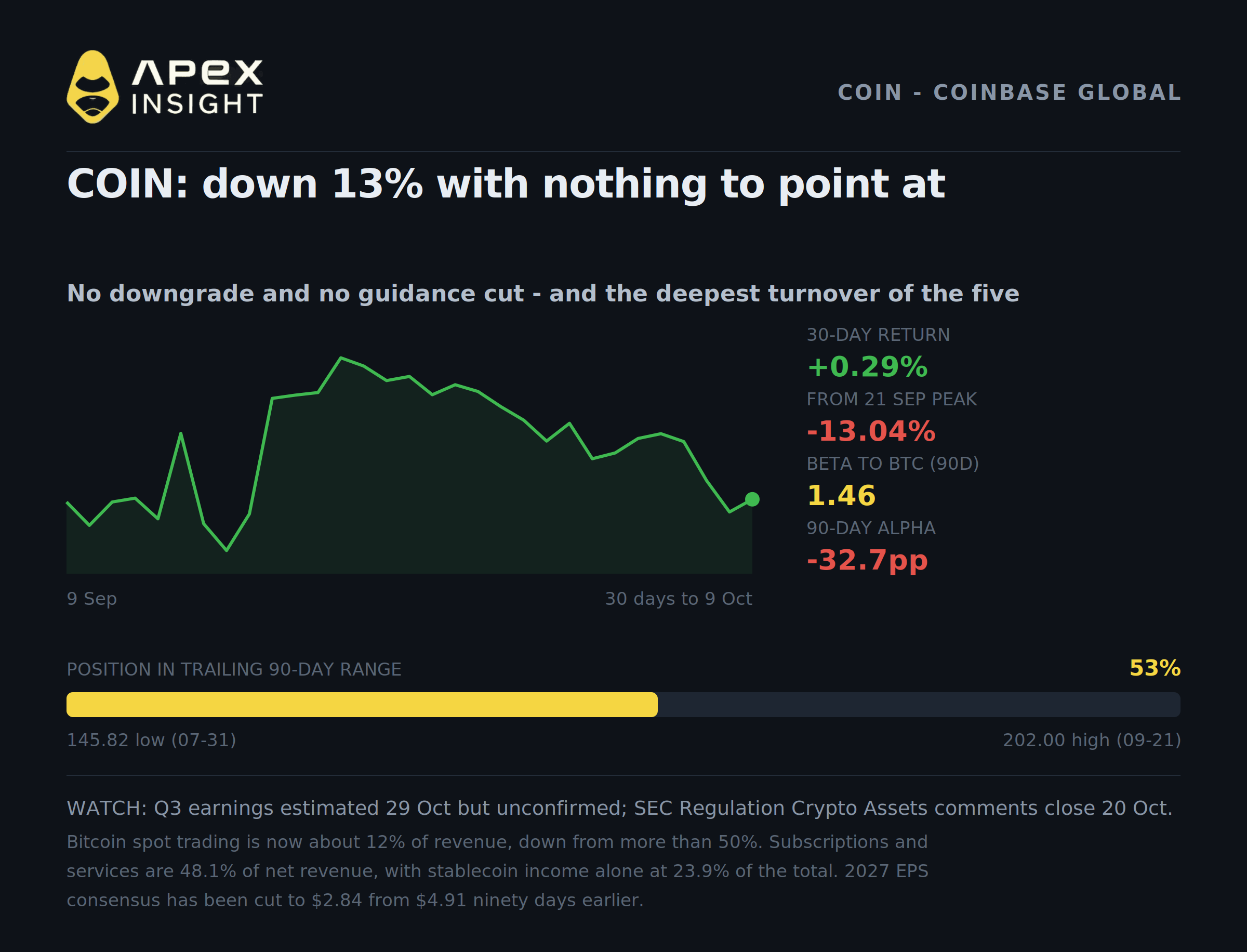
Coinbase is the cleanest example of what "the complex converged" actually costs you. It is 13.0% off its 21 September peak, and nothing in that window explains a 13% move. No downgrade, no guidance cut, no lockup, no secondary. The only dated company-specific items are a 2 October 8-K announcing the retirement of chief accounting officer Jennifer Jones and a steady run of insider sales — the CFO on 23 September, Marc Andreessen across late September and early October. Housekeeping, not a thesis.
The sell side raised targets the entire way down: Goldman $219 to $244 on 7 October, BofA $174 to $203 on 5 October, KBW initiating at Buy with a $237 target on 5 October, BTIG reiterating $240 on 8 October. Consensus sits around $212, though that average hides a wide book — Barclays carries an Underweight with a $149 target.
What is actually repricing is the forward estimate. 2027 EPS consensus has been cut to $2.84 from $4.91 ninety days earlier — a 42% reduction — which at current prices leaves the stock near 62x 2027 earnings. The Q2 print on 30 July was the third consecutive revenue miss: $1.22bn against $1.3bn expected, EPS of −$1.36 against roughly −$0.20, and a net loss of $359.5m.
The part that makes COIN mispriced as a bitcoin proxy is the revenue mix. Bitcoin spot trading is now about 12% of Coinbase's total revenue, down from more than 50% historically. Subscriptions and services are 48.1% of net revenue, and the single largest line inside that is stablecoin revenue at $292m — 23.9% of the whole company — earned on a record $20bn average USDC balance representing more than 30% of all USDC in circulation. Prediction markets passed $100m annualised, growing 106% quarter on quarter.
So the fundamental business is roughly a quarter interest-rate income, a tenth bitcoin trading, and the rest subscriptions and a growing event-contracts book. The ApeX contract trades it at a 1.46 beta to bitcoin with a 0.770 correlation. Over the last ninety days that beta implied a +43.0% move on bitcoin's +29.5%. COIN delivered +10.2% — 32.7 points of negative alpha, the second-worst in the group.
What to watch: Q3 earnings, estimated for 29 October but not confirmed by the company. Also the SEC's Regulation Crypto Assets comment deadline on 20 October and its 17 September conditional exemptive relief for venues trading tokenised NMS stock, which bears directly on Coinbase's tokenised-equities ambitions.
5. HOOD — the crypto stock that isn't one
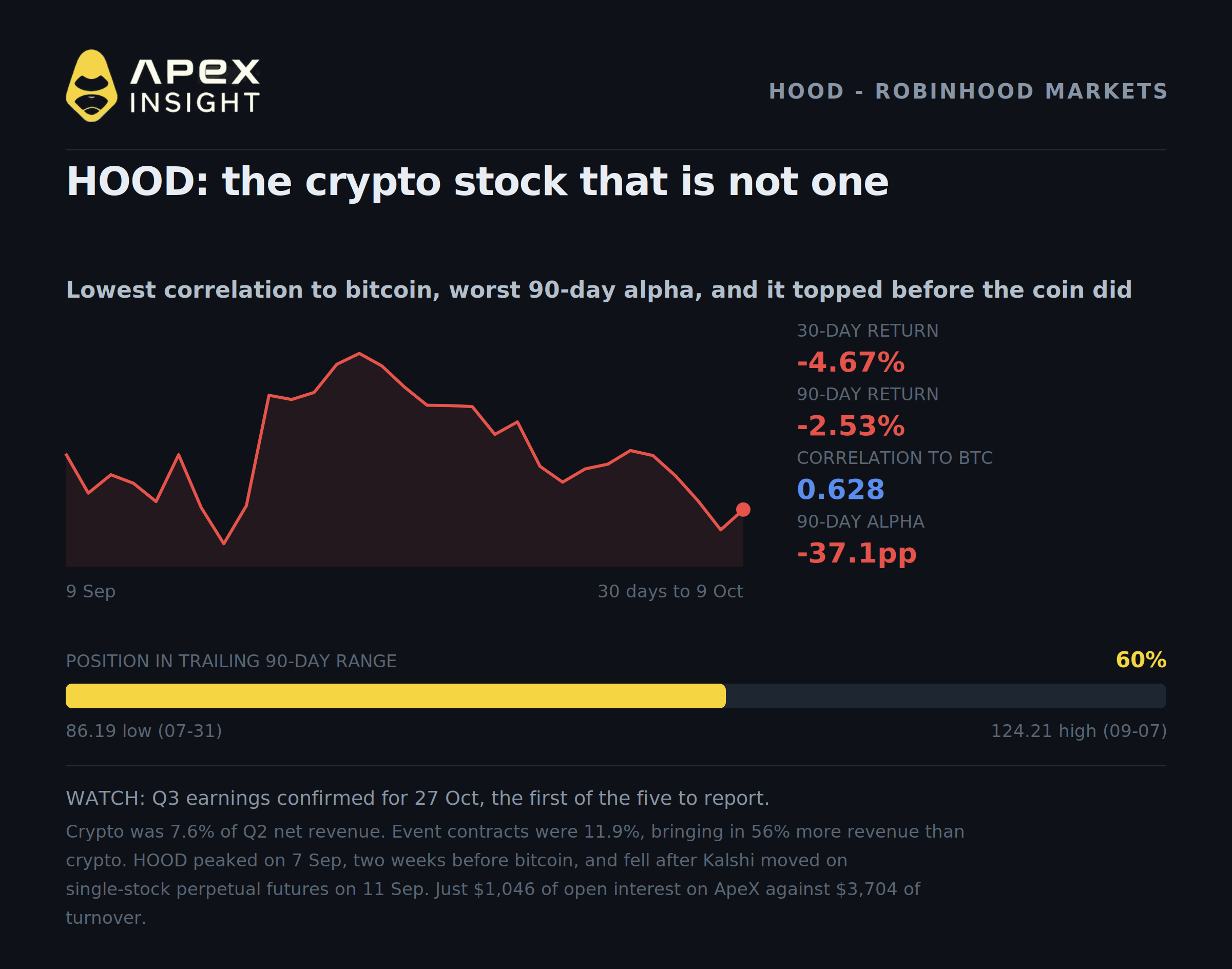
$108.98 · +0.75% on the day · $3,704 turnover · 10 contracts open interest
Robinhood has the lowest correlation to bitcoin in the group at 0.628, the lowest beta at 1.17, and the worst beta-adjusted performance of all five: −37.1 points of alpha over ninety days. It is also the only one of the five that is negative over ninety days outright, at −2.5%, while bitcoin gained 29.5%.
There is a straightforward reason. Crypto is not Robinhood's business any more. In Q2 2026, on $1.308bn of net revenue:
Event contracts: $156m — 11.9% of total net revenue
Crypto: $100m — 7.6% of total net revenue
Prediction markets now bring in 56% more revenue than crypto at Robinhood. The monthly disclosures show crypto notional flat to falling — $17.5bn in August, $17bn in the first 24 days of September — while event contracts ran 4.7bn contracts in August and 4.4bn in 24 days of September. Q2 was a beat: EPS $0.62 against $0.44 expected, 4.8m Gold subscribers, $21.7bn of net deposits, $369bn of platform assets.
And the catalyst for the drawdown is not a crypto catalyst at all. HOOD peaked on 7 September, two weeks before bitcoin did. On 11 September, news broke that Kalshi would seek US approval for single-stock perpetual futures on large-cap names trading 23 hours a day, five days a week, plus commodities; the formal filing followed on 18 September. Kalshi is simultaneously Robinhood's prediction-markets supplier, its largest competitor in the category, and now an aspiring equities and derivatives venue aimed squarely at Robinhood's core business. HOOD fell about 10% off its high that week.
Robinhood had already built its own exit. Rothera, its CFTC-registered exchange, has been clearing contracts since Q2 — $17m of that $156m — and took the World Cup book in June, three months before Kalshi's move.
Twenty analyst actions in the last month produced exactly one target cut — Deutsche Bank from $138 to $134 — against roughly ten raises, including Barclays from $105 to $132 on 8 October and BofA from $140 to $156 on 5 October. Consensus is around $133.
The ApeX positioning here is the outlier worth knowing about. HOOD carries just 10 contracts of open interest, about $1,044 of notional, against $3,704 of 24-hour turnover — a 3.55x turnover-to-OI ratio against 0.88x for COIN and 0.11x for CRCL. Nobody holds this contract; it is traded intraday and flattened. Across all five contracts open interest totals roughly $300,000, so none of this is size — but COIN and MSTR are the two that carry any at all. Earnings are confirmed for 27 October, the first of the five to report.
The overlap nobody prices
Three of these five companies are financially entangled with each other, which means a basket that looks diversified is not.
Coinbase takes 46.3% of Circle's revenue. That is not a competitive relationship, it is a tax — and it is tempting to read it as a natural hedge. It is not. The split is a fixed proportion of a shared pool: when rates or USDC float rise, Circle's gross reserve income rises and Coinbase's cut rises with it, and when they fall both legs fall together. The only shock that would make the two offset each other is a renegotiation of the split, and the agreement is locked to 2029 on unchanged terms. The price data agrees: COIN and CRCL correlate at 0.90 over the last thirty days — the tightest pair in the entire basket. Long both is not a hedge, it is one revenue pool owned twice. And Coinbase is a founding partner of Open USD, the consortium whose economics are the main threat to Circle's take rate: simultaneously Circle's largest distributor, its largest cost line, and a backer of its competitor.
Coinbase and Robinhood both earn from Kalshi. Most of Robinhood's $156m quarterly event-contracts line routes through the same CFTC-regulated designated contract market as Coinbase's $100m-annualised prediction-markets business — though $17m of Robinhood's already runs on its own Rothera. Kalshi is also pushing into both of their core products. Long HOOD and long COIN double-counts the prediction-markets theme and concentrates venue risk.
The two treasury companies have the opposite problem. MSTR and BMNR are not entangled with each other at all, but they are mechanically identical: both are now below 1.0x NAV, both have stopped issuing equity, and both have therefore lost the accretion flywheel that justified a premium in the first place. If you hold both, you own the same broken mechanism against two different coins.
And then there is the structural point sitting underneath all of this. Over ninety days, the two names whose entire business is holding coins beat their beta-implied returns (MSTR +10.3pp, BMNR +13.6pp). The three names that run actual operating businesses serving crypto all missed badly (CRCL −17.6pp, COIN −32.7pp, HOOD −37.1pp). The market spent the quarter paying up for balance-sheet exposure and de-rating the businesses — and then took the balance-sheet premium away as well: Strategy's common was already at 0.97x at its 21 September high, and BitMine crossed under par on 30 September. There is no longer a part of this complex that carries a premium for anything.
Two honest caveats on that. The split is specific to the ninety-day window: stretch it to a hundred and eighty days and it inverts completely, with both treasury companies showing negative alpha and HOOD — the worst name on the ninety-day measure — the only one above its beta, by more than forty points. What the quarter captures is the summer treasury-premium rally and the autumn de-rating of the operating businesses, which is a real pattern inside that quarter rather than a permanent property of the complex. And BMNR is measured against bitcoin here for consistency with the rest of the group, which flatters it: ether returned 40.1% over the same window against bitcoin's 29.5%, so benchmarked to the coin it actually holds, BitMine's outperformance largely disappears.
One more thing visible only in the price data: volatility has collapsed at four of the five and softened at the fifth. Annualised 30-day volatility fell from 94.8% to 52.6% at HOOD, 104.5% to 68.1% at CRCL, 101.1% to 69.1% at BMNR and 106.5% to 79.4% at MSTR, with COIN the laggard at 83.9% to 74.1%. There is no dispersion in funding either: every one of these five equity contracts prints the same +0.00125%, against +0.000175% on the BTC perp and a negative −0.000076% on ETH.
Rising correlation, falling volatility and deepening drawdowns describe a complex being held rather than fought over. What that implies for direction is not something this data settles — quiet, low-dispersion regimes resolve both ways. What it does settle is that these five are currently one position. However the complex resolves, holding a basket of them will not diversify you.
What to watch, in order
The CLARITY Act market-structure bill, which was meant to settle who may pay yield on a stablecoin, failed a Senate cloture vote 49-50 on 15 September with no Democratic support and three Republican nays. The SEC and CFTC both moved within forty-eight hours to proceed under existing authority instead. That resolves some uncertainty for the exchanges and almost none for Circle.
Two days left on the Daily Trading Check-In
All five of these contracts are live perpetuals on ApeX Omni, and all five currently fund at the same +0.00125% — which means the cost of carrying a position is identical whether you are long the one with a 16 October index deadline or the one whose chairman just announced he is done buying.
That matters this week because the Daily Trading Check-In closes on 10 October at 24:00 UTC. Including today, two check-ins remain.
The mechanic is simple and it does not care what you trade or which direction you take:
Register for the campaign
Trade at least 5,000 USDT of Perpetual volume within a single UTC day
Earn a 10 USDT Perpetual Trading Bonus for that day
Daily volume resets at 00:00 UTC and does not carry over, so today's volume counts for today only. The reward pool is 3,000 USDT in total, daily rewards are limited, and allocation is first-come, first-served — which on the final two days of a campaign is the part that actually binds. Wash trading, volume manipulation, multi-account farming, self-dealing and market manipulation are all grounds for disqualification under the terms.
Five thousand USDT of volume is one round trip in a modest COIN or MSTR position, and those two are the busiest of the five: COIN turned over $98,702 in the last twenty-four hours against MSTR's $59,164, while HOOD managed $3,704. If you were going to take a view on this complex before the MSCI announcement lands by next Friday anyway, the volume you were going to do is the volume the campaign pays for — twice, if you do it today and again tomorrow.
Full mechanics and terms: Daily Trading Check-In
All price, volume, open interest, funding and return data sourced from ApeX Omni contract data as of 9 October 2026, midday UTC. Returns are close-to-close on calendar-day bars, so a seven-day return is seven bars and a thirty-day return is thirty bars. Drawdowns and range positions for the five equity contracts are measured from the highest and lowest weekday close of the trailing 90 days, because ApeX prints weekend bars on these contracts while the underlying equity market is closed; bitcoin and ether use all bars. Betas, correlations and volatilities are computed on the full calendar-day series, over 90 daily returns and against the BTC contract, and so include those weekend observations, which damps measured volatility relative to a regular-session series. mNAV figures are computed using ApeX index prices for BTC and ETH against company-disclosed holdings and share counts. Company fundamentals are from SEC filings, company releases and the sources named inline. Nothing here is investment advice; tokenised stock perpetuals carry leverage risk and trade against index prices rather than the underlying exchange-listed shares.