



Note: All market prices in this article are as of August 11, 2026. Prediction markets move continuously, so the figures below will have shifted by the time you read them.
1. The House is nearly settled. The Senate is not.
The two chambers carry completely different levels of uncertainty. Collapsing them into a single question about "who wins the midterms" hides the only genuinely open contest.
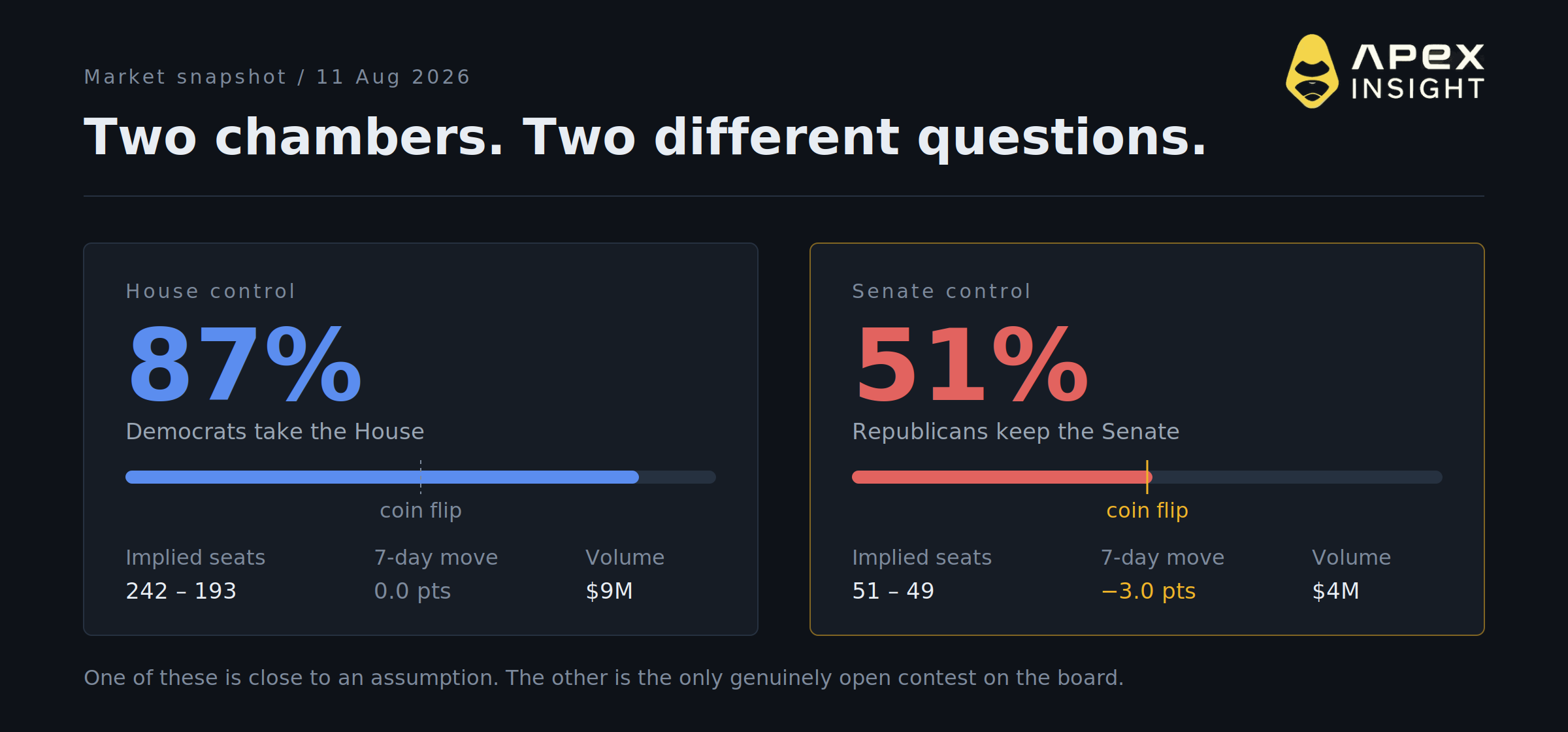
Market | Price | 7-day move | Volume |
|---|---|---|---|
Democrats take the House | 87% | 0 pts | $9M |
Republicans keep the Senate | 51% | −3 pts | $4M |
The House has not moved at all in a week. It sits near the edge of the probability range, with implied seats at 242 to 193. The Senate is a coin flip that drifted three points, implying 51 to 49.
One of those is a question. The other is close to an assumption.
If you follow one number this cycle, follow the Senate.
2. The Senate math looks broken. It is not.
This is the most instructive thing on the board right now, and it is worth sitting with.
Look at the competitive Senate races individually. Maine prices at 69 percent Democrat, with Troy Jackson favored over Susan Collins. Michigan sits at 58 percent for Abdul El-Sayed against Mike Rogers. Texas is 53 percent Democrat, James Talarico over Ken Paxton. Alaska is 52 percent for Mary Peltola against Dan Sullivan. Ohio is 52 percent Democrat, Sherrod Brown over Jon Husted.
That is five races. Democrats are favored in every one. They need four net pickups.
And Senate control still prices at 49 percent for Democrats.
That is not a pricing error. It is how joint probability works, and it is the single most common place people misread election forecasts. Winning five races that each sit near 55 percent is nowhere close to a 55 percent proposition. Stack them and you are down in single digits. Democrats do not need to be favored in each race one at a time. They need to win four of the five simultaneously, hold everything they already have, and do it in a cycle where the seats up for election are disproportionately Republican-held to begin with.
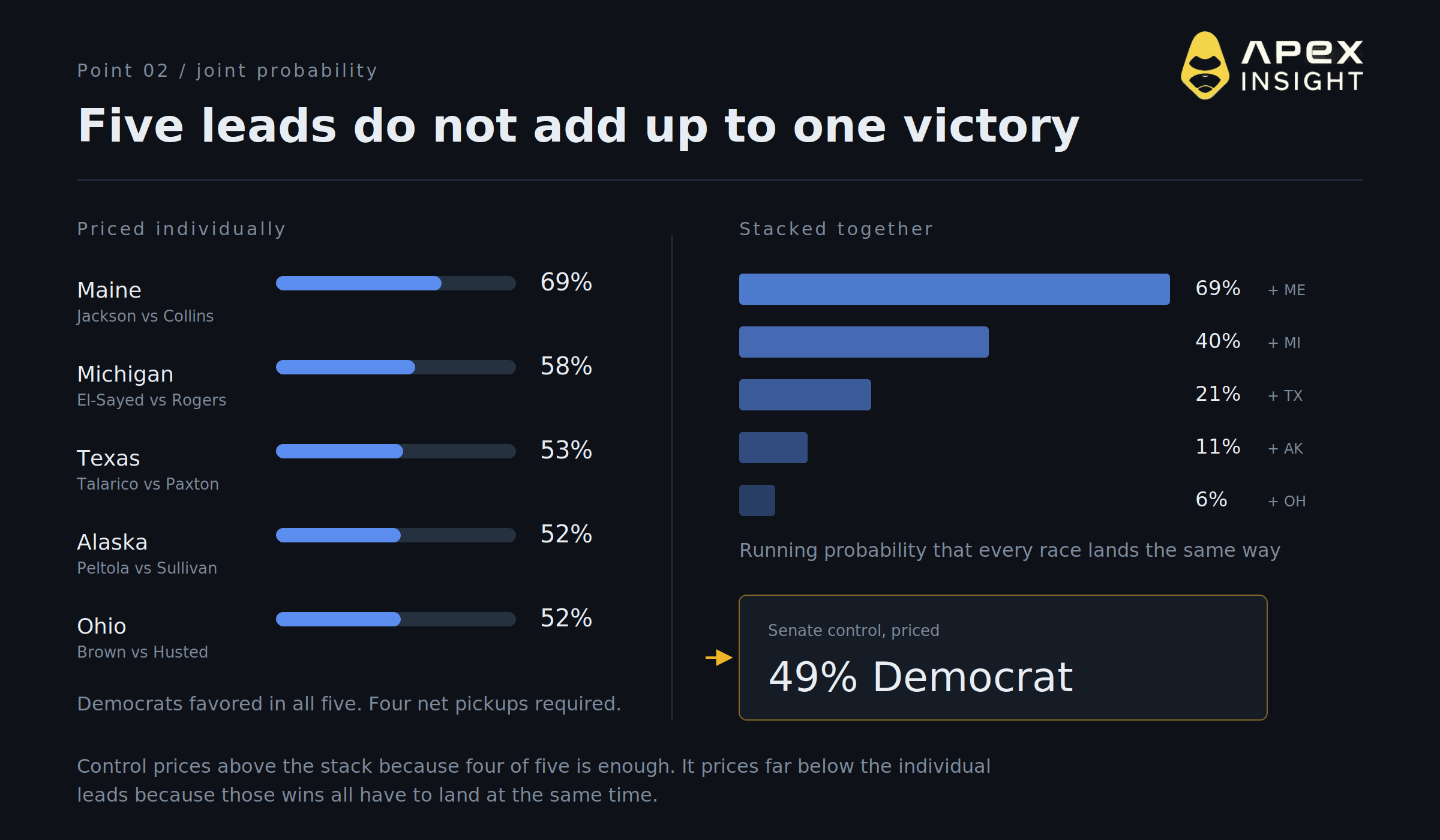
A map of individual leads and a probability of control are answering different questions. Confusing the two is how people end up shocked on election night by an outcome that was priced correctly all along.
3. Volume tells you how much to trust a number
Two markets can show the same confident-looking price and mean entirely different things, depending on how much money stands behind them.
House control carries $9M in volume. The Maine Senate race carries $1M. Ohio's Senate market sits at $133K. The Michigan constitutional rewrite question, priced at a very confident-looking 95 percent no, carries $7,200.
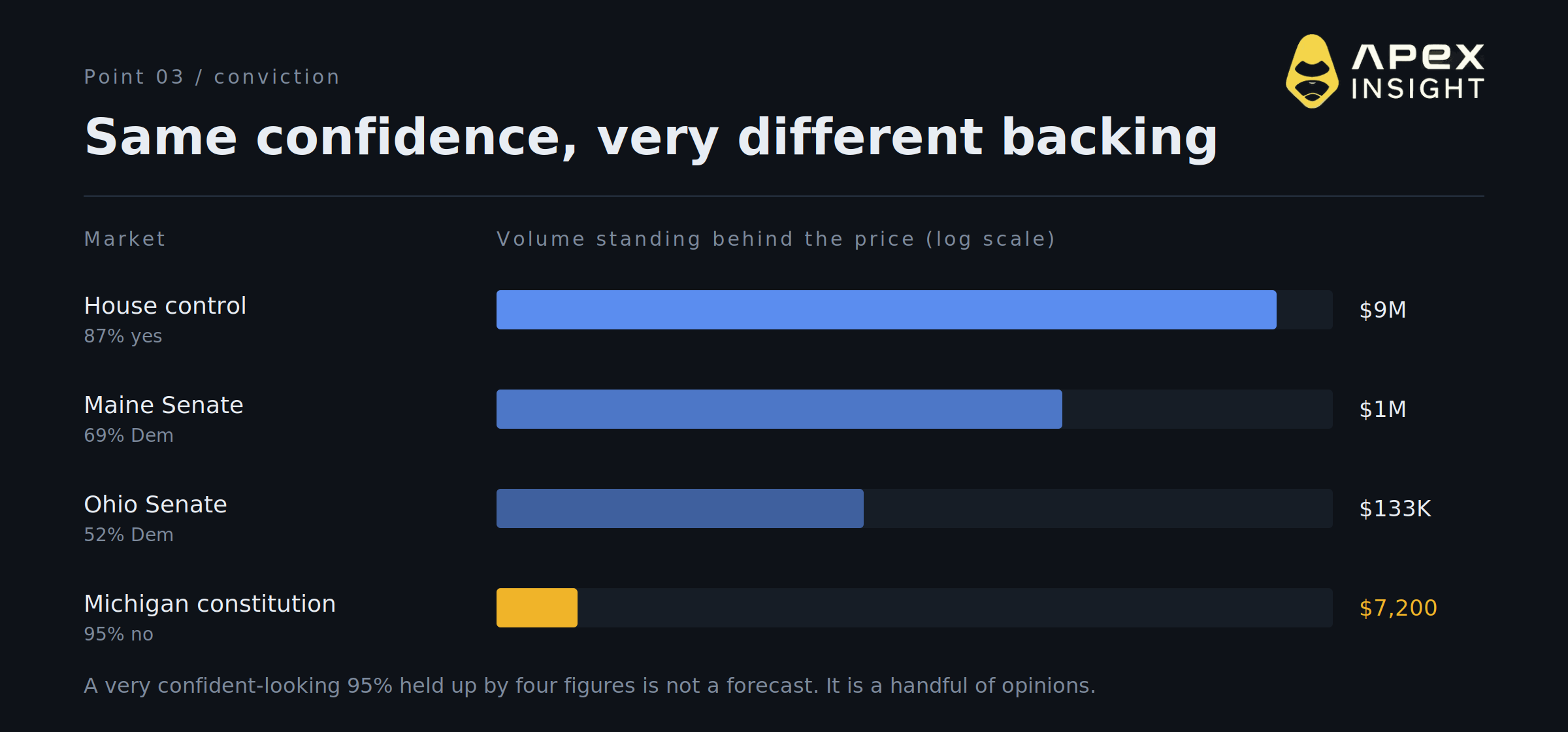
That last number should change how you read the first one. A price supported by a few thousand dollars reflects the view of a handful of participants. It will swing on almost nothing, then revert just as quickly. A price supported by millions has been tested repeatedly by people willing to lose money if they are wrong.
The same discipline applies to polling. A state average built on three surveys deserves materially less weight than one built on thirty, even when both produce the same headline figure. Before you update your view on any number, look at what is underneath it.
4. Movement beats level, and there is a live example
A price sitting at 91 percent tells you far less than how it got there.
The Virginia abortion protection amendment currently prices at 91 percent yes, after moving more than 25 points in seven days. Something concrete happened in that window: a ruling, a certification, a poll, a campaign development. That move is the information. The 91 percent on its own is just a snapshot.
Set that against two others. The Arizona ballot measure on transgender school and athletic access sits at 67 percent yes after a 15-point climb. The California billionaire wealth tax sits at 70 percent no, drifting about two points on $4M of volume.
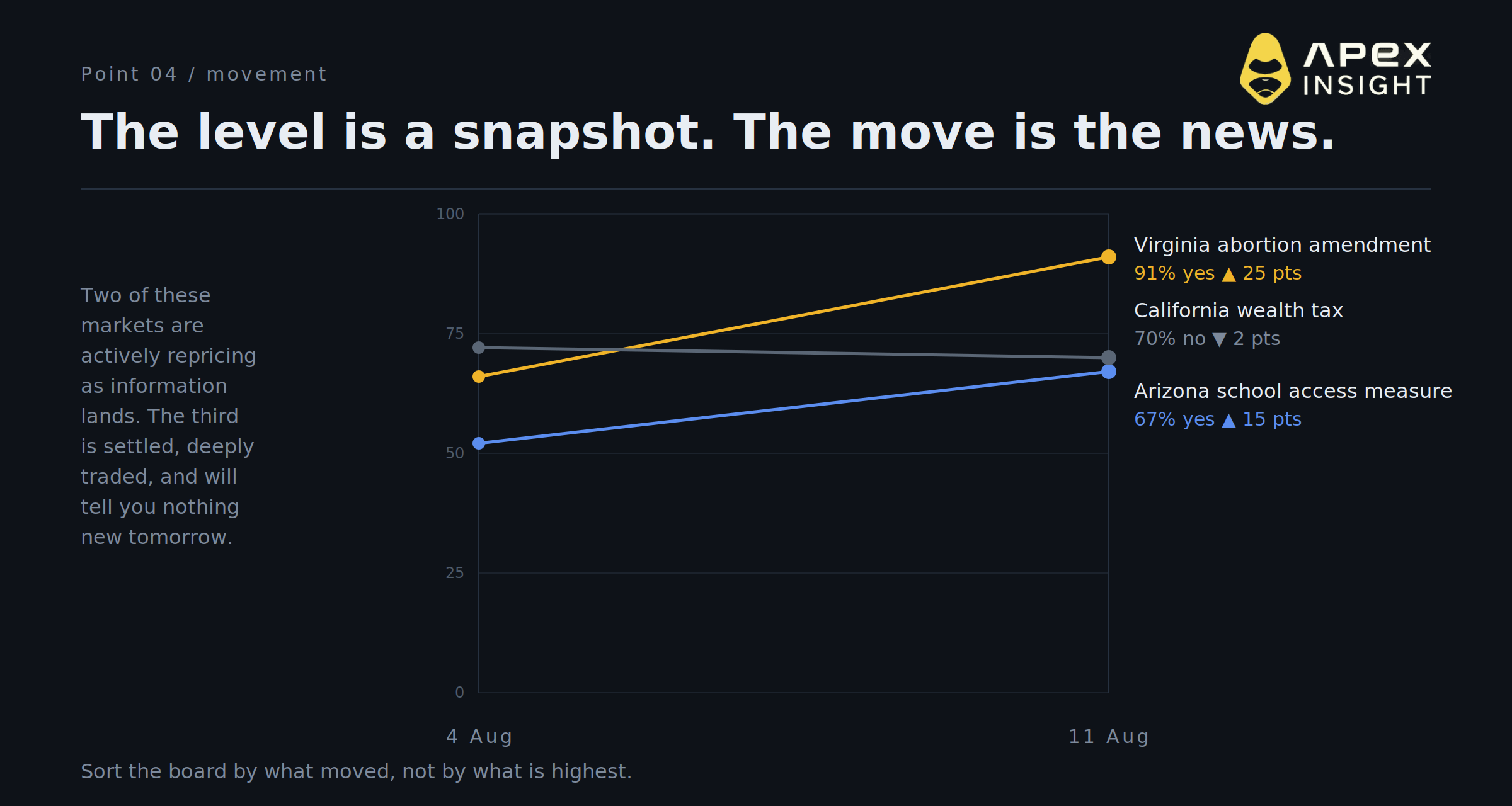
Two of those markets are actively repricing as new information lands. The third is stable, deeply traded, and unlikely to tell you anything new tomorrow.
When you scan the board, sort by what moved rather than by what is highest. Level describes the state of play. Movement tells you what just changed.
5. Rating changes matter more than ratings
Cook Political Report, Sabato's Crystal Ball, Inside Elections and Decision Desk each maintain race-by-race ratings, and early August brought a cluster of revisions.
Kansas: Safe to Likely Republican
Iowa's 2nd and Ohio's 7th: Likely to Lean Republican
Iowa's 3rd: Tilt Republican to Toss-up
Several Michigan seats: consolidating toward Safe Democrat
A static rating tells you little you could not infer from a district's history. A district moving two categories inside a month tells you something real shifted on the ground: a retirement, a recruitment win, a scandal, a fundraising collapse.
It is also worth watching whether analysts are leading or trailing the market. The Kansas Senate contract has been drifting downward at 81 percent Republican over the same period the state's rating was downgraded. When ratings and prices move together, the signal is stronger. When they diverge, one of them is about to be wrong.
6. Some races do not fit the two-party frame
Nebraska's Senate market prices Pete Ricketts at 72 percent against an Independent at 28 percent. There is no Democrat in the contest at all. Montana's margin market similarly carries separate Independent buckets rather than a clean two-way split.
These are easy to skip past when you are scanning a red-and-blue map. They matter far more than their size suggests. In a chamber that resolves 51 to 49, a single independent's caucusing decision can determine control outright. Any forecast that resolves purely on party labels has quietly assumed an answer to a question nobody has asked yet.
7. Margin markets show you conviction, not just direction
Several races carry margin-of-victory contracts alongside the simple binary, and they often reveal more.
Ohio's Senate margin book spreads across ten buckets. Democrat 6 to 9 percent leads at 18 percent. But Democrat 0 to 3 percent sits at 17 percent, and Republican 0 to 3 percent at 16 percent, right behind it.
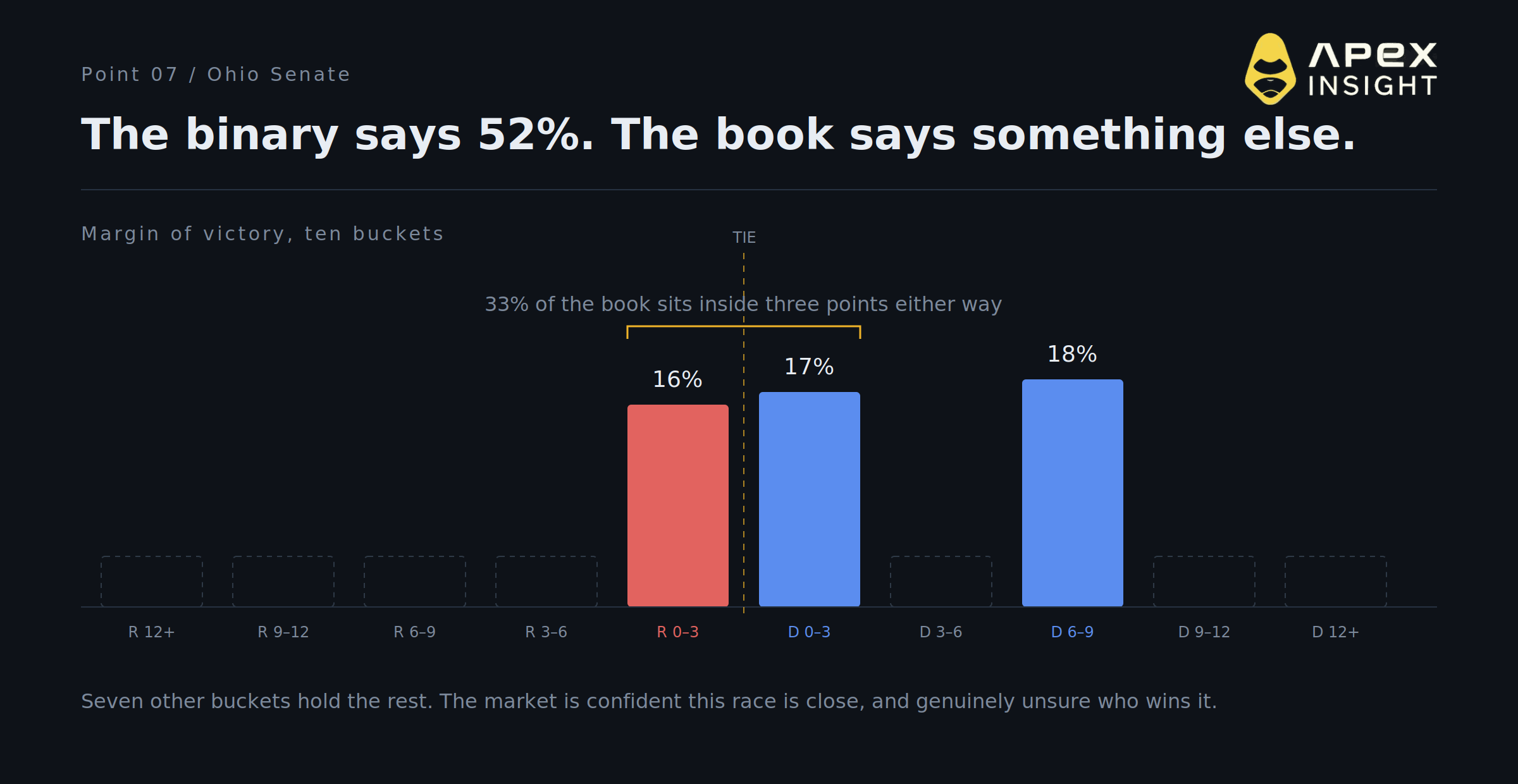
Read together, that book is saying something the binary cannot. The market is confident this race will be close, and genuinely unsure who ends up on top.
The headline 52 percent hides all of that structure. When you want to know how much conviction sits behind a probability, rather than just which way it leans, the margin book is where it becomes visible.
8. Four indicators move prices before prices move
These upstream inputs are worth tracking directly, because they tend to show up in the numbers only after the fact.
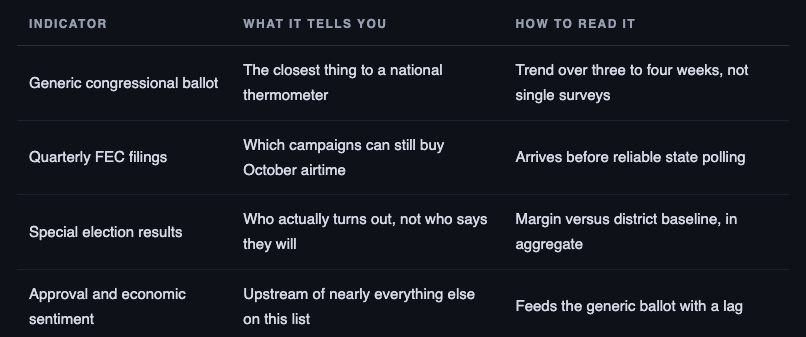
Individual polls carry error margins wide enough to manufacture a narrative that is not there. April's fundraising data measurably moved several Senate races when it landed. Money is not destiny, but a candidate who cannot fund an October media buy is a candidate whose polling will decay.
Special elections are the most underrated of the four. Individually they are small and low-turnout, easy to dismiss. In aggregate, the margin by which each party beats or misses a district's baseline has been among the better leading indicators of the national environment in recent cycles.
9. Four ways people misread a probability
Whether the number comes from a statistical model or a market price, the same interpretation errors recur.
Treating a probability as a prediction. An 87 percent chance means the outcome happens in roughly 87 of 100 runs of this cycle. The other 13 are not mistakes waiting to be exposed. They are part of what the number is saying.
Confusing surprise with error. A forecast that says 30 percent and turns out right about a third of the time is well calibrated and working exactly as intended. Calibration can only be assessed across many forecasts. A single outcome tells you nothing about whether the number was good.
Underestimating correlated error. When polls miss, they tend to miss in the same direction across many states at once rather than independently. This is precisely why the Senate map is more fragile than its individual race prices imply, and why the arithmetic in point two is not as reassuring for either party as it first appears.
Forgetting that favored is not the same as likely. And likely is not the same as safe. A 52 percent race is a coin flip with a lean. Five of them stacked together is something else entirely.
10. The dates that matter
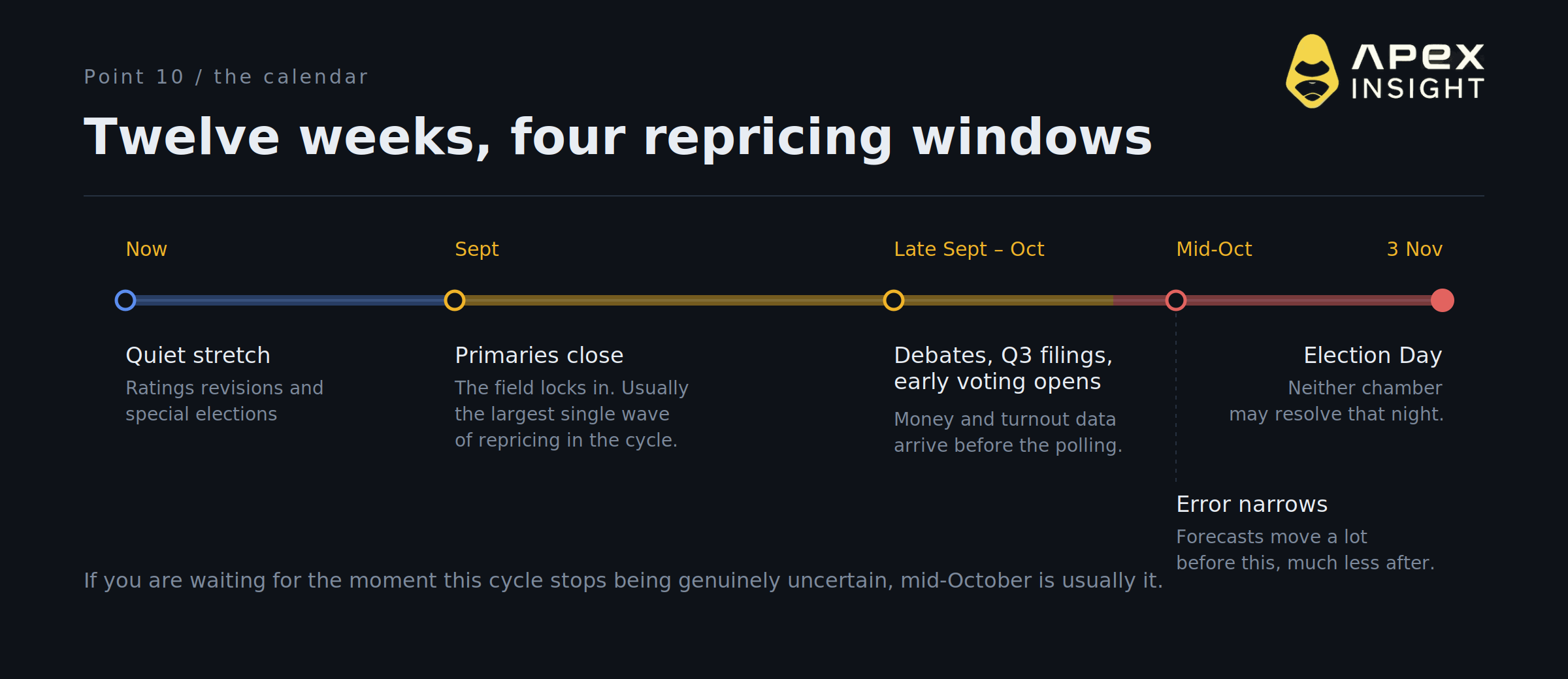
September closes out the remaining primaries and locks in the general election field. That typically produces the largest single wave of repricing in the cycle. Several primary markets are still genuinely live, with FL-19 currently sitting at a 41 percent tie between two candidates, and those resolve into much sharper general election pictures.
Late September through October brings the debates, the final quarterly fundraising picture, and the opening of early voting in many states. Mid-October is historically the point at which polling error begins to narrow, which in practice means forecasts move considerably before it and much less afterward. If you are watching for the moment this cycle stops being genuinely uncertain, that is usually it.
November 3 is Election Day, though control of either chamber may not resolve that night. Several states count mail ballots slowly, and close House races have taken days to call in recent cycles.
Where this leaves you
The cycle has one nearly-decided chamber and one that could break either way. Almost all of the analytical value between now and November sits in the second. The House at 87 percent will mostly confirm what it already says. The Senate at 51 percent has room to tell you something you do not know.
The most useful thing to carry out of all this is not any particular number. Those will all be different by the time you read them. It is the habit of reading them properly: weighting probabilities by the volume and data standing behind them, treating movement as more informative than level, and remembering that a collection of individual leads is not the same thing as a likely outcome. That last point is doing enormous work in this cycle specifically, and it is the one most coverage will get wrong between now and Election Day.
Twelve weeks is enough time for a great deal to change. Watch what moves, and ask what moved it.
Where to watch it
Every price in this article is live on ApeX Omni, where Polymarket's order books are integrated directly: the same liquidity and the same settlement source, minus the KYC. The full midterms board covers chamber control, individual races, margin-of-victory contracts and ballot measures, and it shows you the volume and seven-day move behind each number rather than just the headline probability.
We appreciate your continued support.
Published by ApeX. For informational and educational purposes only. Not investment advice, and not a forecast or endorsement of any political outcome. Trading involves risk, including total loss.